

Akkeron Black Atlas Edition 2025
A round control racket with a broad sweet spot and easy back-court release, asking you to supply the pace when the point needs finishing.
Our Take
Shape
Round
Weight
350 - 375 gr
Touch
Medium-Hard
Core
EVA25K Black
Faces
3K Carbon
Frame
100% Full Carbon
What we like
- Broad sweet spot on defense
- Reliable blocks under hard volleys
- Quick handling for net reactions
What we don't
- Limited punch on power smashes
- Finishing volleys need racket-head speed
- Medium-hard response lacks crispness
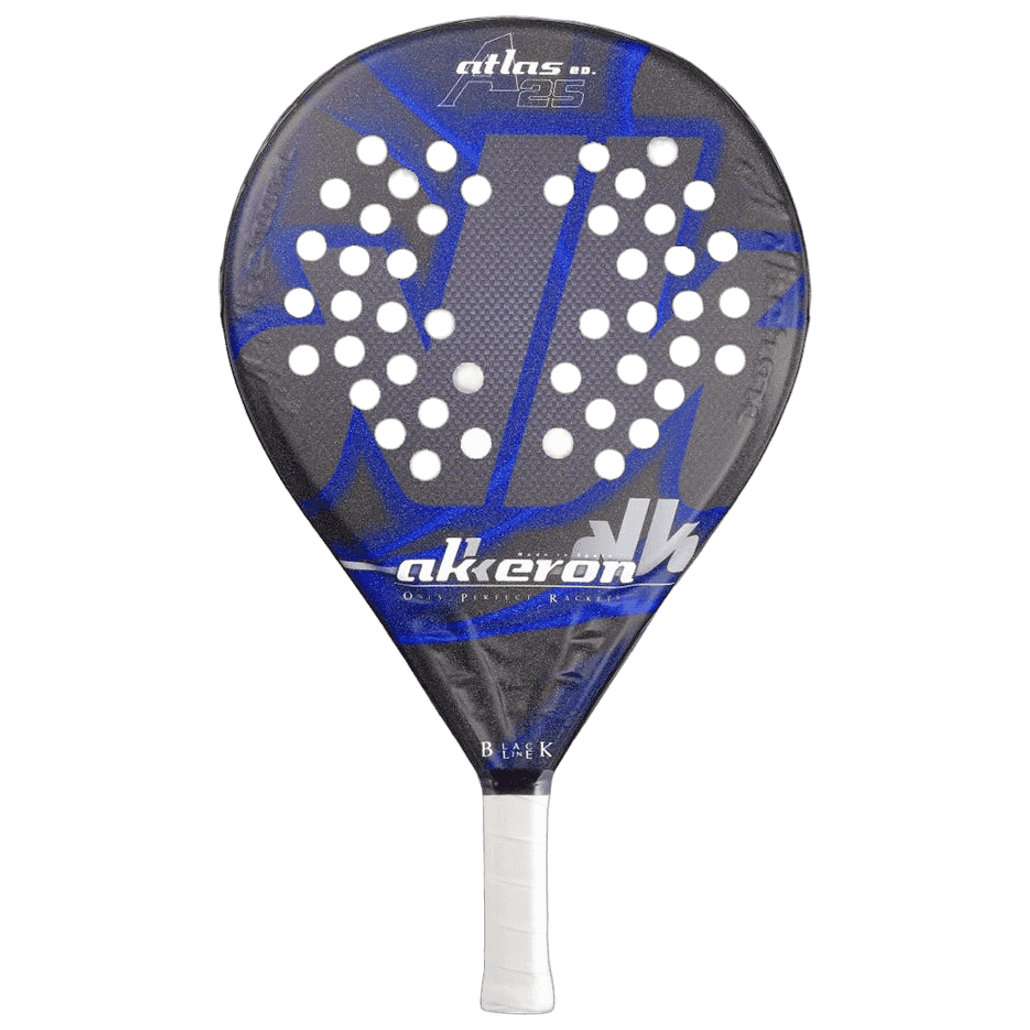
Akkeron Black Atlas Edition 2025 is a control-first racket with a very forgiving hitting area and enough ball exit to make defensive padel less stressful. It does not try to win points for you with raw punch; it rewards clean placement, calm hands, and good court positioning.
I felt its personality most clearly in longer points. It stays composed under pressure, turns rushed blocks into playable balls, and gives me room to aim rather than simply survive.
Technical analysis
Shape & balance
The round shape and medium balance explain much of its behavior. The sweet spot is notably broad, so contact remains predictable even when I catch the ball slightly outside the center. That matters on fast exchanges at the net, but even more on off-the-wall defense where preparation is rarely perfect.
Despite its solid build, it does not feel slow through the air. I can get the racket in position quickly for blocks, defensive lobs, and short directional changes. Players who like a head-heavy racket that pulls through the ball on every overhead will find this calmer and less explosive.
Materials & construction
Akkeron uses a 100% Full Carbon frame, 3K carbon faces, and an EVA25K Black core. The result is a stable structure with a medium-hard feel that sits between soft comfort and a very dry, crisp response.
The faces do not feel excessively rigid, which helps the racket produce accessible ball exit from the baseline. Still, it is not a trampoline-style racket. I need to let the ball enter the face and use a complete swing when I want depth. That controlled compression is useful for placement, but players who prefer either a very soft rebound or a sharply hard impact may not connect with the feel.
On-court feel
Baseline play
This is where the Black Atlas Edition makes the most sense to me. On defense, the large sweet spot reduces the punishment for late contact, and the racket sends the ball out with enough ease to lift a defensive lob without overworking my arm.
Blocks are especially reliable. Against a hard volley, I can hold the face firm and direct the return low or deep rather than feeling the ball twist the racket. It also gives me confidence on a low-driven lob and on controlled exits after the side wall. The trade-off is that it will not add much free pace when I am stretched; I still have to accelerate properly to move opponents back.
At the net
Quick hands are a real strength here. The maneuverability helps me react to body volleys and make small adjustments on short balls, while the round format keeps placement accurate. I enjoyed using it for compact volleys, angled blocks, and the occasional chiquita played from close to the net.
What it does not do as well is finish through the court with minimal effort. A firm attacking volley lands accurately, but it lacks the heavy, penetrating finish of a more head-heavy power racket. To put opponents under real pressure, I need to supply racket-head speed myself.
Bandeja and víbora
For controlled overheads, it is dependable. My bandeja stays easy to place, and the racket does not feel cumbersome when I need to play safely toward the middle or deep into a corner. A víbora can be shaped cleanly too, although the response favors direction over violent acceleration.
Smash
The smash is its clear limitation. It can finish when my timing and technique are good, but it does not provide much extra help on flat power smashes or aggressive finishing volleys. Players whose game depends on easy overhead winners should look elsewhere.
Conclusion
I would choose this racket for a player who builds points with defense, placement, and consistency rather than constant power. It suits a regular intermediate or advanced player who wants a forgiving round racket without dropping into an overly soft feel.
The trade-off is simple: exceptional comfort and precision around the sweet spot, but limited free punch overhead. I get control, maneuverability, and dependable ball exit; I give up some of the automatic aggression that a more attacking racket delivers.
What other reviewers say
- PadelTestLabes
The review places it firmly in the control category: maneuverability, sweet spot, and easy ball output stand out, helping on defense, blocks, and placement. In return, finishing smashes and volleys have limited punch and require the player to create racket-head speed.
Switch Intelligence
Be the first to share where you switched from.
Community reviews
Real feedback from players who used this racket.
Add your review
To submit your review, log in first. You can still read all approved community reviews below.
Add review


