

Alkemia Tenebris 2026
A firm tear-shape with serious bite, built for players who want direct response, heavy volleys, and a decisive smash.
Shape
Tear
Weight
350 - 360 gr
Touch
Medium-Hard
Core
Black EVA PRO React
Faces
Triple-layer 3K carbon fiber
Frame
Kevlar + Carbon
What we like
- Heavy, penetrating volleys
- Stable *bandeja* and *víbora*
- Violent, authoritative smash
What we don't
- Defensive depth needs work
- Late blocks feel demanding
- Limited help on off-center contact
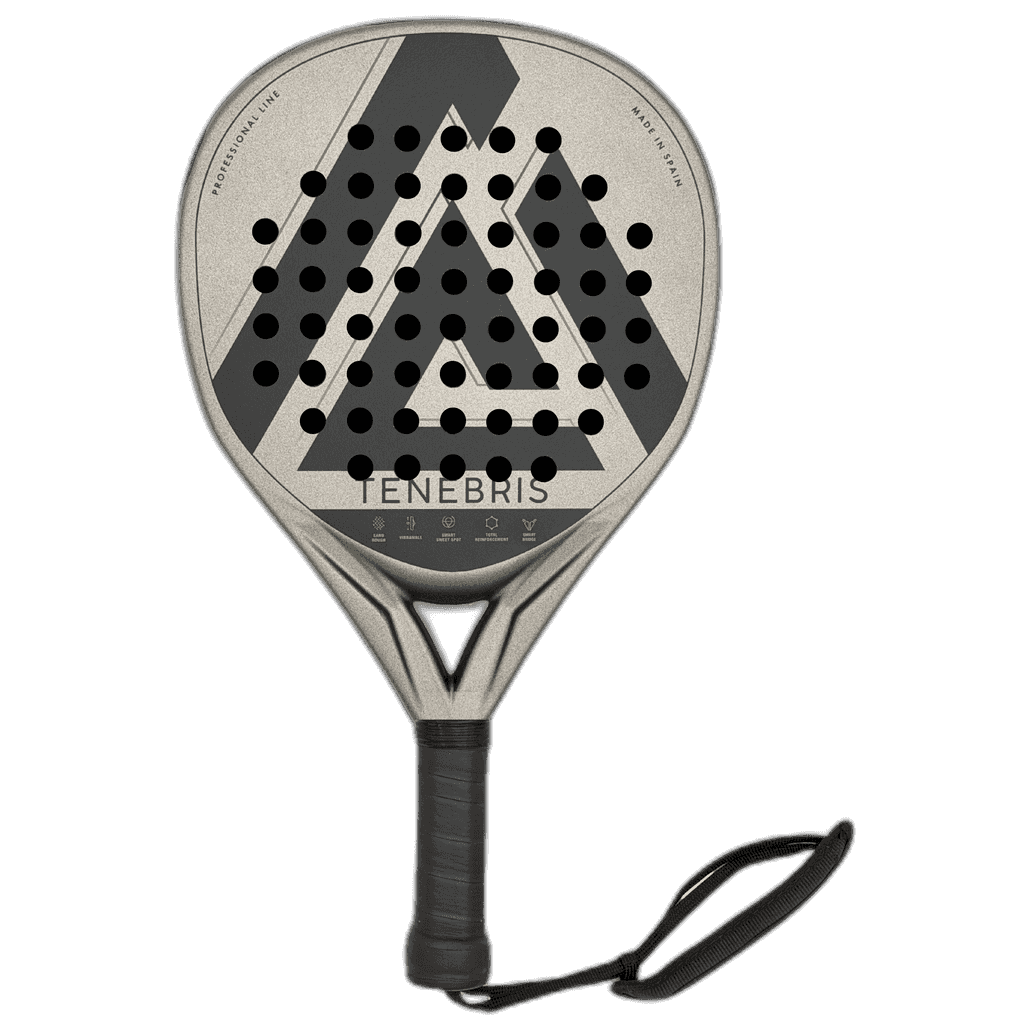
Alkemia Tenebris 2026 is a tear-shaped racket with a clear offensive bias. It feels firm from the first hit, but not dead or harsh. I read it as a racket for players who like to accelerate the ball, hold the net, and finish points with authority rather than just keep the rally alive.
The character is quite direct: medium-hard touch, a solid response, and enough control to stay organized in transition. What it does not do is hand you free depth in defense. If your game depends on easy ball exit from the baseline, this will ask for cleaner mechanics.
Technical analysis
Shape & balance
The tear shape gives the Tenebris a useful middle ground between attack and handling, but the personality leans clearly toward offense. Balance feels composed rather than overly top-loaded, so it does not become a clumsy racket in fast exchanges.
In hand, I find it reasonably quick for a racket with this much punch. It is not ultra-fast in tight blocks or wristy reactions, though. You feel the extra substance when you try to whip it around, and that is part of the trade-off.
Materials & construction
The Kevlar + carbon frame and the Triple layer 3K carbon faces give it a firm, stable structure. The contact is direct, with very little trampoline effect. That matches the Black EVA PRO React core well, because the core keeps the response controlled without making the racket feel overly wooden.
That construction explains the overall behavior I kept seeing in play: a clean ball exit when you commit, a firm hold on impact, and plenty of bite on attacking shots. The downside is simple. You do not get much free help when you are late or stretched, especially on soft defensive balls.
On-court feel
Baseline play
From the baseline, the Tenebris rewards active, committed swings. If you take the ball early and keep the stroke compact, it gives you good direction and enough depth without wandering. I especially liked it on medium-paced rallies where I could build the point with control and then change pace.
Where it loses points is in passive defense. Lower balls, awkward wall rebounds, and emergency blocks need more work from the player. The racket is responsive, but it is not forgiving in the way a softer model is.
At the net
This is where the Tenebris feels most at home. Volleys come out heavy and fairly penetrating, so it is easy to keep pressure on the opponent. It does not float the ball; it pushes it through the court.
The block is solid too, though not especially cushioned. That firmness helps if you like to redirect pace, but it can feel a bit demanding if the incoming ball is fast and you are late to the shot.
Bandeja and víbora
On the overheads, I got the best version of this racket. The bandeja feels stable and easy to direct deep, while the víbora has a nice, firm contact that lets you work the ball with conviction. It is a racket that likes pressure shots more than soft placement.
What it does not offer is effortless spin-generation. You can work the ball, but the response is more about firmness and direction than raw spin assistance.
Smash
This is the shot where the Tenebris justifies its more attacking profile. When I loaded the swing properly, the ball came off with real violence. It feels built for finishing points, not merely threatening them.
Conclusion
I would put the Alkemia Tenebris 2026 in the hands of intermediate-to-advanced players who want a racket with a sharp offensive edge and a firm, serious feel. If you like to play forward, volley aggressively, and finish with the smash, it makes a lot of sense.
You do trade away comfort in slower defense. It is less generous on tired legs and less forgiving on off-center contact than a softer tear-shaped racket. But if you want a racket that answers back when you swing with intent, this one delivers that personality without much sugarcoating.
Switch Intelligence
Be the first to share where you switched from.
Community reviews
Real feedback from players who used this racket.
2 reviews


Possibly my favourite bat of all time and I've had around 30....lol The bat has it all
Add your review
To submit your review, log in first. You can still read all approved community reviews below.
Add review


