

Nox AT10 Luxury Genius 18K Alum 2027 Agustin Tapia
A quick, composed teardrop that keeps the point tidy from the baseline, then gives a clean, confident finish at the net.
Our Take
Shape
Tear
Weight
360 - 375 gr
Touch
Medium-Hard
Core
MLD Black Eva
Faces
Carbon Fiber 18K Alum
Frame
Carbon
What we like
- Quick handling in net exchanges
- Large sweet spot on blocks
- Crisp *bandeja* and *víbora* response
What we don't
- Limited raw smash output
- Demands clean defensive contact
- Less free depth when rushed
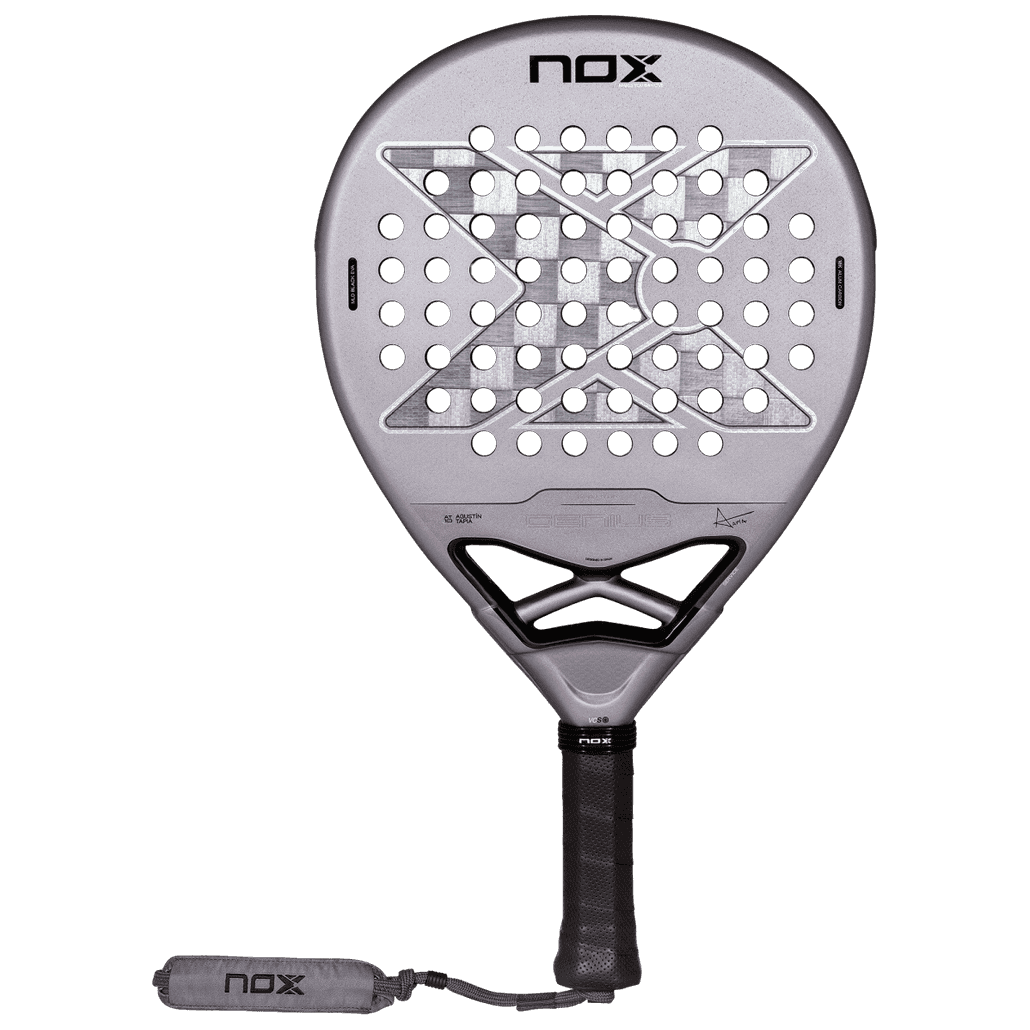
The Nox AT10 Luxury Genius 18K Alum 2027 Agustin Tapia is a fast, precise racket built around placement and quick handling rather than brute-force finishing. Its teardrop shape keeps it attack-minded, but the large sweet spot and very high maneuverability point toward a racket that wants to stay involved in every phase of the point.
I see it fitting an advanced player who builds pressure through tempo, direction, and variation. It is not a head-heavy hammer for forcing every smash out of court.
The medium-hard feel is central to its character: firm enough to give a clean, connected response, without becoming so dry that defensive shots feel punishing.
Technical analysis
Shape & balance
The teardrop shape gives the AT10 a more accessible attacking profile than a pure diamond racket. The shape keeps overheads purposeful, yet it should come around quickly in fast exchanges and compact volley preparation.
That maneuverability matters. At the net, I expect less drag through the ball than from a more aggressively head-heavy model, especially when reacting to body volleys or changing direction late. The trade-off is clear: players who rely on a huge, effortless finishing swing may find it less imposing than a dedicated power racket.
Materials & construction
Nox combines a Carbon frame, Carbon Fiber 18K Alum faces, and an MLD Black Eva core. On paper, that is a firm, stable layup with a controlled response rather than a soft, springy one. The aluminized carbon should help keep the face behavior consistent across changing temperatures and repeated hard contact.
The MLD Black Eva core is likely to give a measured ball exit: enough rebound to help on defensive blocks, but not the loose trampoline effect that can make touch shots float. I would expect the racket to reward a player who accelerates cleanly through the ball. Lazy contact will not get the same free depth as it would from a softer fiberglass-faced racket.
On-court feel
Baseline play
From the baseline, the generous sweet spot should be one of the AT10’s strongest assets. Centered contact ought to feel reliable on blocks, off-the-wall play, and defensive lobs, while the quick frame helps when the ball arrives late at the body.
Its response should suit players who like to guide the ball deep rather than simply absorb pace. Still, the medium-hard construction asks for an active arm on late defensive contact. A soft racket will do more work for players whose preparation is rushed.
At the net
This is where the balance of speed and firmness makes the most sense. I would use it to play aggressive volleys without overcommitting the swing: punch through the middle, redirect to the fence, then close the next ball. The face should offer enough stability for compact blocks against hard counterattacks.
Touch is likely to be good rather than buttery. A chiquita or drop volley should be easy to place when I have time, but the racket does not appear designed around a plush, heavily cushioned feel.
Bandeja and víbora
The AT10 should be particularly convincing on controlled overheads. Its quick handling helps me shape a bandeja late, and the firmer face should give a crisp response on a sliced víbora without making the racket feel slow above the shoulder.
For flat smashes, it should deliver solid acceleration, but this is not the model I would choose solely for maximum raw output. It favors repeatable overhead pressure and direction over all-or-nothing power.
Conclusion
I would look at the AT10 Luxury Genius 18K Alum 2027 if my game depends on fast hands, accurate overheads, and a racket that remains useful from defense through to the net. Advanced players who generate their own pace should get the most from its firm, controlled response.
The compromise is that it will not feel as effortless as a softer racket on rushed defensive shots, nor as destructive as a true head-heavy power frame on the smash. Its appeal is in how often it stays composed, not in trying to end every point with one swing.
Switch Intelligence
Be the first to share where you switched from.
Community reviews
Real feedback from players who used this racket.
Add your review
To submit your review, log in first. You can still read all approved community reviews below.
Add review


