

Nox ML10 Ventus Control 3K 2027 Miguel Lamperti
A round, firm-feeling racket that leans on control, settles the point from the baseline, then asks for clean timing when you finish at the net.
Our Take
Shape
Round
Weight
360 - 375 gr
Touch
Medium-Hard
Core
HR3 Black EVA
Faces
3K Carbon Fiber
Frame
Carbon
What we like
- Broad sweet spot on blocks
- Quick handling in net exchanges
- Accurate *bandeja* and *víbora* placement
What we don't
- Passive defense needs added depth
- Limited effortless smash punch
- Moderate ball exit on compact swings
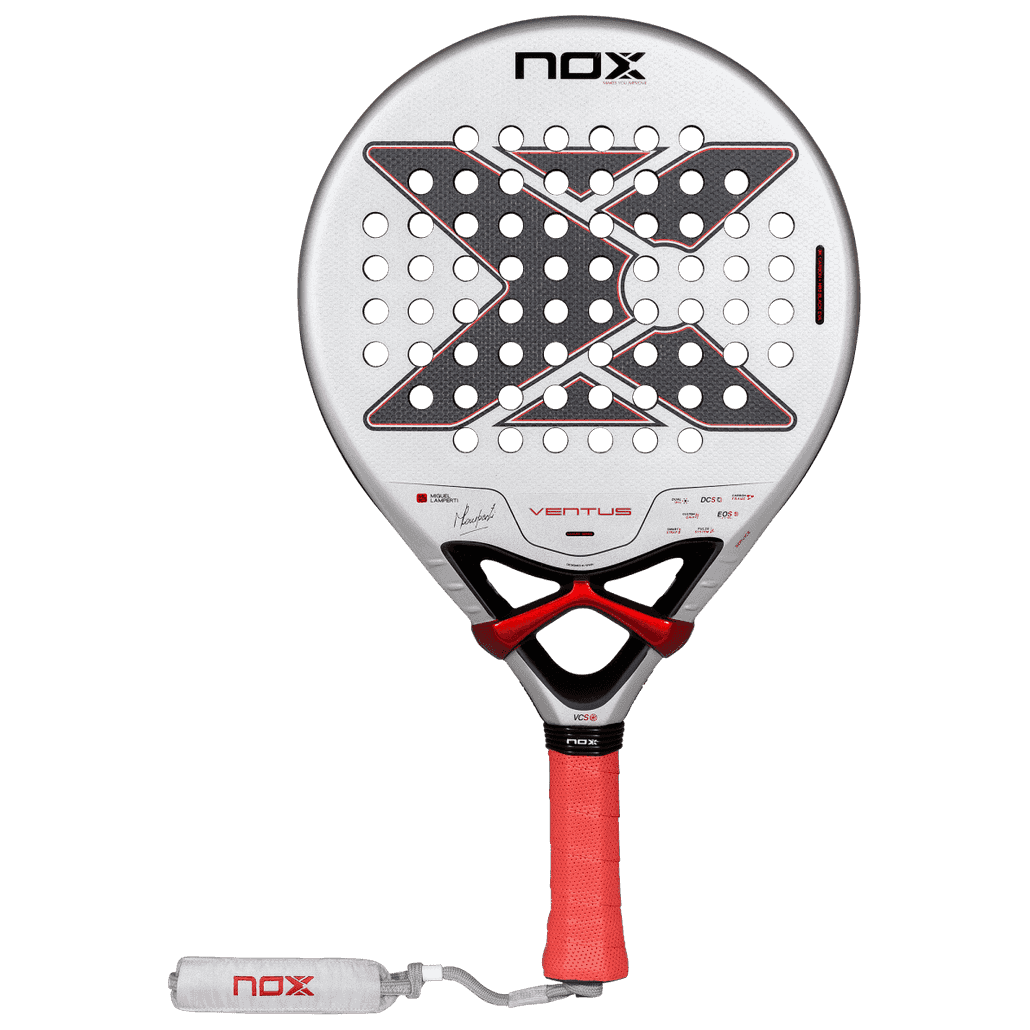
The Nox ML10 Ventus Control 3K 2027 Miguel Lamperti is a versatile racket that leans on control, with enough firmness to keep passive shots from sitting up. It is built for players who want to direct the point rather than force it early.
Its Round shape, broad sweet spot, and Medium-Hard feel give it a composed, accurate personality. I would put it in the hands of an advanced player who values placement, blocks, and reliable overheads more than easy free power.
This is not a soft, springy racket that does the work for you. You need to accelerate through the ball when you want real penetration.
Technical analysis
Shape & balance
The round mold is the foundation of this racket’s behavior. Contact feels predictable across a generous central hitting area, which matters on rushed defensive blocks and off-the-wall play where the strike is not always clean.
The balance appears kept under control rather than pushed aggressively into the head. That makes the racket quick enough in hand for exchanges at the net and helps me adjust the face late. It does not have the heavy, forward-pulling sensation of a diamond racket, so players who rely on the racket’s head to add momentum to every smash may find it a little restrained.
Materials & construction
Nox uses a Carbon frame, 3K Carbon Fiber faces, and an HR3 Black EVA core. That combination explains the racket’s firmer, cleaner response: there is enough structure in the face to keep direction stable, while the core avoids turning every contact into a harsh, dead hit.
Ball exit is moderate rather than explosive. On compact swings, the racket gives a controlled response instead of launching the ball unexpectedly. The trade-off is clear on slower defensive shots: if I am late or too passive, I have to supply more of the depth myself than I would with a softer fiberglass face or a more elastic core.
On-court feel
Baseline play
From the baseline, this racket makes defensive lobs and low-driven lobs easier to place because the face does not feel twitchy. I particularly like that steady response on blocks and on balls coming fast off the back glass; the sweet spot gives some margin without masking poor contact entirely.
It rewards an active stroke. A well-prepared forehand or backhand comes off with good depth and a fairly direct trajectory, but the racket is not especially generous when I just stick the frame out and hope for ball exit. Players wanting maximum assistance in defense may prefer a softer option.
At the net
At the net, maneuverability is one of its better traits. Quick volleys, body shots, and short angled blocks are easy to organize because the racket does not feel cumbersome through the wrist. The firm response also helps keep volleys low instead of overly bouncy.
There is decent bite for controlled placement, although it is not a racket I would choose mainly for producing exaggerated spin. Its strength is accuracy and repeatability: I can press with a firm volley, then play a softer chiquita without feeling that the face changes character.
Bandeja and víbora
The controlled balance suits the bandeja particularly well. I can keep the ball deep and low without needing to overhit, and the racket stays stable through the stroke. A víbora also benefits from the direct face response, especially when I prioritize direction over raw speed.
On the smash, though, this is not a natural power weapon. It can finish when technique and timing are there, but it will not provide the effortless head-heavy punch some attacking players expect.
Conclusion
I would recommend this racket to players who build points with consistency, defend with intention, and want a reliable transition toward the net. Its round format and medium-hard response make it especially convincing for controlled volleying, blocks, and overhead placement.
The compromise is power assistance. It does not generate easy depth from slow swings, nor does it offer the automatic finishing force of a more aggressive shape. If your game depends on dominating with the smash, look elsewhere. If you prefer to win the point through clean decisions and repeatable contact, this ML10 has a very clear case.
Switch Intelligence
Be the first to share where you switched from.
Community reviews
Real feedback from players who used this racket.
Add your review
To submit your review, log in first. You can still read all approved community reviews below.
Add review


