

Pallap Evoforce Elite 2026
A quick hybrid with a dry, firm response, built to attack through the net while keeping blocks and defense comfortably in hand.
Our Take
Shape
Tear
Weight
360 - 365 gr
Core
Impulse 2 Layer (EVA Fusion 30 + 2mm PN)
Faces
Dualforge 15K + 3K Carbon
Frame
Dual Carbon
What we like
- Quick volleys and counterattacks
- Stable on hard defensive blocks
- Biting, powerful *víbora* response
What we don't
- Springy output reduces touch precision
- Dry feel on delicate drop shots
- Slow swings can overhit lobs
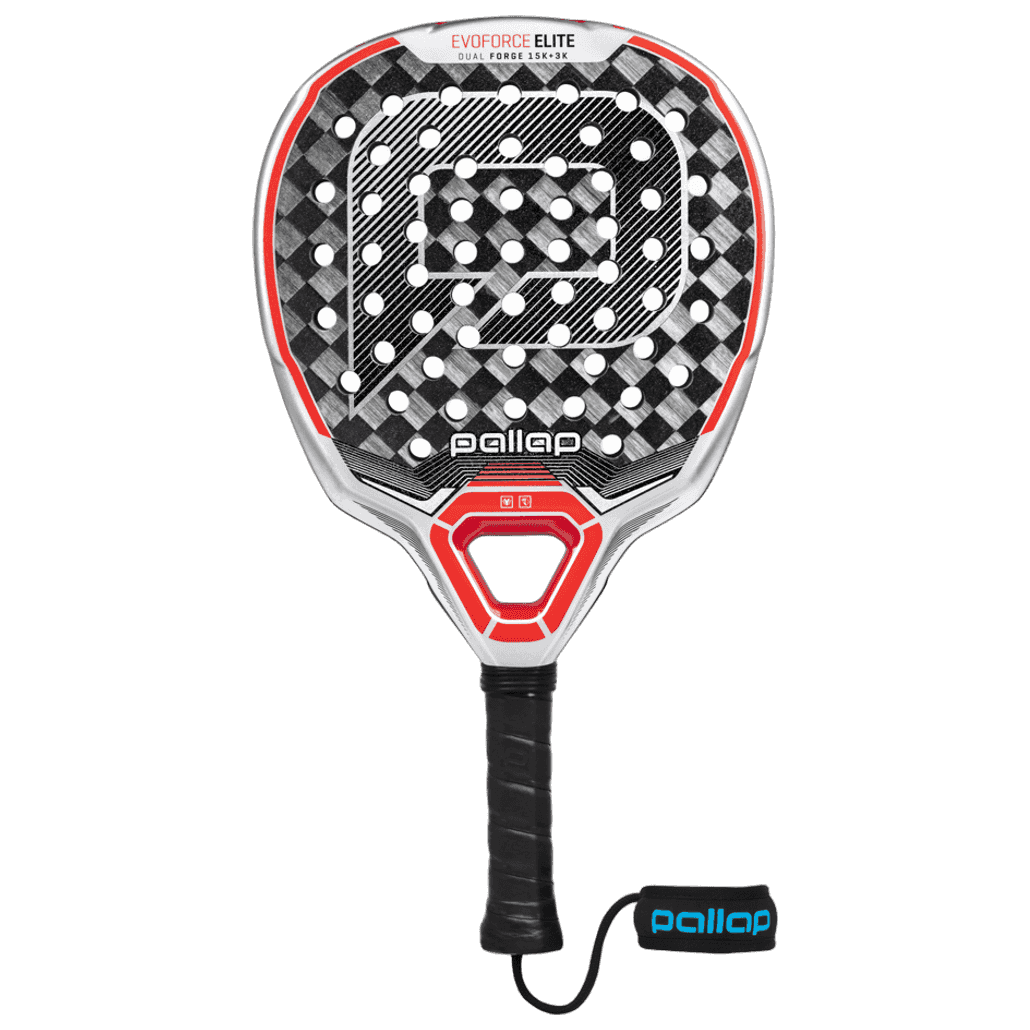
The Pallap Evoforce Elite 2026 is a fast hybrid racket with more punch than its easy handling suggests. It sits on the offensive side of the all-court spectrum, but it does not demand the long, slow preparation of a true head-heavy diamond.
I’d put it in the hands of an intermediate-to-advanced player who wants to press at the net, counter quickly, and still have enough help from the racket at the baseline. Its character is firm, lively, and direct rather than plush.
That liveliness is also the trade-off. Players who prefer a very muted, soft response for delicate placement may find its output a little too springy at times.
Technical analysis
Shape & balance
The tear shape gives the Evoforce Elite a useful middle ground: enough mass through the upper area to accelerate the ball, without feeling slow when the point turns into a rapid volley exchange. Its balance appears reasonably manageable for this power level, which matches player feedback describing quick preparation and good mobility in defense.
I notice this kind of setup most on reaction shots. It should come around quickly for blocks, compact volleys, and counterattacks, rather than asking you to force the racket through the ball. The sweet spot also seems more accommodating than the shape alone might suggest, particularly when contact is not completely clean.
Still, this is not a pure control racket. If your game relies on slowing everything down and feathering short balls, there are calmer options.
Materials & construction
Pallap uses a Dual Carbon frame, Dualforge 15K + 3K Carbon faces, and an Impulse 2 Layer core built around EVA Fusion 30 with a PN layer. Player reports describe a medium, dry feel: firm enough to feel connected to the ball, yet with noticeable ball exit once you apply pace.
The frame stability is one of the more convincing parts of the package. Reports consistently mention that the racket holds up when the pace rises, which matters on hard volleys and defensive blocks where a less stable racket can twist or feel vague.
The downside is predictability. Some owners have felt a more trampoline-like response than they expected, especially on controlled shots where they want the ball to stay on the faces a fraction longer. It is not a dead, precision-first response.
On-court feel
Baseline play
From the baseline, the Evoforce Elite should help players who defend actively rather than simply absorb pressure. Blocks and off-the-wall returns benefit from the accessible ball exit, while the maneuverability makes it easier to get the racket into position late.
A defensive lob does not need excessive effort, and the racket should also work well for a low-driven lob when you can meet the ball in front. But touch players may need a few sessions to calibrate depth. On slower swings, the rebound can occasionally send the ball deeper than intended.
At the net
This is where I expect the Evoforce Elite to make the strongest case for itself. It is quick enough for rapid volley exchanges and stable enough to punch the ball through the middle or toward the fence. You can accelerate short preparation swings without the racket becoming clumsy.
Its firm response also suits an assertive chiquita or a blocked volley played with purpose. What it does less well is ultra-soft drop-shot work; the dry face response gives less forgiveness if your contact is too sharp.
Bandeja and víbora
The combination of maneuverability, bite, and reserve power should make this racket enjoyable for aggressive overheads. Feedback around the víbora has been particularly positive, with enough grip to shape the ball while still driving it forward.
A flat smash has real finishing potential, but this is not a pure power weapon built only for overhead winners. It rewards clean acceleration more than brute force.
Conclusion
I see the Evoforce Elite as a strong option for players who want a quick, attacking racket without moving into an unwieldy diamond shape. It should suit active net players, counterpunchers, and anyone who values quick preparation on volleys and overheads.
The trade-off is feel. Its firmer, livelier response will not suit players who want maximum touch, a soft impact, or absolute predictability on every slow defensive ball.
What other reviewers say
- Padel Magazineen
The test describes a racket that stays stable as the pace rises yet remains agile in quick net exchanges, defensive blocks and counterattacks. It highlights strong grip for víboras, a forgiving sweet spot and enough power in reserve to finish points.
- Reddit r/Padelracketen
One player found a medium, dry feel, easy placement and quick preparation from the low weight and balance, especially enjoying volleys, víboras and defense. Another owner of the standard Elite felt more trampoline effect and less predictable control, though he still credited its defensive help and maneuverability.
- Reddit r/Padelracketen
An owner comparing the Elite with the Dark Star found the Evoforce Elite drier and more powerful, in exchange for slightly less control. The comment is based on limited time with the Elite, so it is an early impression.
Switch Intelligence
Be the first to share where you switched from.
Community reviews
Real feedback from players who used this racket.
Add your review
To submit your review, log in first. You can still read all approved community reviews below.
Add review


