

Royal Padel 34 Aniversario Light 2024
A light, forgiving control racket with a silky response, built to keep the arm quiet and the ball moving through long points.
Our Take
Shape
Tear
Weight
350 - 365 gr
Touch
Medium-Soft
Core
High-density polyethylene
Faces
Double layer of aluminized fiberglass fabric
Frame
Bidirectional fiberglass tubular frame with carbon reinforcements
What we like
- Generous sweet spot on blocks
- Easy ball exit from baseline
- Muted impact helps sensitive elbows
What we don't
- Less planted against heavy pace
- Limited smash finishing power
- Aggressive víboras need clean technique
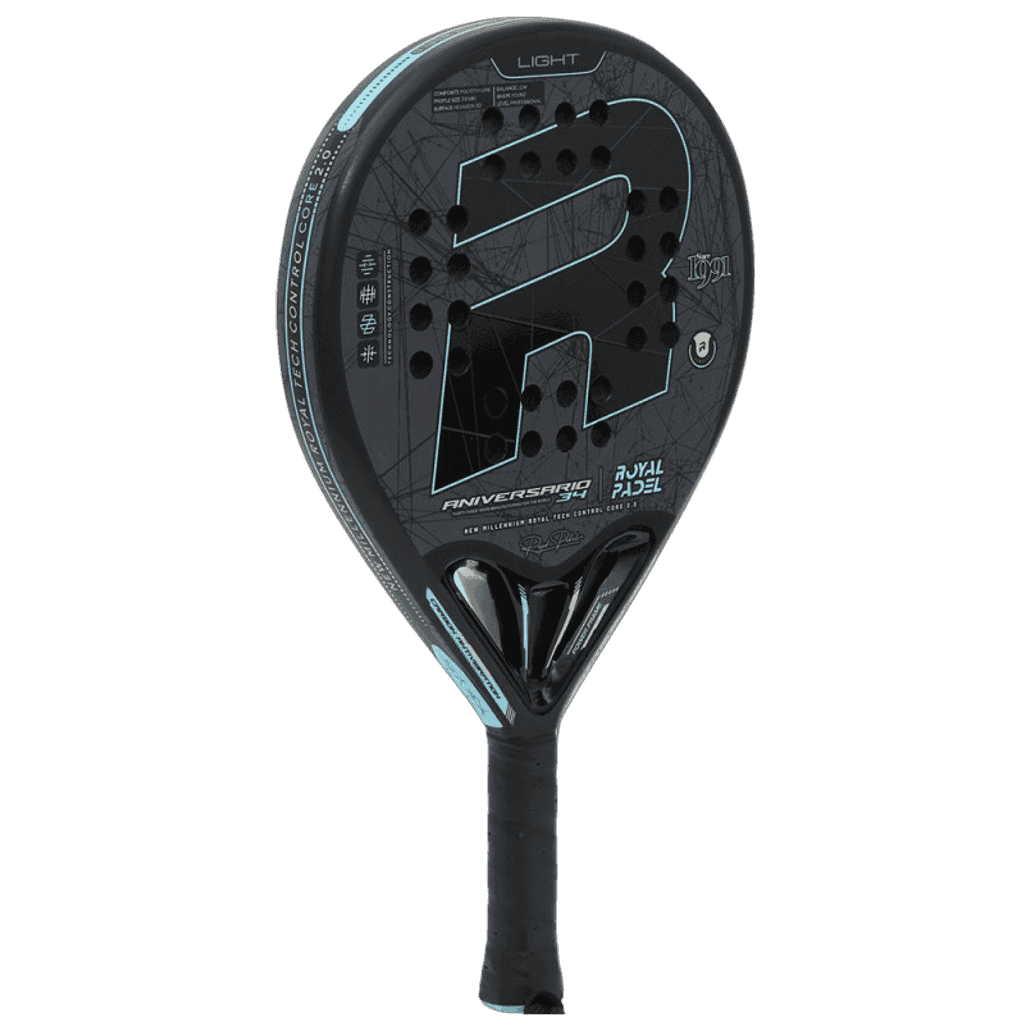
Royal Padel 34 Aniversario Light 2024 is a comfort-first racket with unusually easy ball exit and a sweet spot that feels generous even when contact is not clean. I see it as a control racket for players who want to defend, build points, and protect their arm without using a dead-feeling frame.
Its tear shape gives it enough attacking reach to avoid feeling passive, while the medium-soft feel keeps the response forgiving. This is not a racket that asks me to swing harder on every ball.
The light, agile handling is a major part of its character. In long matches, especially for players dealing with elbow or shoulder sensitivity, that reduced strain can matter more than a few extra points of smash power.
Technical analysis
Shape & balance
The tear profile sits between the easy handling of a round racket and the extra punch of a more aggressive shape. Its balance feels manageable rather than head-heavy, which helps me get the racket into position quickly on defensive blocks, fast exchanges, and off-the-wall play.
That broad sweet spot is one of its strongest traits. Contact outside the center still produces a usable ball, so I can play a defensive lob or a controlled counter without feeling heavily punished by slight timing errors. Players coming from firmer carbon rackets may find the response less precise at full speed, though.
Materials & construction
Royal Padel uses a bidirectional fiberglass tubular frame with carbon reinforcements, paired with double-layer aluminized fiberglass faces. That construction explains much of the racket’s softer, more damped response. It does not transmit the sharp, dry impact some players expect from 12K or 18K carbon faces.
Inside, the high-density polyethylene core gives the racket its lively ball exit. It helps the ball leave the faces with little effort, particularly on slower defensive shots and compact volleys. Reviews consistently point to strong vibration absorption, and that matches the material package: impact feels muted without becoming vague.
On-court feel
Baseline play
From the baseline, this racket makes defense easier than it makes attack spectacular. Blocks come off cleanly, and I can send the ball deep without overhitting. The easy rebound is especially useful when I am late on a ball after the glass or forced to play with a short swing.
There is a trade-off. Against a very heavy ball, the soft response can feel less planted than a firmer, more head-heavy racket. I get control and comfort, but not the same crushing stability when absorbing pace.
At the net
At the net, the quick handling is noticeable. I can react well in fast volley exchanges, and the larger sweet spot gives me confidence to close the face and direct the ball toward the feet. The reported 3D rough texture also helps create useful bite on cut volleys and drop shots.
It is more about placement and repeatability than finishing through the opponent. Flat volleys have good output, but they do not carry the heavy, penetrating feel of a harder carbon racket.
Bandeja and víbora
The racket works well for controlled overheads. On the bandeja, I can shape the ball with spin and keep it low without needing a big swing. The maneuverability also helps when I have to adjust late under a lob.
A more aggressive víbora is possible, but it needs clean technique. The faces will not add much free violence to the shot, so players who rely on a hard, fast overhead may want a firmer response.
Conclusion
I would choose this racket for a regular intermediate or advanced player who values arm comfort, easy defense, and a forgiving response around the court. It suits a patient game built on lobs, controlled volleys, and well-placed overheads.
The compromise is clear: it does not offer the hard finish or stable, heavy impact of an attack-focused carbon racket. If my game depends on winning points through the smash, I would look elsewhere.
What other reviewers say
- Practica Padelen
The review highlights outstanding vibration damping and a soft yet responsive touch, particularly suited to players managing elbow sensitivity. Its light weight aids maneuverability in long rallies, while the 3D texture supports spin and confidence on volleys and bandejas.
- Pala Hacken
This analysis rates control and ball output as its strongest traits, alongside high maneuverability and a broad sweet spot. It places power a step lower, giving the racket a control-and-comfort character rather than a pure power profile.
Switch Intelligence
Be the first to share where you switched from.
Community reviews
Real feedback from players who used this racket.
Add your review
To submit your review, log in first. You can still read all approved community reviews below.
Add review


