

Royal Padel Whip Polietileno 2026
A plush, forgiving round racket that turns defensive pressure into calm placement, though its soft response keeps flat smashes in check.
Our Take
Shape
Round
Weight
360 - 380 gr
Touch
Soft
Core
High-recovery soft polyethylene
Faces
Carbon-reinforced Fibertech
Frame
Carbon-reinforced Fibertech
What we like
- Easy depth from baseline blocks
- Broad sweet spot on volleys
- High vibration absorption over sessions
What we don't
- Limited flat-smash penetration
- Muted feedback on touch shots
- Needs early preparation at net
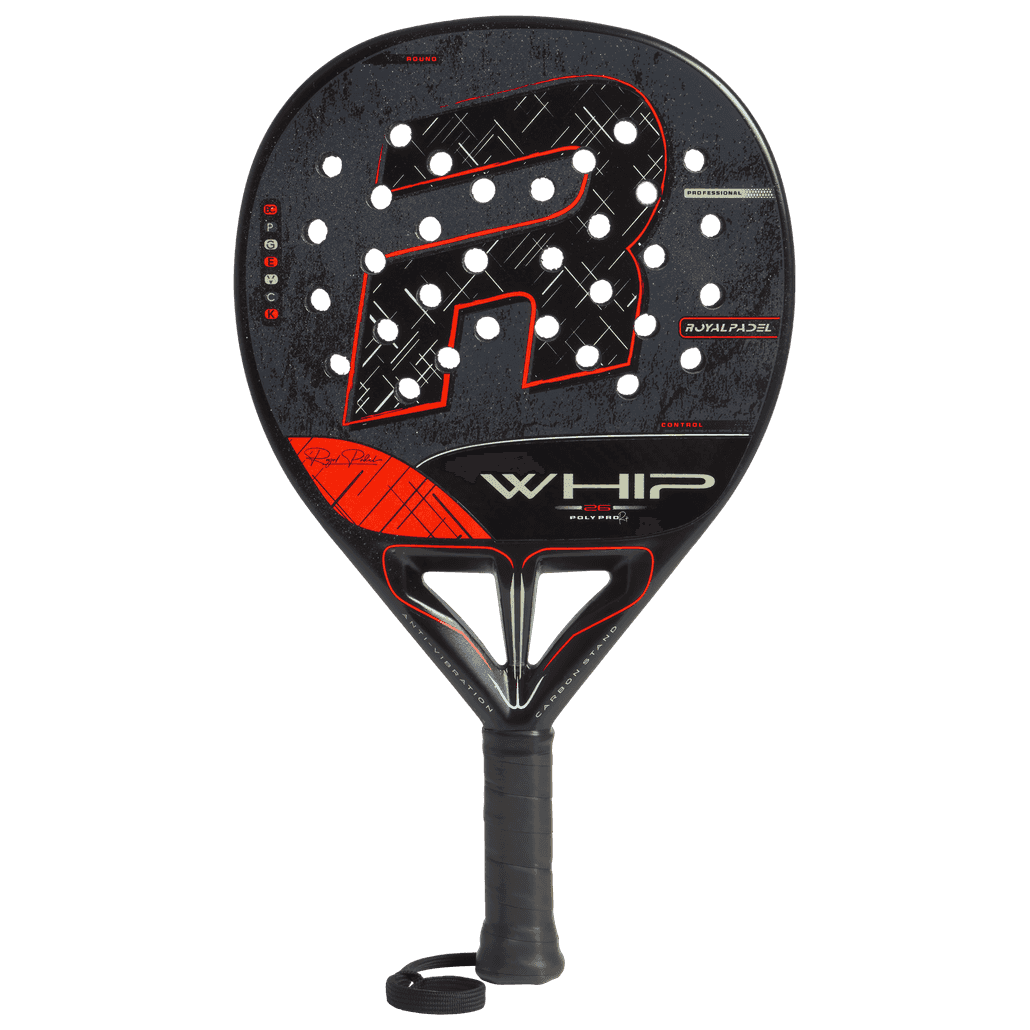
The Royal Padel Whip Polietileno 2026 is a comfort-first racket built around absorption, easy depth, and a forgiving response. I read it as a patient player’s tool: it helps me defend, reset the point, and place the ball without having to force every swing.
Its round shape and soft feel make the character clear from the first few exchanges. This is not a racket that asks me to hit harder. It asks me to play cleaner.
Technical analysis
Shape & balance
The round mold puts a large, usable sweet spot in the center of the face. Off-center contacts are not completely invisible—as they should not be—but the racket is notably forgiving on defensive blocks, rushed volleys, and balls taken late after the glass.
Balance feels contained rather than head-heavy, which helps keep the racket stable through long defensive points. It does not feel like a lightning-fast net racket, though. In quick hand battles, I need to prepare early and keep the swing compact; otherwise, the soft response can make the ball sit up more than I want.
Materials & construction
Royal Padel uses carbon-reinforced Fibertech in the frame and faces, paired with a high-recovery soft polyethylene core. On court, that construction translates into very strong vibration damping and a progressive ball exit rather than a sharp, hard-carbon response.
The faces do not give me the crisp definition I get from a firmer 12K or 18K carbon racket. Some players will enjoy that muted impact, especially over long sessions or with a sensitive elbow. Others will miss the clearer feedback on delicate touch shots and aggressive volleys.
On-court feel
Baseline play
From the baseline, this is where the Whip Polietileno earns its reputation. I can block hard balls with a relaxed hand, use the wall without needing a huge swing, and send defensive lobs deep with less effort than expected. The soft core returns energy well, so getting length is straightforward even when I am under pressure.
Placement is its real strength. I found it easy to play controlled drives, low-driven lobs, and a chiquita that stays low enough to make the opponent volley up. It rewards calm construction more than brute-force transitions.
At the net
At the net, the broad sweet spot gives a lot of confidence on blocks and neutral volleys. The racket absorbs pace well, so I can take speed off the ball and direct it toward the feet or into the middle without the frame feeling unstable.
What it does not do especially well is finish a fast exchange with one short, violent punch. The response is soft and comfortable, but not explosive. Against a well-set pair, my volley needs placement and repetition rather than raw penetration.
Bandeja and víbora
The racket works nicely for a controlled bandeja. Its soft response helps me keep the ball deep and low while maintaining margin over the net. A víbora is more about direction and consistency than cutting through the court with heavy pace.
I would not choose it for an overhead game based on constantly accelerating the ball. The face gives enough output for sensible attacking shots, but it does not generate easy extra speed at full swing.
Conclusion
I would put the Whip Polietileno 2026 in the hands of intermediate to advanced players who value comfort, defense, and placement over a hard, attacking feel. It is particularly convincing for players who spend long matches building points from the baseline and want reliable help on blocks, lobs, and off-the-wall play.
The trade-off is clear: maximum smash power and sharp feedback are not its strengths. A flat smash can work with clean contact, but it will not regularly break down a strong defense the way a rigid, head-heavy attacking racket can.
For my game, it makes sense when I want to reduce vibration, defend with less effort, and play percentage padel. It is not the racket I reach for when the plan is to overwhelm opponents with pace.
What other reviewers say
- PadelStares
This review highlights an extremely soft, arm-friendly response with strong vibration absorption, defensive stability and accurate placement for patient point construction. It finds the power adequate but limited for aggressive attacking play and heavy smashes.
- AvisPadelfr
AvisPadel particularly rates its easy ball output, broad sweet spot and control, saying it helps with blocks, glass defense and placement shots. It is capable enough on clean smashes, but lacks the punch to consistently break down a well-set defense.
- PadelRacketReviews.comes
The analysis presents it as a comfortable, damped racket that still provides useful output on drives and smashes for intermediate players. Its main trade-off is agility: quick net exchanges require early preparation, while loose or off-centre contact sacrifices precision.
- padel.howen
The review describes a very soft, progressive response with high control, a broad sweet spot and easy defense, blocks, lobs and depth without a full swing. It supplies accessible power at moderate effort, but the low balance and soft build reduce the pace and penetration of a fully accelerated flat smash.
Switch Intelligence
Be the first to share where you switched from.
Community reviews
Real feedback from players who used this racket.
Add your review
To submit your review, log in first. You can still read all approved community reviews below.
Add review


