

Sane Agressor Evolution BlueLight 2026
A forgiving teardrop with lively ball exit and a generous sweet spot, making defense simpler while keeping the net game moving.
Our Take
Shape
Tear
Weight
345 - 365 gr
Touch
Medium
Core
Pro Touch
Faces
NanoGraf (fiberglass with graphene)
What we like
- Easy depth on defensive blocks
- Broad, forgiving sweet spot
- Predictable *bandeja* and *víbora* length
What we don't
- Needs early net preparation
- Delicate shots can lift
- Limited x3 smash punch
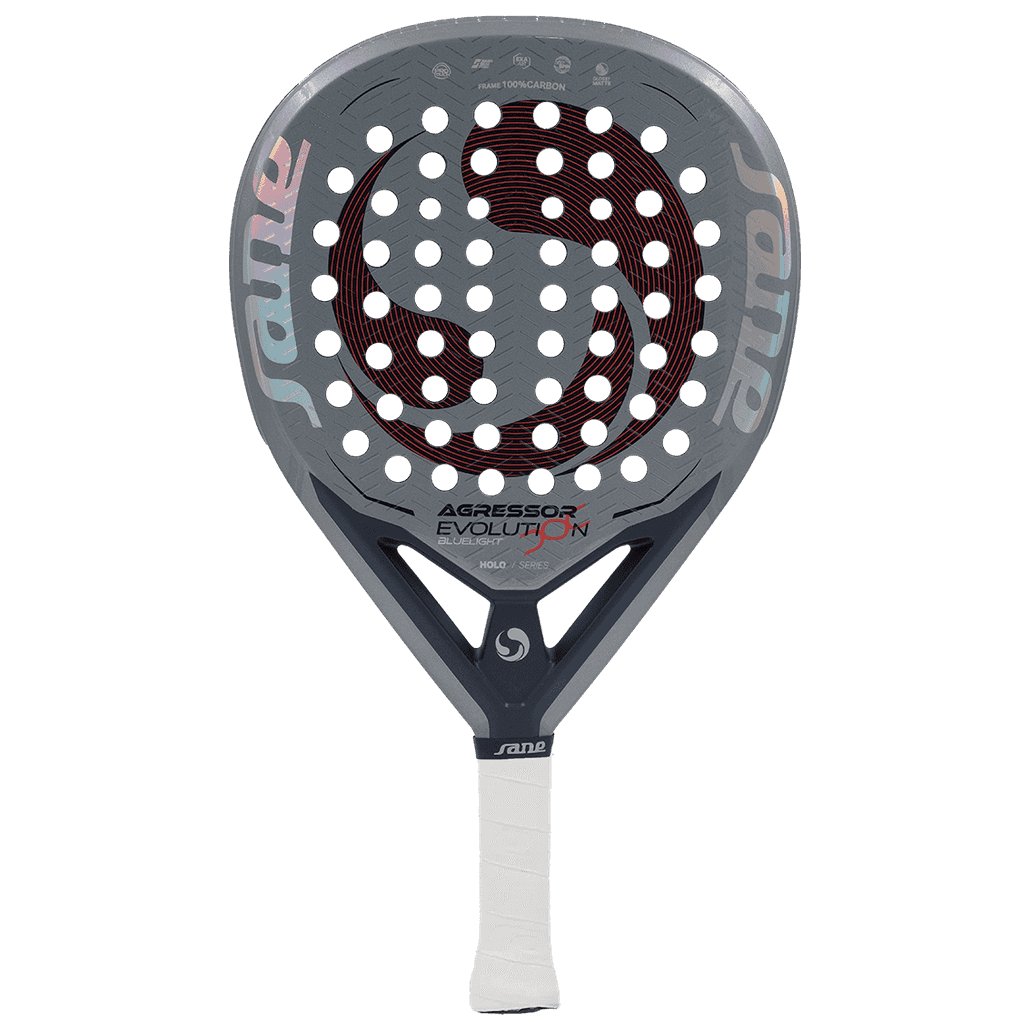
Sane Agressor Evolution BlueLight 2026 is a lively, forgiving racket that gets the ball moving without asking for a huge swing. I see it as a control-oriented attacking option: quick enough to defend under pressure, but with enough finish for players who like to step forward.
Its personality comes from easy ball exit and a generous hitting area rather than raw, head-heavy force. That makes it friendlier in long points than a pure power racket.
Technical analysis
Shape & balance
The tear shape gives this racket a useful middle ground between a round control frame and a demanding diamond. The sweet spot feels broad and accessible, which matters when I am late on an off-the-wall ball or defending with a compact block.
Its balance feels controlled rather than aggressively head-heavy. I can bring the racket through the ball quickly, although fast hand battles at the net still require early preparation. It is maneuverable, but it does not have the ultra-fast, stripped-back feel of a genuinely head-light racket.
Materials & construction
The faces use NanoGraf, a fiberglass construction reinforced with graphene, paired with the Pro Touch core. That combination explains the medium feel: there is a bit of flex and rebound at impact, without the vague sensation that some soft fiberglass rackets can produce.
I found the response more helpful than surgical. The racket gives depth easily on defensive shots and rewards a compact swing, but the softer, more elastic behavior means it will not provide the same crisp feedback as a hard 12K or 18K carbon face. Players who like to feel every contact point precisely may want a firmer face.
On-court feel
Baseline play
From the baseline, this is where the BlueLight makes most sense to me. The ball comes off the face easily, and that broad sweet spot helps when contact is not clean. In practical terms, I can send a defensive lob deep without overhitting, and blocks have enough exit to avoid leaving a short ball in the middle.
That easy rebound is especially useful in rushed defense. Research on this model consistently points to its ability to produce depth with shorter swings, and that matches its materials and medium response. The trade-off is that touch shots need a calmer hand; on a delicate drop shot or chiquita, the racket can add more lift than I intended if I leave the face too open.
At the net
At the net, the BlueLight is dependable rather than brutal. Volleys leave the face with good speed, and I can direct the ball comfortably without having to force the wrist. The forgiving response also helps on reaction blocks when the opposing pair attacks my body.
Still, it is not the sharpest tool in frantic exchanges. I need to prepare the racket earlier than I would with a more head-light, firmer control model. If I am late, the ball can sit up rather than stay low and dead.
Bandeja and víbora
The racket works well for building pressure with a bandeja or víbora because it offers easy length and a predictable launch. I do not need to over-accelerate to keep the ball deep, which helps preserve position after an overhead.
A flat smash is competent when I catch it cleanly, but this is not a dedicated x3 weapon. It has enough punch on favorable balls, yet players who rely on finishing from behind the service line will miss the more violent output of a stiffer, higher-balance racket.
Conclusion
I would put the BlueLight in the hands of an intermediate or advanced player who values easy defense, a large sweet spot, and reliable depth before maximum smash power. It suits players who build points, use the lob well, and want a racket that does not punish slightly imperfect contact.
The compromise is clear. You gain rebound and forgiveness, but not the hardest, most direct response in fast net exchanges or outright overhead finishing. For my game, that is a reasonable trade if I want a racket that keeps me in the point and still lets me press forward.
What other reviewers say
- AvisPadelfr
The review highlights easy ball output and a broad sweet spot, helping players defend and send the ball deep even with compact swings. It is capable on favorable smashes but lacks the punch of a dedicated x3 racket, while rapid net exchanges require earlier preparation.
Switch Intelligence
Be the first to share where you switched from.
Community reviews
Real feedback from players who used this racket.
Add your review
To submit your review, log in first. You can still read all approved community reviews below.
Add review


