

Softee Trionic 3K Nano Mesh 2026
A firm teardrop built for players who press from the baseline, pairing crisp control with enough weight behind the smash.
Our Take
Shape
Tear
Weight
355 - 375 gr
Touch
Hard
Core
Professional Black EVA
Faces
3K Carbon
Frame
100% Carbon
What we like
- Stable, penetrating net volleys
- Controlled *bandeja* and *víbora*
- Decisive ball exit on acceleration
What we don't
- Demanding depth from the baseline
- Less forgiving on late defense
- Direct feel limits touch shots
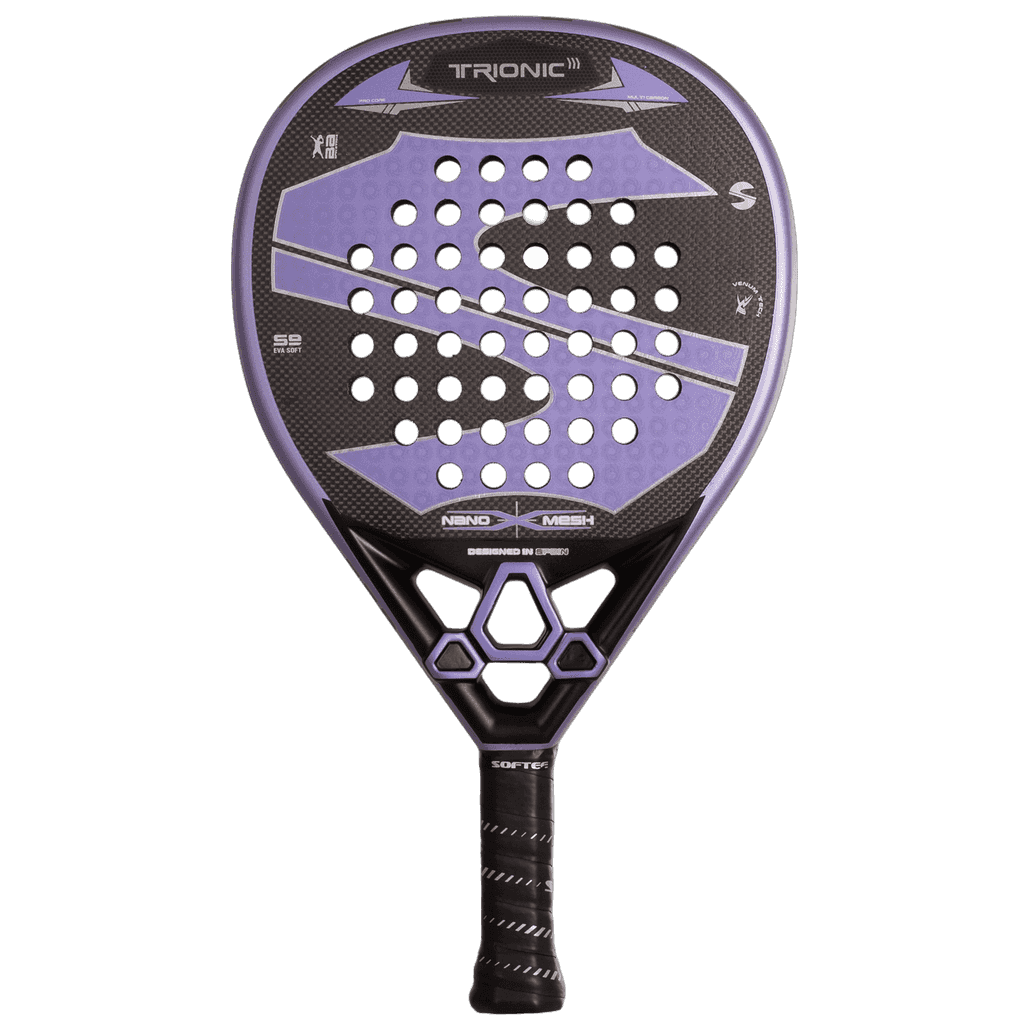
Softee Trionic 3K Nano Mesh 2026 is a firm, attack-minded racket with more control than its hard construction first suggests. It wants an active player behind it; this is not a racket that creates easy depth from a loose swing.
The tear shape keeps it more manageable than a full diamond, while the hard feel gives every clean strike a direct, compact response.
It suits intermediate-to-advanced players who like to build points with pace, then finish them at the net without losing confidence in their placement.
Technical analysis
Shape & balance
The tear profile places the sweet spot above center, but not so high that the racket becomes clumsy in defense. I expect a moderately head-heavy character: enough mass through the ball for aggressive volleys and overheads, without the slow preparation of a pure power racket.
That balance should reward a player who prepares early. On rushed blocks or quick exchanges close to the body, it will not feel as quick as a head-light control racket. Still, the listed maneuverability suggests it should remain usable in fast net battles rather than becoming a one-dimensional smash tool.
Materials & construction
The 100% carbon frame gives the structure a stable, firm base, and the 3K carbon faces should provide a fairly clean response rather than a soft, muted one. There is little indication of a trampoline-like face here. I would expect the ball to leave decisively when I accelerate, but with less free help on passive shots.
Its Black EVA Professional core reinforces that firmer profile. The benefit is precision: the racket should hold its line well on driven volleys, blocks, and low-driven lobs. The trade-off is comfort. Players who rely on a soft core to absorb impact or generate easy ball exit from the baseline may find it demanding, particularly in colder conditions or after a long session.
On-court feel
Baseline play
From the baseline, I would use this racket with a deliberate, compact swing. The hard response should make it reliable for directing defensive lobs and playing controlled returns off the wall, provided I meet the ball in front.
It is less forgiving when I arrive late. A soft racket can sometimes save a defensive ball with minimal acceleration; this one is likely to ask me to push through the shot. That is the main limitation for players who spend a lot of time under pressure or prefer a cushioned touch.
At the net
At the net, the Trionic’s firmness should be much more useful. Volleys ought to come off with pace and a stable face, especially when I want to play through the middle or pin the ball low at an opponent’s feet. The combination of a broad sweet spot and controlled rebound should help keep aggressive volleys from flying long.
Touch shots are not its natural strength. I would not choose this racket for a very soft drop shot or a delicate chiquita played mainly with the wrist. It can execute those shots, but the feel is more direct than plush, so clean contact matters.
Bandeja and víbora
This is where the tear shape and firm core make sense together. A bandeja should stay compact and penetrating, while the face stability should let me accelerate a víbora without the racket twisting too much at impact.
For the smash, it should offer serious pace when technique supplies the acceleration. But it is not a shortcut to easy winners; the hard setup will reward clean timing more than it will rescue incomplete contact.
Conclusion
I would put the Trionic 3K Nano Mesh 2026 in the hands of an intermediate-to-advanced player who prefers a direct racket and plays proactively at the net. It has enough control for structured play, but its real value is in firm volleys, overhead pressure, and decisive ball exit.
The trade-off is comfort and passive forgiveness. Players wanting a softer touch, effortless defense, or help generating depth from compact swings should look elsewhere.
Switch Intelligence
Be the first to share where you switched from.
Community reviews
Real feedback from players who used this racket.
Add your review
To submit your review, log in first. You can still read all approved community reviews below.
Add review


