

Softee Trionic Fiber 2026
A comfortable, forgiving tear-shape that makes defense feel easy and keeps the net lively, though it prefers placement to a finishing smash.
Our Take
Shape
Tear
Weight
355 - 370 gr
Touch
Medium
Core
EVA Soft
Faces
Fiberglass
Frame
Mixed
What we like
- Easy depth on defensive lobs
- Forgiving sweet spot off-center
- Quick handling in net exchanges
What we don't
- Vague feedback on driven shots
- Limited bite for *víboras*
- Smash lacks finishing authority
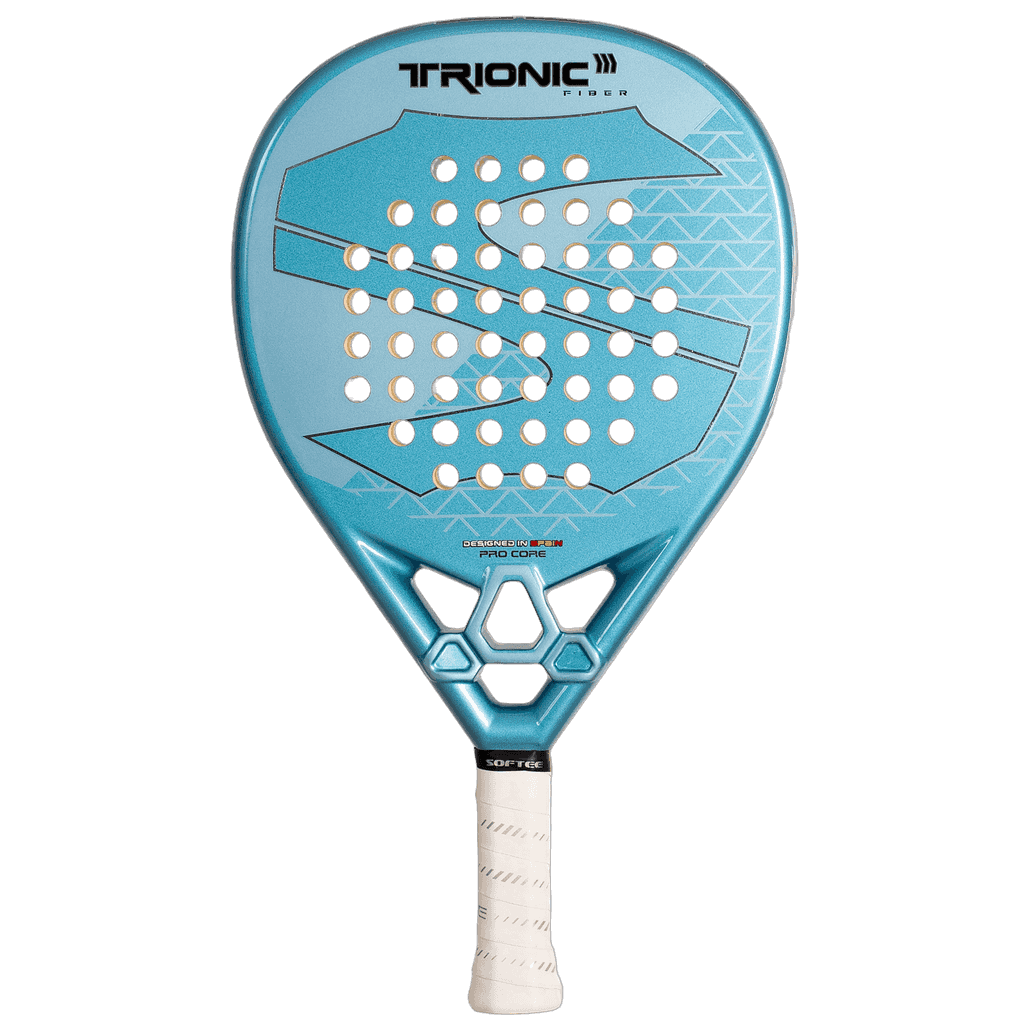
Softee Trionic Fiber 2026 is a forgiving, easy-output racket built around comfort rather than outright finishing force. It helps me defend, block, and find depth without having to hit every ball cleanly.
The tear shape gives it a useful middle ground between a round defensive racket and a more demanding attacking model. Its medium feel is soft enough to be friendly, though the response can feel a little vague when I try to play with maximum precision.
Technical analysis
Shape & balance
This is a maneuverable tear-shaped racket with a broad, accessible sweet spot. Slightly off-center contact does not punish me much, which matters on hurried volleys, defensive pickups, and awkward balls coming off the glass.
I would not call it a racket that rewards brute acceleration. It moves quickly through fast exchanges and feels easy to position at the net, but its power delivery is more elastic than explosive. Players who like a firm, immediate response from the face may find it somewhat muted.
Materials & construction
The mixed frame, fiberglass faces, and EVA Soft core explain much of that behavior. The construction absorbs vibration well and gives the ball plenty of exit, especially at moderate swing speeds. During longer matches, it feels comfortable on the arm rather than harsh or demanding.
That softness comes with a trade-off. The faces do not give the cleanest feedback at impact, particularly on driven shots where I want to judge exactly how long the ball stays on the racket. The smooth surface also limits bite, so generating heavy spin takes more technique than it would with a rougher, firmer carbon face.
On-court feel
Baseline play
From the baseline, this is where the Trionic Fiber earns its place. Defensive lobs come off easily, and I can send the ball deep without forcing the swing. On wall exits and blocks, the racket supplies useful rebound; I mainly need to present the face well and let the core do some work.
That assisted ball exit is helpful for improving players, but it can make short touch shots less exact. A chiquita or soft drop shot needs a calm hand because the soft core wants to add a little more launch than expected.
At the net
At the net, I like its speed. It is quick to reset for reaction volleys and stable enough for simple blocks against pace. Placement is the stronger option here: I can direct volleys into space and keep the point moving without feeling late.
Hard, flat volley acceleration is less convincing. If I really punch through the ball, the response is not always as consistent as with a firmer racket. It does not collapse, but it lacks that crisp, authoritative contact that lets me repeatedly force weak replies.
Bandeja and víbora
The bandeja is comfortable because the racket helps carry the ball deep with a controlled swing. A defensive overhead or low-driven lob is also easy to manage.
The víbora is less natural. There is limited surface bite, and the softer impact reduces the sharp cut I want when trying to make the ball stay low after the glass.
Smash
A well-timed smash has enough output to finish favorable balls, especially when I can use placement. Still, this is not a racket for routinely forcing winners through raw power or producing a reliable kick smash. It asks for clean technique, and even then the finish is more measured than violent.
Conclusion
I would choose this racket for an improving beginner or intermediate player who wants easy defense, a forgiving sweet spot, and a comfortable response over a long match. It makes baseline play less laborious and stays quick in busy net exchanges.
The trade-off is clear: less precision on delicate touch, less spin on cut overheads, and limited authority on the smash. Players who build points with consistency and depth will get more from it than players who want every volley and overhead to feel hard, crisp, and punishing.
What other reviewers say
- PadelRacketReviews.comen
This review finds it manageable and forgiving for beginners, with a friendly sweet spot and enough output to develop aggressive strokes. It also criticizes the indistinct feel and inconsistent power delivery, particularly on volleys and driven shots.
- AvisPadelfr
AvisPadel highlights easy depth from the back court, tolerance on off-centre contact, and quick handling in fast net exchanges. It says the smash works on favorable balls, but it is not a racket for routinely finishing points with a kick smash.
- PadelTestLabfr
The analysis describes highly assisted response on blocks, wall exits, and lobs, with enough comfort and stability to defend without overworking the arm. In return, the elastic feel and smooth surface reduce precision on cut volleys, bite on víboras, and crisp finishing power on smashes.
Switch Intelligence
Be the first to share where you switched from.
Community reviews
Real feedback from players who used this racket.
Add your review
To submit your review, log in first. You can still read all approved community reviews below.
Add review


