

Tecnifibre Wall Breaker 355 2024
A quick, lively diamond that makes defense and spin easy, though off-center contact and flat finishing demand cleaner timing.
Our Take
Shape
Diamond
Weight
355 gr
Core
EVA
Faces
Carbon, graphite
What we like
- Quick handling in net exchanges
- Easy ball exit on defense
- Rough face adds slice bite
What we don't
- Modest sweet spot off-center
- Flat smashes lack free power
- Fast víboras need acceleration
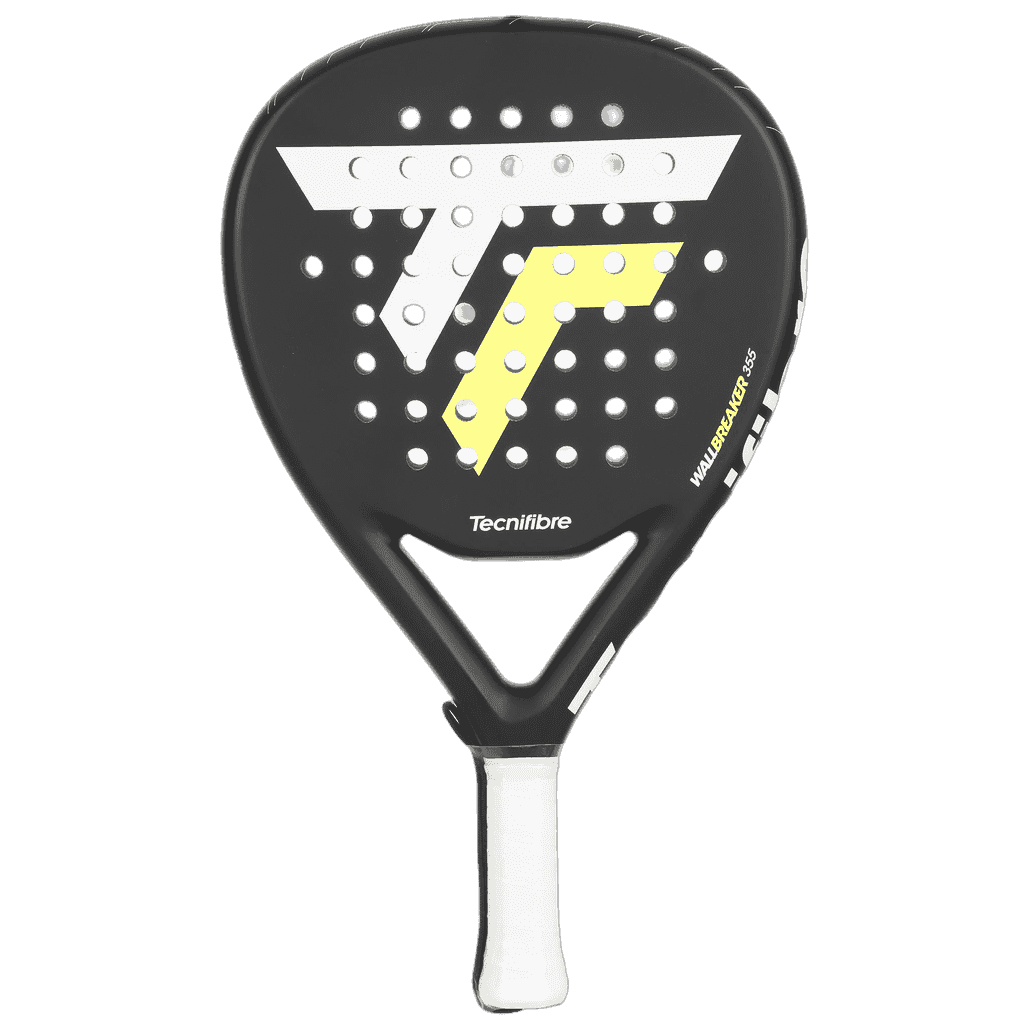
Tecnifibre Wall Breaker 355 2024 is a quick-handling Diamond racket that plays less aggressively than its shape suggests. I see it as a control-oriented attacking racket: lively enough to move the ball through the court, but not built to end points with minimal effort.
Its strongest trait is accessibility in the rally. It gets through defensive exchanges, blocks, and overhead control shots without feeling slow or overly demanding.
That said, the smaller effective hitting area matters. Miss the center under pressure and the response becomes less clean than the racket’s easy maneuverability might lead you to expect.
Technical analysis
Shape & balance
The diamond shape gives the Wall Breaker 355 a naturally attack-minded outline, but the balance does not feel excessively head-heavy in use. It moves quickly between forehand and backhand at the net, and I would expect most intermediate players to adapt to it faster than they would to a more top-loaded diamond racket.
That maneuverability helps on rushed volleys, defensive blocks, and compact swings off the wall. The trade-off is that the sweet spot is not especially generous. Contact needs to be reasonably centered, particularly when absorbing pace or defending low balls near the baseline. Players who regularly catch the ball toward the frame may find it a little unforgiving.
Materials & construction
Tecnifibre uses Carbon, graphite on the faces with an EVA core. The resulting response seems geared toward ball exit rather than a hard, dry impact. I would describe the character as accessible and responsive rather than explosive: the ball leaves the face easily when I guide it, but it does not produce that sharp catapult effect that helps weaker technique create free power.
The rough surface is useful. It gives me enough bite to work slice into volleys, drop shots, and overheads without making the racket feel overly specialized. I would not expect the face to compensate for poor racket-head speed, though. Spin is available, but I still need to accelerate properly and brush the ball with purpose.
On-court feel
Baseline play
From the baseline, this racket makes defense fairly straightforward. The ball comes off the face with enough assistance to send a defensive lob deep, and I like the speed through the air when reacting to hard shots after the glass. Blocks do not require a big swing; a firm, compact presentation of the racket is usually enough to return depth.
Where it asks more from me is on imperfect contact. The sweet spot is not broad, so late pickups and off-center off-the-wall shots can lose direction and stability. It helps players who prepare early, but it is not the racket I would choose solely for maximum forgiveness.
At the net
At the net, the Wall Breaker 355 feels fast and controlled. I can close the face on a quick block volley, redirect pace, and keep the ball low without fighting a heavy head. That makes it comfortable for building pressure rather than trying to hit through every volley.
The racket also responds well to touch. A short chiquita or a disguised drop shot feels easier to place than with a stiffer power-focused diamond. Still, the volley does not carry huge natural weight. To push opponents back with a deep, heavy ball, I need to supply acceleration myself.
Bandeja and víbora
This is one of its better areas. The quick handling helps me adjust under the ball, and the rough face gives slice on the bandeja without demanding a huge swing. I can keep the ball low and controlled while recovering net position.
A fast víbora is less automatic. The racket can produce it, but it does not add much extra pace on its own. I need a clean kinetic chain and good racket-head speed to make the shot bite through the court.
Smash
The smash is the clear limitation. Flat smashes do not come off with the same easy finish as they do from a more aggressive, harder, head-heavy racket. Players who rely on power to bring the ball back over the fence will need to generate nearly all of it themselves.
For placement smashes and controlled angles, it remains usable. But raw finishing power is not its main job.
Conclusion
I would look at the Wall Breaker 355 if I wanted a maneuverable diamond racket with easy ball exit, useful slice, and reliable behavior in defensive blocks and controlled overheads. It suits an intermediate player who wants to attack with placement and construction rather than constant brute force.
The compromise is clear: a modest sweet spot and limited free power on flat smashes. It rewards clean contact and active technique, while players seeking a more forgiving face or heavier finishing ball should look elsewhere.
What other reviewers say
- PadelTestLabes
This review finds it highly maneuverable, with easy ball output for defense, block volleys and bandejas. The rough face helps generate slice, but flat smashes and fast víboras need extra arm speed because finishing power is limited.
- Racketguide.comen
The short written user reviews say the racket strikes the ball well, but two comments characterize it as somewhat unforgiving. That points to less forgiveness when contact or execution is imperfect.
Switch Intelligence
Be the first to share where you switched from.
Community reviews
Real feedback from players who used this racket.
Add your review
To submit your review, log in first. You can still read all approved community reviews below.
Add review


