

Akkeron Predator 2025
A firm, assertive tear-drop built to drive the ball hard, yet composed enough to keep defensive work from turning frantic.
Our Take
Shape
Tear
Weight
355 - 375 gr
Touch
Medium
Core
EV30 Black
Faces
K12IMPACT Carbon
Frame
100% Full Carbon
What we like
- Stable, weighted net volleys
- Deep, controlled bandejas
- Direct power on committed smashes
What we don't
- Muted exit on rushed defense
- Demanding late off-the-wall recoveries
- Less convincing on delicate touch
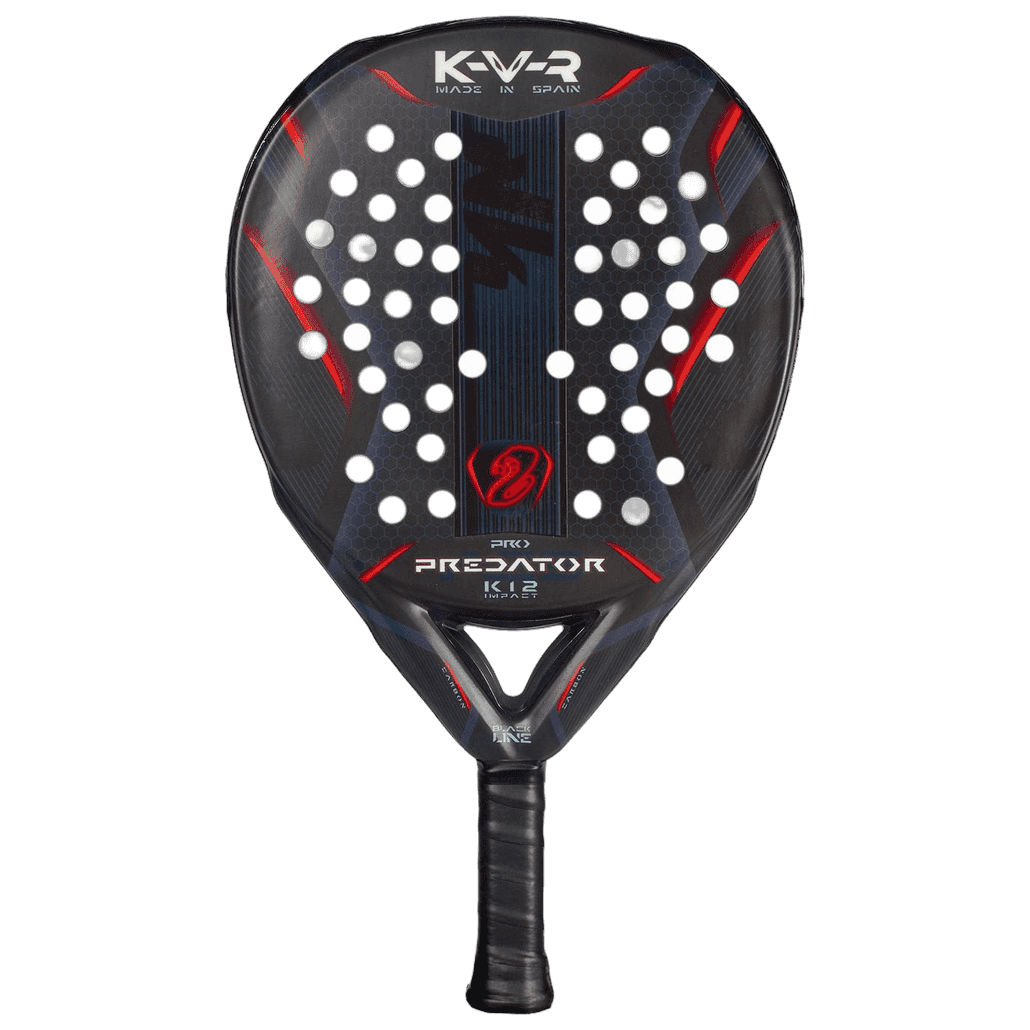
Akkeron Predator 2025 is an attacking racket with enough composure to keep a point organized from the baseline. Its tear shape puts it between a classic control-focused round racket and a full diamond weapon: quick enough for fast exchanges, but built to finish rather than simply keep the ball in play.
I’d call the character firm, direct, and demanding in a good way. The medium feel and high-end construction give it a crisp response, though it does not provide the easy ball exit that softer rackets offer on lazy defensive shots.
Technical analysis
Shape & balance
The tear format gives the Predator 2025 a broad enough hitting area to feel reliable outside the center, while still placing enough mass toward the upper half for aggressive overhead work. Its sweet spot is not tiny, but it is also not the sort of racket that masks poor contact.
I found that balance useful in quick volleys and when accelerating through a víbora. The racket comes through the ball with purpose, without feeling excessively head-heavy during rapid hand battles at the net. Players who prefer a very head-light racket for pure defense may still find it slightly more demanding over a long match.
Materials & construction
Akkeron uses a 100% Full Carbon frame, K12IMPACT Carbon faces, and an EV30 Black core. That is a serious, firm recipe, and the response reflects it: stable at impact, clean on direct strokes, and less springy than a fiberglass-faced model.
The face feels made for players who accelerate the racket themselves. When I hit through the ball, there is satisfying penetration and a predictable trajectory. On the other hand, the Predator does not hand out free depth on slow blocks or late off-the-wall recoveries. You need to get behind the ball and give it some intent.
On-court feel
Baseline play
From the baseline, the Predator feels controlled rather than overly lively. Defensive lobs can be placed accurately when the contact is clean, and I liked the way it holds its line on low-driven lobs. The medium response keeps the ball from jumping too much off the faces.
That same trait can punish passive play. If I was late on a back-wall ball and merely presented the racket, the exit was more muted than I wanted. Players coming from a soft EVA racket will need a few sessions to adjust their timing and produce depth consistently.
At the net
This is where the racket makes the most sense. Firm volleys come off with good weight, and the stable frame helps me block hard drives without the face twisting. There is enough maneuverability to play a short chiquita or change direction late, although it is more convincing on assertive volleys than on delicate touch shots.
The Predator rewards a compact stroke. I could press the opponent with controlled pace rather than overhitting, especially on backhand volleys. Its bite is decent, but I would not choose it primarily for exaggerated slice or soft drop-shot work.
Bandeja and víbora
Overhead control is one of its stronger areas. The balance gives my bandeja enough weight to stay deep, while the firm faces let me drive a víbora through the middle without feeling the racket wobble. It is easier to attack the ball than to feather it.
Smash
A committed smash gets a strong, direct response. The Predator is not a trampoline-style power racket, so technique and acceleration still matter, but it transfers force well once the swing is there. Flat smashes and aggressive kick attempts both benefit from the stable upper section.
Conclusion
I’d put the Predator 2025 in the hands of an intermediate-to-advanced player who likes to build from the baseline and take control at the net. It suits someone with developed overhead technique far more than a player looking for effortless comfort.
The trade-off is clear: you get stability, precision, and serious attacking potential, but not a soft, forgiving response on rushed defense. If your game relies on easy ball exit and touch above all else, this racket may feel too firm.
Switch Intelligence
Be the first to share where you switched from.
Community reviews
Real feedback from players who used this racket.
Add your review
To submit your review, log in first. You can still read all approved community reviews below.
Add review


