

Alkemia Vento 2026
A lively teardrop that blends easy ball exit with enough bite and stability to keep attacking play measured rather than wild.
Shape
Tear
Weight
350 - 360 gr
Touch
Medium-Soft
Core
Black EVA PRO React
Faces
Double layer of 3K carbon fiber, medium-soft hardness
Frame
Kevlar + Carbon
What we like
- Quick ball exit under pressure
- Accessible *bandeja* and *víbora* pace
- Forgiving on hurried volleys
What we don't
- Passive blocks can run deep
- Limited touch on soft drop shots
- Less direct on flat smashes
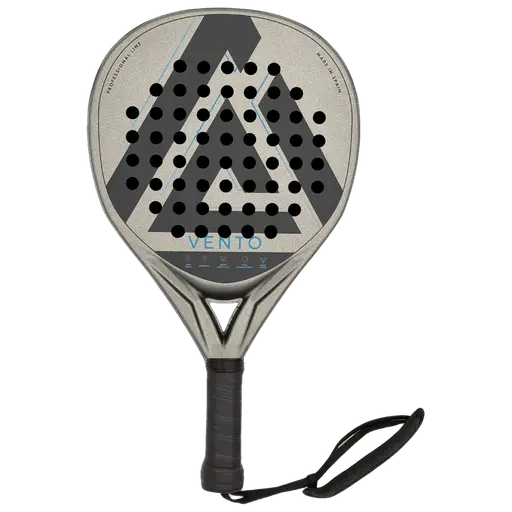
Alkemia Vento 2026 is a lively attacking racket that keeps more touch than its power-oriented behavior suggests. It wants to accelerate the ball, but it does not punish you every time the point starts at the baseline.
Its tear shape puts it in the middle ground between a control-first round racket and a committed diamond. Add the medium-soft feel, and the Vento reads as a racket for players who create pace themselves but still want help on defensive contacts.
I see it fitting an intermediate-to-advanced player who plays an active game at the net and values quick ball exit. It is less convincing for someone who wants an ultra-firm, surgical response on every slow ball.
Technical analysis
Shape & balance
The tear format gives the Vento a reasonably broad working area without making the head feel slow through the air. The sweet spot should be accessible for a racket with this level of attacking intent, particularly on volleys and overheads where you contact the ball in front.
Balance appears tuned toward the upper half rather than fully head-heavy. That helps it generate penetration on a bandeja or víbora without demanding the same preparation as a more aggressive diamond. Still, this is not a head-light racket built around effortless defensive movement. If your timing is late, its liveliness can make the ball leave earlier than you intended.
Materials & construction
The Kevlar + Carbon frame is paired with double-layer 3K carbon faces, a construction that should give the racket a stable, slightly elastic impact rather than a dry carbon-board sensation. The face is not marketed as excessively hard, and that matters: the Vento is designed to return energy instead of asking you to compress every ball with a full swing.
Underneath sits a Black EVA PRO React core. That core is the likely source of the racket’s quick rebound. On medium-paced exchanges, I would expect easy depth with compact strokes and a useful response when blocking hard volleys. The trade-off is that delicate touch requires a quiet hand; this is not the kind of racket that naturally deadens the ball on a soft drop shot.
On-court feel
Baseline play
From the baseline, the Vento’s main asset is its ball exit. Defensive lobs and off-the-wall recoveries should not need a huge swing to reach length, which is valuable when you are under pressure and contacting low.
That same rebound can work against players who rely on passive blocks. A loose wrist or an open racket face may send the ball too deep, especially on faster courts. I would use it proactively: firm blocks, low-driven lobs, and deliberate chiquitas rather than hoping the racket will absorb pace for me.
At the net
At the net, the Vento should feel quick enough to manage rapid volley exchanges while still putting weight through the ball. The softer side of its response gives some margin on contacts away from the center, so it is not overly punishing in hurried hands battles.
I would not call it a precision instrument for ultra-short angled volleys. Players who prioritize placing the ball inches above the net may prefer a firmer, lower-rebound face. The Vento is more comfortable accelerating through the volley and making the opponent play from behind the service line.
Bandeja and víbora
This is where the tear shape makes sense. The racket should move cleanly through the overhead swing and provide enough output to keep the ball deep without forcing a full smash motion. The medium-soft response can also help maintain pace when contact is not completely centered.
For flat, full-power smashes, it has enough punch, but it will not feel as brutally direct as a hard, head-heavy diamond. Its strongest overheads are the ones that combine speed, placement, and repeatability.
Conclusion
The Vento suits players who want accessible power, quick rebound, and a more forgiving attacking racket than the usual hard-carbon option. It should reward an active net game and confident overhead technique.
The compromise is clear: that easy exit reduces passive control. Players seeking a muted touch, very soft defensive absorption, or maximum smash authority may find it a little too lively in some situations.
Switch Intelligence
Be the first to share where you switched from.
Community reviews
Real feedback from players who used this racket.
Add your review
To submit your review, log in first. You can still read all approved community reviews below.
Add review


