

Babolat Counter Crest 2026
A soft, quick-handling teardrop that makes defense feel simple and gives controlled attacking shots a forgiving, easy exit.
Our Take
Shape
Tear
Weight
355 gr
Touch
Soft
Core
Soft EVA
What we like
- Effortless depth on defensive lobs
- Generous sweet spot on blocks
- Quick handling in net exchanges
What we don't
- Soft response lacks smash finish
- Excess rebound under fast pace
- Limited bite on víbora shots
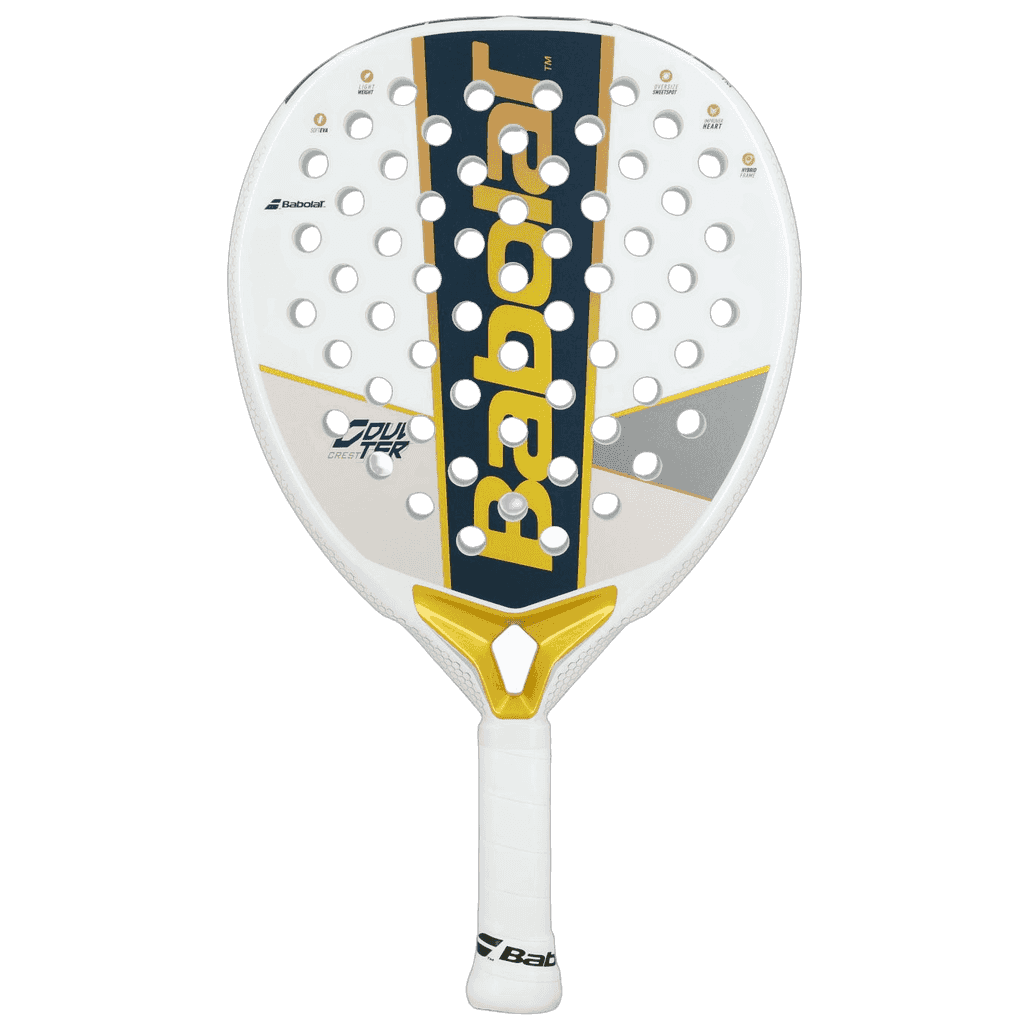
The Babolat Counter Crest 2026 is a forgiving counterattacking racket with an unusually easy response. It is built around comfort, quick handling, and help from the racket when the ball arrives awkwardly.
Its teardrop shape keeps the profile balanced rather than aggressively head-heavy. I see it fitting players who spend plenty of time defending from the baseline, then look to turn a neutral ball into a controlled attack.
The trade-off is clear: this is not a racket for players who want a hard, punishing hit on every overhead. Its strength is making padel feel less demanding in fast exchanges.
Technical analysis
Shape & balance
The teardrop format gives the Counter Crest a large, accessible hitting area without the slower handling of a more attack-focused diamond. The sweet spot feels generous, particularly on blocks and off-the-wall pickups where contact is rarely clean.
Its balance also feels easy to manage. I can get the racket into position quickly for a late volley, a defensive lob, or a reaction block at the net. Players coming from a head-heavy racket may initially miss the extra mass through the ball, especially when trying to finish points with a flat smash.
That maneuverability is one of its main assets. It does not ask me to force the swing; it rewards compact preparation and clean direction.
Materials & construction
The stated Soft EVA core defines the racket more than anything else. This is a soft feel racket with a noticeable trampoline effect, giving it very strong ball exit on slower swings. In practical terms, I do not need to overhit a defensive ball to send it deep.
That soft response is useful, but it has limits. On very fast volleys or when I really accelerate through a víbora, the contact is less crisp than it would be with a firmer EVA and carbon-focused face. I get comfort and rebound, not a dry, sharp impact.
Babolat does not specify the frame or face material in the available data, so I would not read a carbon-style, hard-contact character into this model. Its behavior points firmly toward easy output and forgiveness.
On-court feel
Baseline play
From the baseline, this is where I enjoy the Counter Crest most. The high ball exit helps when I am stretched wide or digging out a low ball after the glass. Defensive lobs come off the face with little effort, and I can find depth without needing a full swing.
It is also a comfortable racket for players whose defense relies on absorbing pace rather than striking through everything. Blocks stay controlled, while the soft core helps send the ball back with enough length to reset the point.
The downside is precision under pace. If I hit too loosely, the racket can add more rebound than I intended. Players with a very fast, aggressive swing may need a firmer face to feel more connected to placement.
At the net
Quick hands are another strong point. The manageable balance makes short volleys and reflex blocks easy to organize, and the broad sweet spot is helpful when contact lands toward the upper part of the face.
I would use it to construct pressure rather than simply blast through opponents. It works well for angled volleys, controlled drop shots, and a low chiquita that forces the opponent to lift the next ball. Heavy punch volleys are possible, but they do not carry the same dense, penetrating finish as a harder racket.
Bandeja and víbora
A controlled bandeja feels natural because the racket moves cleanly through the preparation and gives easy depth. I can keep the ball deep without overworking my shoulder.
The víbora is less of a weapon. There is enough help to direct it, but not the firmer response I want for a fast, biting ball that stays low after the glass.
Conclusion
I would choose the Counter Crest for a developing or intermediate player who values forgiveness, defensive support, and fast handling over raw finishing power. It makes difficult contacts easier and does not punish imperfect timing.
Its biggest trade-off is firmness. Players who hit with a very aggressive overhead game, rely on a decisive smash, or want maximum bite on the víbora may find the response too soft. For controlled counterplay, though, its comfort and ball exit make a lot of sense.
Switch Intelligence
Be the first to share where you switched from.
Community reviews
Real feedback from players who used this racket.
Add your review
To submit your review, log in first. You can still read all approved community reviews below.
Add review


