

Babolat Viper 3.0 2026 Juan Lebron
A hard, attack-minded diamond racket with crisp volleying and enough composure to keep the point from falling apart in defense.
Shape
Diamond
Weight
370 gr
Touch
Hard
Core
Black EVA
Faces
3K Carbon
Frame
Carbon fiber
What we like
- Strong volley ball exit
- Clean *bandeja* and *víbora*
- Stable, direct net response
What we don't
- Defense demands active footwork
- Not easy on late baseline
- Smash power not absolute



Updated on 15 Oct (shipping cost not calculated)


Updated on 26 Aug (shipping cost not calculated)
Are you a store owner? Join our platform to be featured here.
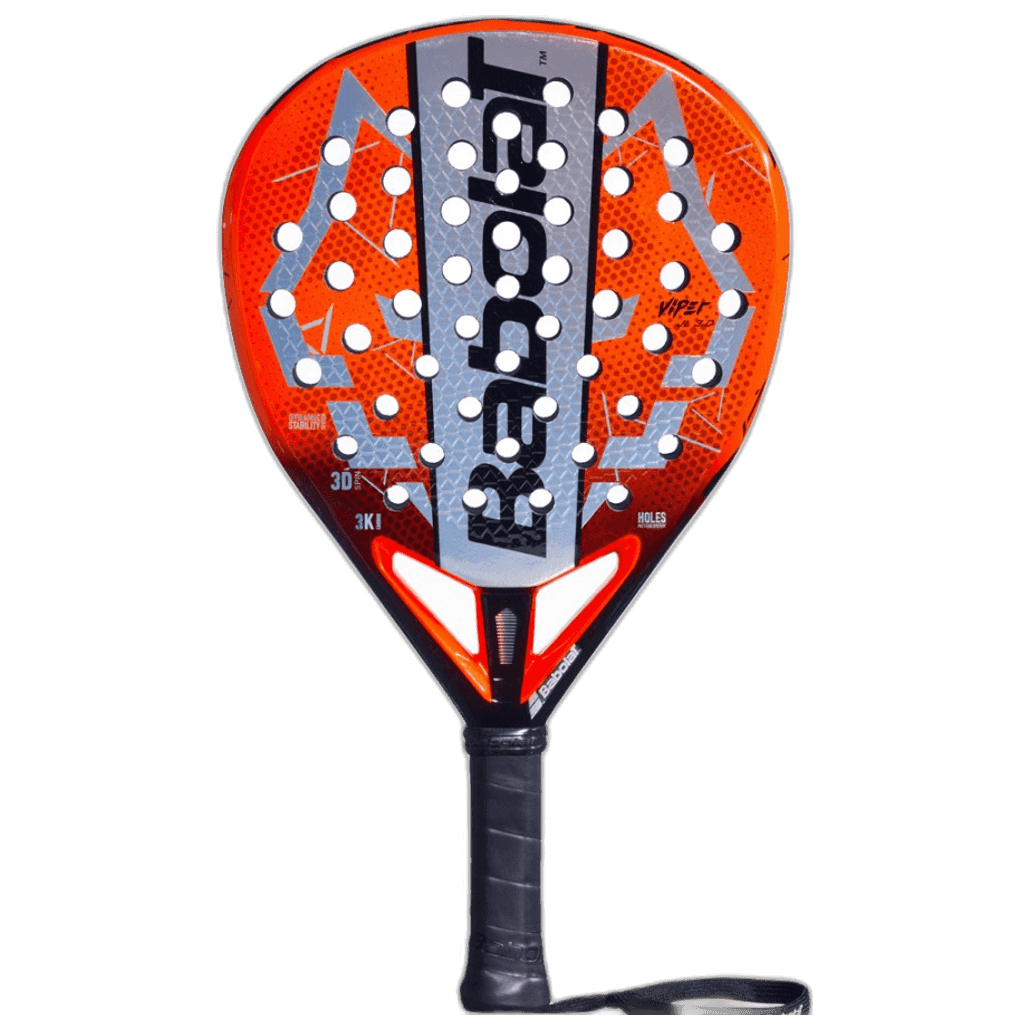
Babolat Viper 3.0 2026 Juan Lebrón is a hard, attacking racket with a very clear bias toward fast points and work above the head. It has the kind of personality I associate with aggressive net play first, survival in defense second.
The diamond shape and hard feel set the tone immediately. It’s not trying to be friendly. It’s trying to let me accelerate the ball cleanly, especially when I’m stepping into volleys, bandejas, and finishing balls.
Technical analysis
Shape & balance
The diamond shape pushes the balance upward and gives the racket a more attacking identity than all-round comfort. I feel that most in transition: once I’m set at the net, it responds well to a compact swing and rewards an assertive wrist. It wants the point to speed up.
That same setup also means this is not the easiest racket to manage when I’m late or stretched on the baseline. It asks for timing. If I’m lazy with preparation, the head-heavy feel shows up fast.
Materials & construction
The fiber carbon frame and 3K Carbon faces give it a firm, direct response. There’s little softness in the contact, and that helps when I want the ball to come off fast and with intent. The Black EVA core keeps the feel on the firmer side, but it doesn’t turn the racket into a brick.
What I notice most is that the construction gives me a clean response without a totally dead impact. It still has some touch for placement, but the priority is clearly ball acceleration and stability when I hit through the shot.
On-court feel
Baseline play
From the back, it’s workable but not effortless. Defensive lobs come out better when I stay active with my feet and use the racket face early. Blocks are solid if I keep the motion short. If I get rushed, though, the racket makes me earn every reset.
There’s enough control to keep the ball in play, but this is not the kind of frame that bails me out when I’m under constant pressure. It rewards clean technique more than passive defense.
At the net
This is where it feels most natural. Volleys have a strong ball exit and a crisp response, so I can keep pressure on opponents without over-swinging. It’s especially good when I’m closing the net and trying to keep the exchange sharp.
I also like how stable it feels on quick reactions. It does not get vague or mushy in fast hands battles. That said, it’s not a soft-touch racket, so finesse at the net takes a little more precision than with a more forgiving model.
Bandeja and víbora
In overhead construction, the racket gives me a nice mix of bite and direction. The bandeja comes out with enough depth to keep opponents pinned back, and the víbora has a sharp enough response to make the ball skid off the glass after contact.
It’s comfortable here because the hit feels clean and predictable. I don’t need to force the shot to get useful pace. What I do need is good technique, because the racket is more about efficient acceleration than easy free power.
Smash
On the smash, I can get heavy contact and good access to offensive depth, but I would not call this the most brutal racket for pure max-power finishing. It has plenty of pop, yet it feels more like a controlled attacker than an out-and-out cannon.
That actually suits the frame. It lets me finish points, but it doesn’t turn every overhead into a reckless all-or-nothing swing. If I’m looking for a more balanced attacking racket with serious net output, it makes sense. If I only care about absolute smash violence, I’d want more.
Conclusion
This is a racket for players who want an aggressive feel, strong net performance, and a clear bias toward taking control of the point. If I play often, attack the net, and like my overheads to feel direct and firm, I can get a lot out of it.
I would not hand it to a beginner and expect easy results. The demand level is real, especially in defense and when the rally gets messy. What I trade off for that attacking response is comfort in passive situations and a bit of margin on off-center contact.
What other reviewers say
- Padel Reviewes
The review portrays a hard-feeling, diamond-shaped racket that performs better at the net than in passive defense. It stands out in volleys and when accelerating the point, but it does not seem like the most brutal option for max-power smashes.
Switch Intelligence
Be the first to share where you switched from.
Community reviews
Real feedback from players who used this racket.
6 reviews


Add your review
To submit your review, log in first. You can still read all approved community reviews below.
Add review


