

Dunlop Titan 2.0 2024
A cushioned, forgiving tear shape that makes defense feel simpler, with easy length and a calmer response when contact drifts.
Our Take
Shape
Tear
Weight
360 - 375 gr
Touch
Medium
Core
Mega Flex Core
Faces
Fiberglass
Frame
100% graphite (wavy frame, 100% carbon insert in the bridge)
What we like
- Easy defensive lob depth
- Broad sweet spot on blocks
- Quick, cushioned net volleys
What we don't
- Limited bite on víboras
- Flat smashes lack punch
- Muted feel on drives
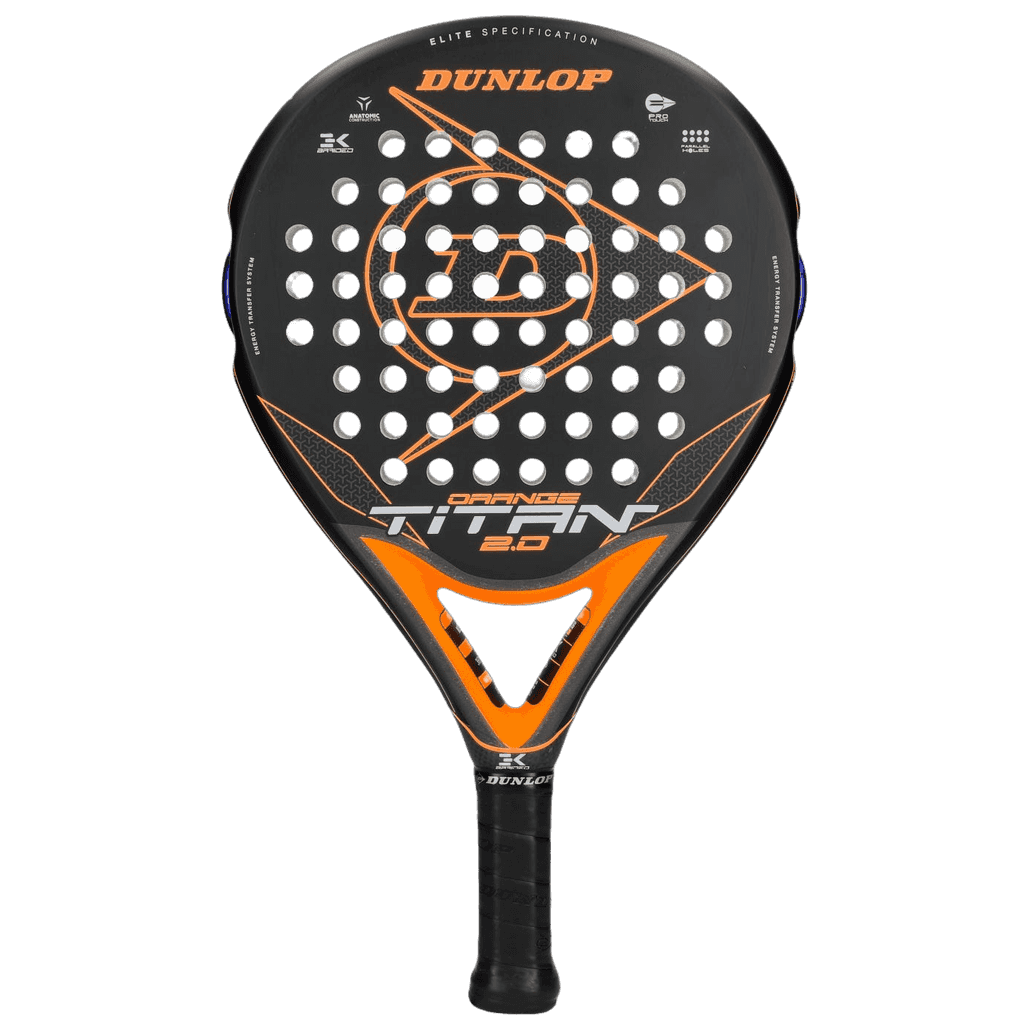
Dunlop Titan 2.0 2024 is a forgiving, comfort-first racket that favors clean depth and easy ball exit over outright aggression. I see it as a sensible option for the regular player who wants help from the baseline without carrying a sluggish racket at the net.
Its character is controlled rather than passive. The response is cushioned, the contact window is generous, and it stays manageable through quick exchanges. What it does not bring is the hard, explosive finish of a genuinely attacking model.
Technical analysis
Shape & balance
The tear shape gives the Titan 2.0 a middle-ground personality. There is enough mass toward the upper half to make volleys and overheads feel purposeful, but it does not behave like a head-heavy diamond racket that demands early preparation on every ball.
I found its forgiving nature to be the main story. The sweet spot is notably broad, so slightly late blocks, defensive lobs, and off-center contacts do not die in the frame. That makes a real difference during scrappy points, particularly when defending fast balls after the glass.
Materials & construction
A 100% graphite frame works with fiberglass faces and the Mega Flex Core to produce a medium feel with plenty of cushioning. The fiberglass is doing much of the work here: contact feels softer and less abrupt than on a stiff carbon-faced racket, with easy rebound even when the swing is compact.
The trade-off is a less direct hit. Players who like to feel the ball sit firmly on the faces before driving through it may find the Titan a little muted. The smooth surface also limits bite; it does not grab the ball particularly well for heavy-cut shots.
On-court feel
Baseline play
From the baseline, this is where I think the Titan 2.0 earns its place. Ball exit comes easily, so I do not need to force the swing to send a defensive lob deep. It is especially helpful when I am stretched wide, playing off the wall, or simply trying to reset the point with height and margin.
Blocks feel calm rather than lively in an unpredictable way. The racket absorbs pace well and gives enough rebound to return the ball with length. A low-driven lob is also accessible, although players who generate pace naturally may prefer a firmer face for more precise output.
At the net
At the net, the manageable balance keeps the racket quick through short volleys and reaction blocks. The softened response makes it comfortable for controlling the ball into the middle or dropping it short, rather than accidentally overhitting.
I would not expect it to dominate with punch alone. To make volleys penetrate, I need to accelerate cleanly and use placement. The Titan rewards a measured attacking game more than a flat, hit-through-everything approach.
Bandeja and víbora
The generous sweet spot is useful on a bandeja, particularly when contact drifts slightly away from the center. Depth is easy to find, and the racket does not punish an imperfect preparation as harshly as a harder model would.
A víbora is less convincing. It can be directed well enough, but the smooth fiberglass face does not provide much spin assistance. I can create cut with technique, yet the racket itself is not adding much grip.
Smash
The smash is adequate, not a weapon. It will finish a short ball with good mechanics, but flat smashes lack the hard, immediate punch available from stiffer carbon faces and a more attacking balance.
Conclusion
I would point regular intermediate players toward the Titan 2.0 if they value forgiveness, easy defensive depth, and a comfortable response in fast exchanges. It suits players building confidence at the net without wanting a demanding head-heavy racket.
The compromise is clear: less bite on spin, less authority on flat smashes, and a softer connection at impact. For control-oriented padel with reliable ball exit, those are reasonable sacrifices.
What other reviewers say
- PadelTestLaben
This test highlights notably easy ball exit and a broad sweet spot, particularly helpful for defence, lobs and bandejas struck slightly off-centre. It feels cushioned and controlled on volleys, but flat smashes and víboras give up punch and spin versus harder or rougher rackets.
- BestPadelen
The review positions it as a versatile racket with a comfortable touch and manageable balance, performing consistently in both defence and attack. Its ratings lean slightly more toward control than power, while clearly marking down spin from the smooth face.
Switch Intelligence
Be the first to share where you switched from.
Community reviews
Real feedback from players who used this racket.
Add your review
To submit your review, log in first. You can still read all approved community reviews below.
Add review


