

Enebe MX Turbo 12K Yellow 2027
A medium-hard diamond with serious punch and a demanding sweet spot that asks for committed contact on every ball.
Our Take
Shape
Diamond
Weight
350 - 365 gr
Touch
Medium-Hard
Core
Medium HR3 EVA
Faces
12K Carbon
Frame
Carbon
What we like
- Punchy volleys through the court
- Direct *bandeja* and *víbora* response
- Stable firm blocks at net
What we don't
- Small sweet spot punishes misses
- Demanding off-the-wall defensive lobs
- Touch shots need softer hands
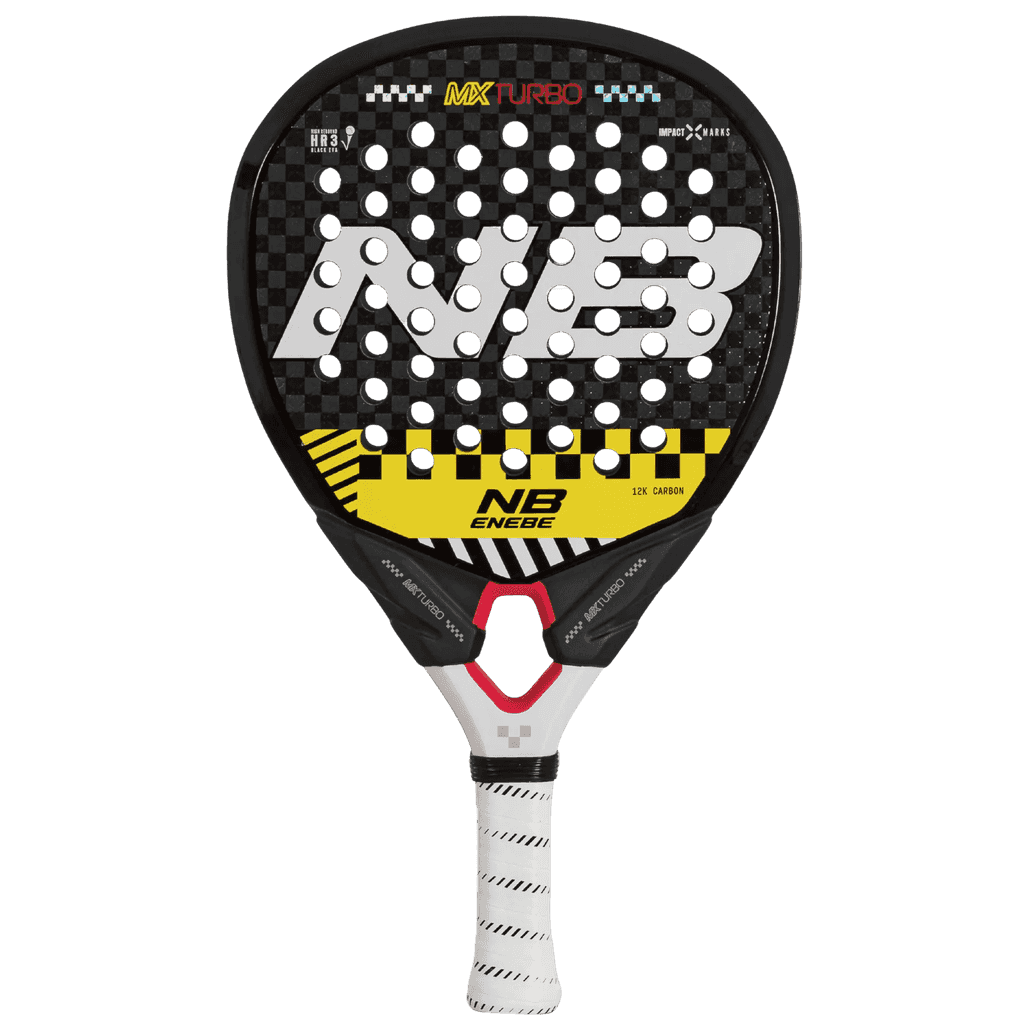
The Enebe MX Turbo 12K Yellow 2027 is built to finish points, not to make defensive padel feel easy. Its Diamond shape gives it a clear preference for players who take charge at the net and can generate their own racket speed.
I see it fitting an intermediate-advanced player with a confident overhead game. There is real punch available, but the smaller usable hitting area means lazy preparation gets exposed.
This is not a soft, automatic racket. The medium-hard feel rewards a committed swing and clean contact far more than it helps a player who relies on easy ball exit.
Technical analysis
Shape & balance
The diamond mold places the sweet spot higher in the face, which explains the racket’s high power ceiling and its more demanding nature in neutral exchanges. Even with a medium balance (255 mm), it feels designed for volleys hit in front of the body, aggressive overheads, and finishing opportunities rather than passive defending.
Maneuverability should remain respectable once the racket is moving, but it will not feel head-light during rushed reactions. In fast exchanges at the net, I would expect it to be more effective when I take the ball early than when I am late and just trying to get the racket in the way. The sweet spot is not especially generous, so contact toward the lower face will cost depth and direction.
Materials & construction
The 12K carbon faces, carbon frame, and HR3 Medium EVA core point toward a firm, direct response. I would expect a clean strike to feel stable rather than springy, with enough compression to avoid the harsh, board-like response some hard attacking rackets produce.
That material package should give the ball a solid exit when I accelerate through it, particularly on flat shots. It is less likely to provide much free help on slow defensive blocks. The face should reward players who shape the ball deliberately, but it will not mask poor timing or an open racket face.
On-court feel
Baseline play
From the baseline, I would use the MX Turbo 12K with intention rather than trying to absorb everything. It should work well for low-driven lobs and firm blocks when I meet the ball out in front, because the firmer construction favors a compact, positive contact.
Off-the-wall play is where the trade-off becomes clearer. The response should be predictable on centered contact, but the limited sweet spot leaves less margin when the ball comes awkwardly off the glass. Defensive lobs need good preparation and a full enough swing; this is not the racket I would choose for simply flicking the ball back under pressure.
At the net
At the net, the racket’s character makes sense. Punch volleys should carry good weight, and the diamond mold helps me drive the ball through the court instead of merely placing it. The firmer face also suits aggressive blocks against hard volleys, provided I keep the racket stable.
Touch shots are less natural. A chiquita or short drop volley will require softer hands than with a softer, more forgiving racket. I would not call it clumsy, but its default response is penetration, not delicate cushioning.
Bandeja and víbora
The overhead game is its strongest territory. A bandeja should come through with a direct, firm trajectory, while the racket has enough structure for an attacking víbora without feeling unstable through the swing. The high sweet spot helps when I contact above shoulder height and want to keep pressure on the opposing pair.
On the smash, the power is there, but it needs technique. Players with a developed overhead motion can make use of the racket’s leverage; players who rely on the racket to create easy power may find it demanding.
Conclusion
I would choose the MX Turbo 12K Yellow 2027 for an attacking player who already feels comfortable taking the net and accelerating through overheads. It has the materials and shape to reward a decisive game, especially on volleys, víboras, and smashes.
The trade-off is forgiveness. Defensive scrambling, off-center contact, and touch-heavy play are not its natural strengths. If I wanted a softer response or a larger margin from the baseline, I would look elsewhere.
Switch Intelligence
Be the first to share where you switched from.
Community reviews
Real feedback from players who used this racket.
Add your review
To submit your review, log in first. You can still read all approved community reviews below.
Add review


