

Enebe Phoenix Attack 16K Blue 2027
A medium-hard teardrop built to finish with pace, yet composed enough at the baseline to drive heavy balls without feeling unwieldy.
Our Take
Shape
Tear
Weight
350 - 365 gr
Touch
Medium-Hard
Core
Medium HR3 EVA
Faces
16K Carbon
Frame
Carbon
What we like
- Penetrating volleys taken early
- Directional control on the *bandeja*
- Solid smash power transfer
What we don't
- Rushed defensive blocks are demanding
- Sweet spot is fairly narrow
- Limited easy ball exit
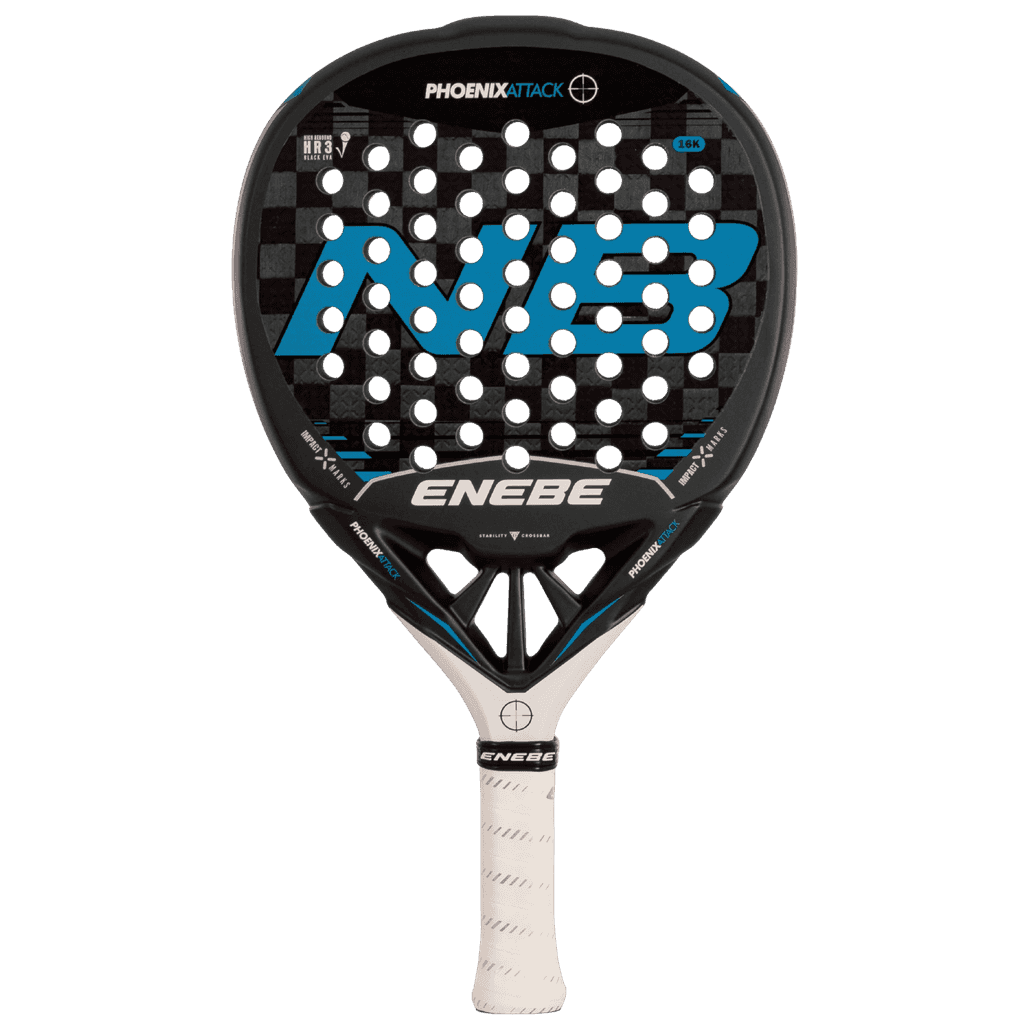
The Enebe Phoenix Attack 16K Blue 2027 is an attacking racket with a fairly disciplined side to it. It wants me to take charge at the net and finish overheads, but the tear shape keeps it from feeling as demanding as a full diamond.
I see it fitting an intermediate-to-advanced player who creates pace rather than waiting for the racket to do all the work. The response is firm, direct, and built around purposeful swings.
It is not a soft, forgiving defensive racket. Players who rely on easy ball exit from awkward positions may find it a little less helpful than its attacking name suggests.
Technical analysis
Shape & balance
The tear format puts the sweet spot above center without pushing it as far toward the tip as an aggressive diamond. That gives the Phoenix Attack a useful compromise: enough leverage for a heavy volley and smash, while still allowing me to get the racket into position quickly in fast exchanges.
Its balance is medium, so it never feels head-heavy, yet the racket still leans toward attack. I would expect it to suit players who like to press forward after the return and keep the opponents under pressure. The trade-off is clear on rushed defensive blocks: the upper part of the frame needs clean contact, and off-center shots will not be rescued as easily as they would be with a round control racket.
Materials & construction
The carbon frame, 16K carbon faces, and HR3 EVA Medium core point to a compact, firmer build. The listed medium-hard feel makes sense for this specification: there should be enough firmness to drive the ball through the court, but not the hard, dead sensation some power rackets produce at low speed.
I would expect a fairly measured ball exit rather than a springy rebound. That helps when I want to flatten a víbora or hold a volley low, but it also means the racket asks for acceleration on slower balls. The sweet spot is not especially broad on paper, so clean preparation matters.
On-court feel
Baseline play
From the baseline, I would use this racket to build toward attack rather than simply absorb pressure. The firmer face should reward a low-driven lob and a deeper defensive lob when I can step into the ball. Off-the-wall play will likely feel precise once the contact is centered, with less trampoline effect than softer EVA setups.
That same character can be demanding late in the point. If I am stretched wide or defending body shots, I would need a stable wrist and a committed block. It is not the sort of racket that turns a lazy defensive swing into effortless depth.
At the net
This is where the Phoenix Attack should make most sense. The tear profile and carbon faces favor penetrating volleys, especially when I am taking the ball early and directing it through the middle. It should feel quick enough for hand battles, while staying stable enough to stop the ball from floating.
Touch shots are more technical. A drop shot or chiquita will need softer hands than with a flexible fiberglass face; the racket is likely more comfortable punching the ball than cushioning it.
Bandeja and víbora
The medium-hard response should work well for an aggressive bandeja and a flatter víbora. I would expect good directional control when cutting through the ball, with enough firmness to keep the shot deep rather than leaving it short in the service box.
For the smash, the attack-focused layout should provide solid transfer when the swing is complete. It will reward timing and technique, but it is not likely to supply easy power on poorly struck overheads.
Conclusion
The Phoenix Attack 16K Blue suits players who want an assertive racket for volleys, overheads, and taking control of the net. Its construction suggests a direct response with more precision than rebound.
The price of that attacking character is forgiveness. Defensive players looking for a large sweet spot, soft touch, and easy ball exit should look elsewhere. I would choose it for an active, forward-moving game—not for passive defense or delicate touch-first padel.
Switch Intelligence
Be the first to share where you switched from.
Community reviews
Real feedback from players who used this racket.
Add your review
To submit your review, log in first. You can still read all approved community reviews below.
Add review


