

Star Vie Eternal 2027 Sanyo Gutierrez
An attacking tear shape with a firm, composed response, built to finish overheads while keeping enough touch for the baseline.
Our Take
From CA$380 at 2 stores
Updated on 18 Nov


Updated on 18 Nov (shipping cost not calculated)


Are you a store owner? Join our platform to be featured here.
Shape
Tear
Weight
350 - 370 gr
Touch
Medium
Core
M-Eva Balance
Faces
18K Carbon Hybrid
What we like
- Penetrating *víbora* and *bandeja*
- Purposeful overhead acceleration
- Stable, weighted punch volleys
What we don't
- Modest sweet spot on mishits
- Demanding late defensive blocks
- Limited passive rebound and depth
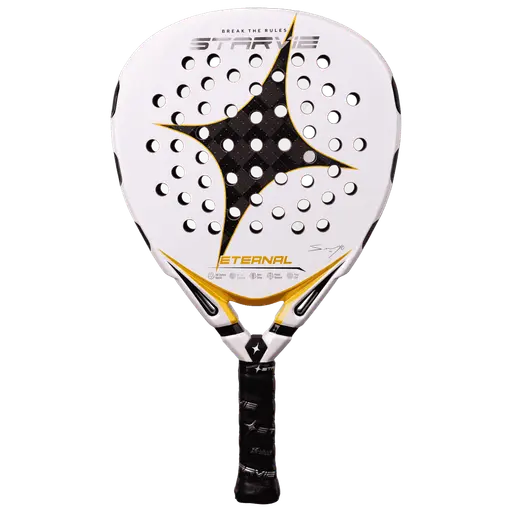
The Star Vie Eternal 2027 Sanyo Gutierrez is an attacking tear-shaped racket with a more measured response than its power rating suggests. It wants to finish points, but it does not feel like a one-dimensional cannon.
I see it suiting an advanced player who builds pressure with volleys, overheads, and deep aggressive balls rather than relying on easy ball exit from the baseline. The medium feel keeps it connected to the ball, though the sweet spot is not especially generous.
Technical analysis
Shape & balance
The tear shape gives this racket a useful middle ground between a round control model and a full diamond attacker. There is enough mass toward the upper half to make overhead shots feel purposeful, yet it should remain quicker through the air than a very head-heavy power racket.
That said, this is not a racket that does all the work for you. Its listed sweet spot is relatively modest, and I would expect mishits high on the face or toward the outside edge to lose pace and direction. Clean preparation matters, especially when defending fast balls into the body.
Materials & construction
Star Vie uses 18K Carbon Hybrid on the faces and an M-Eva Balance core. On paper, that pairing points toward a firm, controlled impact rather than a soft, springy response. The carbon face should give the ball a crisp release when I accelerate through it, while the core should stop the racket from becoming overly dry.
The trade-off is rebound. This is not the sort of racket I would choose for passive defense or for simply placing the face behind the ball and expecting depth. It should reward an active swing much more than a compact, low-effort block.
On-court feel
Baseline play
From the baseline, I would use the Eternal to drive the ball with intention and look for controlled depth after the glass. The medium response should help with low-driven lobs and firmer defensive shots because the contact is likely to feel defined rather than vague.
But it will ask more of me on late defensive contacts. Players who rely on easy ball exit for high lobs, stretched forehands, and reactive blocks may find it less forgiving than a softer round racket. The sweet spot and rebound figures point in that direction.
At the net
At the net, this looks far more natural. The tear profile should give volleys enough weight to push opponents back without making quick exchanges feel sluggish. I would expect the face to feel stable on punch volleys, particularly when closing the racket face and sending the ball down through the middle.
Touch shots need a deliberate hand. A drop shot or chiquita should be available, but the firmer carbon construction is unlikely to provide the soft, cushioned feedback some players prefer for deadening the ball.
Bandeja and víbora
This is where the Eternal’s identity makes sense. The shape and attacking orientation should help me accelerate through a bandeja or víbora without the racket feeling unwieldy. There should be enough firmness in the face to keep the ball penetrating after the bounce.
A full smash is also clearly in its wheelhouse, but technique remains central. The racket has the potential to transfer pace well; it is not likely to rescue a poorly timed overhead.
Conclusion
I would look at the Eternal 2027 Sanyo Gutierrez if my game is built around taking the net, pressing with volleys, and using overheads to control the point. It has an assertive profile without going all the way into demanding diamond-racket territory.
The compromise is comfort under pressure. Defensive players wanting a broad sweet spot, soft touch, and easy rebound will probably work harder with this racket. For a player who swings cleanly and prefers a firmer, more direct response, that trade-off makes sense.
Switch Intelligence
Be the first to share where you switched from.
Community reviews
Real feedback from players who used this racket.
Add your review
To submit your review, log in first. You can still read all approved community reviews below.
Add review


