

Bullpadel Icon 2027 Juan Martin Diaz
A diamond-frame attacker with a firm, composed response, built to finish overheads while keeping enough touch for the baseline.
Our Take
Recommended retail price €275 From €250 at 2 stores
Updated on 18 Nov



Updated on 18 Nov (shipping cost not calculated)





Are you a store owner? Join our platform to be featured here.
Shape
Diamond
Weight
365 - 375 gr
Touch
Medium
Core
MultiEVA
Faces
X-Tend Carbon 12K
Frame
Carbon
What we like
- Penetrating volleys through the middle
- Crisp flat smash response
- Predictable off-the-wall control
What we don't
- Reduced forgiveness on edge contacts
- Demands acceleration under baseline pressure
- Slower in quick hand exchanges
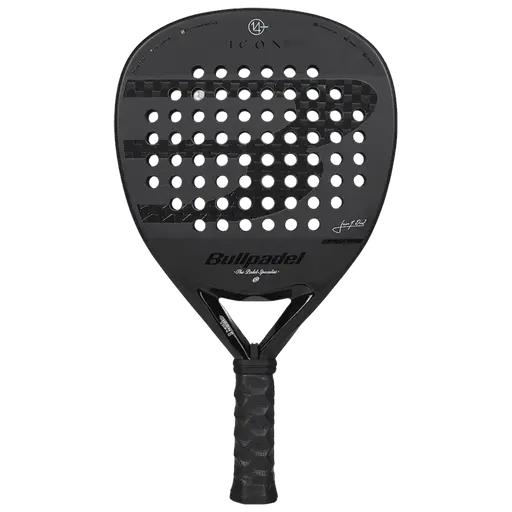
Bullpadel Icon 2027 Juan Martin Diaz is an attacking diamond racket with a more measured response than its shape suggests. It wants to play forward and finish points, but it does not feel like a pure cannon that gives up all sense of placement.
I see it fitting an intermediate-to-advanced player who builds points patiently, then looks to take over at the net. The diamond profile, medium feel, and firm carbon faces give it a clear offensive lean without making every defensive ball feel like hard work.
Technical analysis
Shape & balance
The diamond shape puts the sweet spot slightly higher than on a round or teardrop racket. That is useful when I am hitting overheads with a full swing, especially on aggressive bandejas, víboras, and flat smashes. The racket rewards clean contact; catch the ball too low or too far toward the frame, and the response loses some of its clarity.
Its balance feels oriented toward the head, though not to the point of becoming slow and clumsy. There is enough mass through the ball to make volleys travel with authority, but quick hand exchanges demand good preparation. I would not choose it for a player who relies on a very head-light racket to react late at the net.
Materials & construction
Bullpadel uses a Carbon frame, X-Tend Carbon 12K faces, and a MultiEVA core. That combination points toward a fairly direct strike: firmer than fiberglass, but without the harsh, ultra-dry sensation of a hard EVA setup.
The MultiEVA core helps temper the 12K face. On slower defensive shots, I get enough ball exit to lift a lob or send a controlled ball deep from the back wall. Still, this is not a soft, trampoline-like racket. It asks me to provide some of the acceleration, particularly when I am under pressure at the baseline.
On-court feel
Baseline play
From the baseline, the Icon is more capable than its aggressive silhouette first suggests. Blocks stay stable, and I can guide a low-driven lob with decent confidence if I meet the ball in front. The medium response also makes off-the-wall play more predictable than on a very hard power racket.
Its limitation is forgiveness. The sweet spot is not especially broad, so defensive contacts near the edge of the face do not get much help. Players with compact mechanics will manage it; players who often defend late and off-balance may find a rounder racket easier to live with.
At the net
This is where the racket makes most sense. Volleys come off the face with a solid, penetrating trajectory, and the frame feels stable when blocking fast balls at shoulder height. I particularly liked the way it lets me press a volley through the middle without needing a huge swing.
Touch shots require restraint. A chiquita or soft drop shot can sit up if I let the firm face do too much of the work. The racket prefers purposeful contact over delicate, last-second manipulation.
Smash
The Icon has the structure to reward a committed smash. When I accelerate properly, the head-biased setup helps transfer energy into the ball, and the 12K carbon gives the strike a crisp finish. It is more convincing on flat power and aggressive overheads than on improvised, low-contact smashes.
Conclusion
I would buy this racket for an attacking player who wants to control the net, hit a heavy volley, and use overheads to keep opponents pinned back. It has enough usable control to avoid feeling one-dimensional.
The trade-off is clear: it is not the easiest defensive racket, and it will not flatter inconsistent contact. If your game depends on effortless ball exit, a huge sweet spot, or very fast handling in chaotic exchanges, this is probably not the right frame.
Switch Intelligence
Be the first to share where you switched from.
Community reviews
Real feedback from players who used this racket.
Add your review
To submit your review, log in first. You can still read all approved community reviews below.
Add review


