

Star Vie Triton Power 2027 Plus
A hard-hitting diamond that brings real authority overhead, yet keeps enough precision to work the point from the baseline.
Shape
Diamond
Weight
350 - 366 gr
Touch
Hard
Core
H-EVA Power
Faces
18K Carbon Hybrid
What we like
- Precise directional control from baseline
- Heavy, penetrating net volleys
- Stable *bandeja* and biting *víbora*
What we don't
- Demanding defensive ball exit
- Higher balance slows reaction blocks
- Hard feel punishes late contact
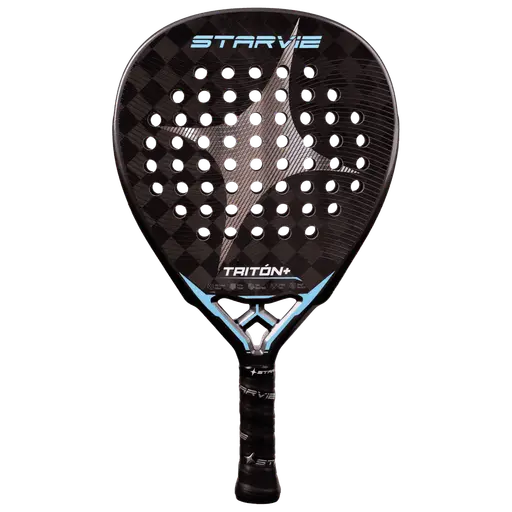
The Star Vie Triton Power 2027 Plus is a demanding attacking racket with far more precision than its diamond profile first suggests. It wants an assertive swing, especially above the shoulder, and it rewards players who can generate their own pace.
I see it in the hands of an advanced player who builds points patiently from the baseline but wants to take over once the ball sits up. It is not a forgiving, easy-exit racket for passive defense.
Technical analysis
Shape & balance
The diamond shape places the sweet spot higher than a round control racket, and the balance naturally favors overhead play. That gives the Triton Power Plus a purposeful, slightly head-heavy sensation: the racket carries through the ball well, but it does not disappear in the hand during quick exchanges.
Its listed sweet spot is reasonably generous for this shape, which matters. I would not call it broad enough to rescue late contact, but clean strikes feel stable rather than twitchy. Players with compact preparation can still place volleys and low-driven lobs accurately; those who arrive late will notice the head wanting to keep moving.
Maneuverability is the compromise. Fast hand battles at the net require a firm grip and early racket preparation. If you prefer a head-light racket that you can flick around on reflex, this is not that kind of tool.
Materials & construction
The 18K Carbon Hybrid faces and H-EVA Power core point toward a firm, direct build. The overall hard feel is clear in the response: there is little of the cushioned, trampoline-like ball exit that softer rackets provide. I can feel the ball on the face long enough to direct it, but the racket expects me to supply the acceleration.
That construction suits players who like a crisp impact and a predictable response under pressure. Blocks stay compact and controlled when the face is set properly. On the other hand, slow defensive contacts do not get much free help. A lazy block from deep can die short unless I push through it.
On-court feel
Baseline play
From the baseline, the Triton Power Plus is more controlled than its name implies. The firm faces give a clean line on defensive lobs, chiquitas, and off-the-wall balls when I strike in front. Its response is not overly springy, so depth comes from timing and technique rather than from simply putting the racket behind the ball.
That is also where the limitation appears. In stretched defense, especially when I am late after the glass, the hard feel is less accommodating than a softer core. It will not manufacture an easy reset for a player who relies on ball exit.
At the net
At the net, the racket makes sense quickly. Volleys come off with a heavy, penetrating trajectory, and the face remains composed when I want to press the ball through the middle rather than overhit it. There is enough control to play a short drop shot, although the firm touch demands soft hands.
Quick reaction blocks are possible, but they are not effortless. Against fast exchanges, I need to prepare the face early; otherwise the higher balance can make the racket feel a fraction late.
Bandeja and víbora
This is one of its strongest areas. The diamond profile and hard response let me accelerate a bandeja without the racket feeling unstable, while the face gives enough bite to shape a víbora toward the fence or into the body. It encourages an aggressive overhead game without turning every ball into an all-or-nothing smash.
Conclusion
I would choose the Triton Power 2027 Plus if I already have reliable technique and want a hard, attack-minded racket that still offers real directional control. It suits players who enjoy taking the net, using heavy volleys, and finishing points with purposeful overheads.
The trade-off is comfort. It asks more in defense, feels less agile in frantic net exchanges, and does not provide much free ball exit. Players wanting a softer response or easier help from the back of the court should look elsewhere.
Switch Intelligence
Be the first to share where you switched from.
Community reviews
Real feedback from players who used this racket.
Add your review
To submit your review, log in first. You can still read all approved community reviews below.
Add review


