

Star Vie Triton T-One 2027 Tamara Icardo
A versatile diamond that can finish points with authority, yet composed enough at the baseline to keep defensive lobs and blocks under control.
Our Take
Recommended retail price €310 From €236 at 2 stores
Updated on 18 Nov


Updated on 18 Nov (shipping cost not calculated)

Are you a store owner? Join our platform to be featured here.
Shape
Diamond
Weight
347 - 366 gr
Touch
Medium
Core
M-Eva Balance
Faces
18K Carbon Hybrid
Frame
Carbon
What we like
- Penetrating firm net volleys
- Direct aggressive víbora trajectory
- Controlled medium ball exit
What we don't
- Less forgiving sweet spot than round shapes
- Demanding late baseline defense
- Passive touch shots need precision
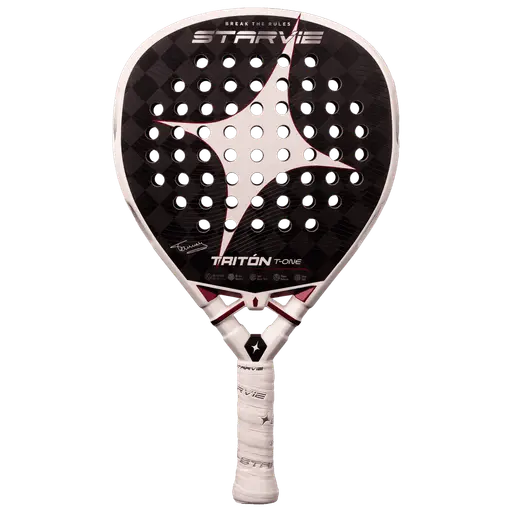
Star Vie Triton T-One 2027 Tamara Icardo is the signature women's racket of Tamara Icardo. It is a Diamond racket for versatile play with an attacking edge: it rewards decisive overheads, heavy volleys, and a player who is comfortable taking charge of the point.
I found its medium feel more controlled than harsh, but this is not a forgiving, easygoing diamond. The sweet spot is not especially generous, so clean preparation matters.
It suits an advanced female player who generates her own pace and spends plenty of time pressing at the net. Defensive players who rely on effortless ball exit may find it more demanding.
Technical analysis
Shape & balance
The diamond shape puts the useful hitting area higher in the face and gives the racket its attacking posture. The balance feels geared toward acceleration through the ball rather than quick, wristy corrections, although its maneuverability is still respectable for this category.
That balance helps on aggressive volleys and overheads because the head carries through contact well. The trade-off appears when the ball arrives late at the baseline: off-center blocks can feel less stable than the frame suggests, and I would not expect much help from a relaxed swing.
Materials & construction
The Carbon frame gives the structure a firm, connected response, while the 18K Carbon Hybrid faces should provide a crisp contact without pushing the racket into a hard, board-like feel. There is enough firmness here to direct the ball accurately, especially when flattening a volley or driving a low ball through the middle.
The M-Eva Balance core tempers that carbon construction. Ball exit is present, but it does not feel overly springy. I like that for controlling pace at the net and for keeping bandejas low; players looking for a soft racket that lifts defensive lobs with minimal effort will need to supply more through the stroke.
On-court feel
Baseline play
From the baseline, the Triton T-One asks for active footwork. When I set early, it gives me a clean, medium response for deep returns and low-driven lobs. The face feels precise enough to change direction off the wall without the ball jumping unpredictably.
Late defense is the weaker area. The less generous sweet spot means mishits lose depth more quickly, and the diamond profile is less comfortable for emergency blocks than a round or lower-balanced racket. It can defend well, but it does not defend for me.
At the net
This is where its personality makes sense. Firm volleys come off with good penetration, and the racket feels stable when I block a hard ball rather than trying to over-swing. It also has enough maneuverability to handle quick exchanges, though not the whippy, head-light speed some players prefer in hand battles.
Touch shots need a softer hand. Drop volleys and a short chiquita are possible, but the firm carbon face rewards a deliberate release rather than a loose, passive touch.
Bandeja and víbora
The medium balance helps me keep the racket moving through an aggressive bandeja and gives the víbora a convincing, direct trajectory. I can accelerate without feeling that the head stalls before contact.
It is less suited to players who use overheads mainly to reset the point. This racket encourages pressure and depth; it is not especially subtle when I want to slow everything down.
Conclusion
I would choose this racket for an advanced, versatile female player who builds points to finish at the net and has reliable overhead mechanics. Its strongest moments are firm volleys, aggressive víboras, and smashes hit with full commitment.
The compromise is clear: the sweet spot is less forgiving, and baseline defense demands cleaner timing than more control-oriented shapes. Players wanting easy ball exit or a softer, more forgiving response should look elsewhere.
Switch Intelligence
Be the first to share where you switched from.
Community reviews
Real feedback from players who used this racket.
Add your review
To submit your review, log in first. You can still read all approved community reviews below.
Add review


