

Star Vie Triton Balance 2027 Plus
A composed diamond with firm finishing weight at the net, keeping its attacking intent without making every exchange feel frantic.
Our Take
Shape
Diamond
Weight
360 - 370 gr
Touch
Medium-Hard
Core
M-Eva Balance
Faces
18K Carbon Hybrid
What we like
- Heavy, controlled early volleys
- Stable blocks against hard pace
- Strong smash punch and placement
What we don't
- High, compact sweet spot
- Slow balls need acceleration
- Demanding defense on low balls
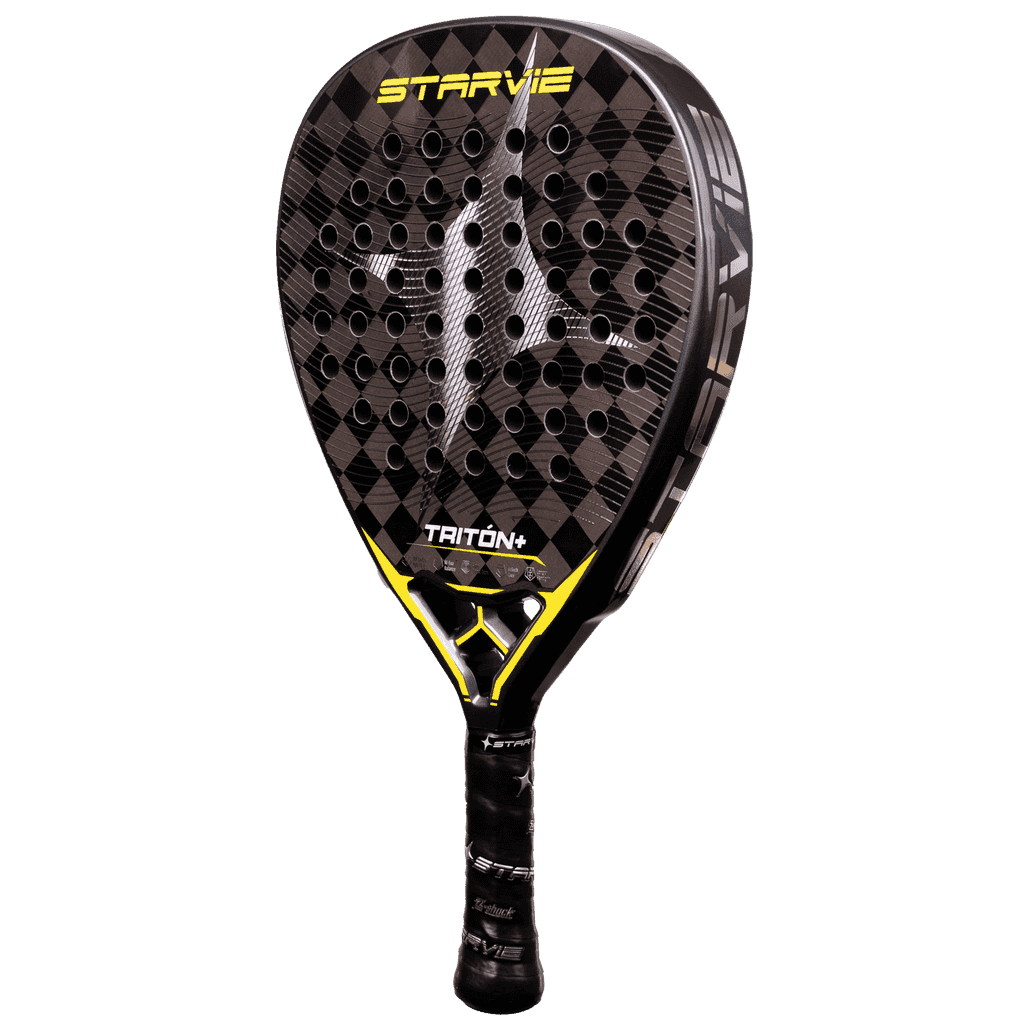
Star Vie Triton Balance 2027 Plus is an attacking racket that stops short of becoming a pure sledgehammer. It still wants me moving forward and taking the ball early, but it is less punishing than the Triton Power+ when contact is not completely clean. Star Vie markets it as a versatile racket, but on court it plays as an attacking one.
Its Diamond shape, medium balance, and Medium-Hard response put it firmly in the hands of an advanced player who builds points to finish at the net. I would not call it an easy defensive racket, though.
Technical analysis
Shape & balance
The diamond mold places the sweet spot high, which explains much of its personality. When I meet the ball in front and above the net line, the racket feels stable and forceful. On overheads and aggressive volleys, it carries the ball well without the overly abrupt response I associate with more demanding power models.
That balance is more manageable than the Power+ version, but it is not head-light. Late preparation still shows up in the shot. Contact near the upper edge or toward the frame loses precision quickly, so this is not the racket I would choose for casual, improvised defense.
Materials & construction
The 18K Carbon Hybrid faces give the strike a firm, compact character. There is a solid impact on hard volleys and smashes, with enough dwell time to direct the ball rather than simply launch it. Against pace, the racket holds its line well; blocking a hard volley does not make the face twist or flutter.
Underneath, the M-Eva Balance core keeps the response controlled rather than harsh. Ball exit is moderate, not automatic. I need to accelerate through slow balls to create depth, particularly from below net height. That trade-off is clear: the racket rewards an active swing, but it does not rescue short preparation.
On-court feel
Baseline play
From the baseline, I found the Triton Balance Plus more usable than its aggressive profile suggests, provided I stay organized. Firm blocks and low-driven lobs come off cleanly when I get behind the ball. It also has enough stability to redirect pace after the glass.
Still, defensive lobs hit late or with a compact swing can fall short. Low balls do not get free lift, and off-the-wall play demands good footwork because the high, relatively compact sweet spot is not especially forgiving.
At the net
This is where the racket makes the most sense. Quick volleys feel heavy and controlled, particularly when I take the ball early and use the face to press through the middle. There is enough maneuverability for fast exchanges, although I would not describe it as lightning-fast in the hand.
The solid response also helps on countervolleys. I can absorb a hard ball, keep the racket stable, and send it back with purpose rather than merely surviving the exchange.
Bandeja and víbora
The rough face gives noticeable bite on the first bandeja and víbora. I can shape the ball well, especially when looking for a lower trajectory toward the side wall. The racket does not generate spin by itself, but the surface gives good feedback when I brush properly.
Smash
A clean smash is the Triton Balance Plus’s strongest shot. It produces convincing punch without needing the all-out swing demanded by harsher, more head-heavy diamonds. Flat finishes and controlled power smashes both feel dependable.
Conclusion
I would put this racket in the hands of an attacking advanced player who already has reliable overhead technique and wants a firmer racket for volleys, spin shots, and smashes. It is the more approachable choice for players who liked the Triton Power+ concept but found that model too demanding.
The compromise is defense. The sweet spot is high and not especially broad, ball exit is restrained on slow swings, and low contact needs proper mechanics. Players wanting easy depth from the baseline or a more forgiving response around the frame should look elsewhere.
What other reviewers say
- PadelTestLaben
This test rates it as an attacking diamond with convincing punch on smashes, quick volleys and spin shots, while offering more leeway on less-than-perfect contact than the Triton Power+. The compromise is defensive demand: slow balls and low contact do not get free depth, and the high sweet spot punishes off-centre hits.
- PadelVerdicten
The review describes firm, heavy output on smashes and volleys, with good stability against pace and a less harsh response than the Power+. Its more manageable balance helps place bandejas and recover rushed defensive balls, but it remains a diamond whose limited sweet spot penalises contact near the frame.
Switch Intelligence
Be the first to share where you switched from.
Community reviews
Real feedback from players who used this racket.
Add your review
To submit your review, log in first. You can still read all approved community reviews below.
Add review


