

Enebe Mercury Attack 12K Grey 2027
A tear-shaped attacker with a composed medium touch, built to drive the point forward without losing its head from the baseline.
Our Take
Shape
Tear
Weight
350 - 365 gr
Touch
Medium
Core
Medium HR3 EVA
Faces
12K Carbon
Frame
Carbon
What we like
- Firm volleys pin opponents back
- Controlled *bandeja* and penetrating *víbora*
- Stable blocks and off-the-wall play
What we don't
- Demands committed swings for depth
- Less forgiving on late contacts
- Limited plush touch on drops
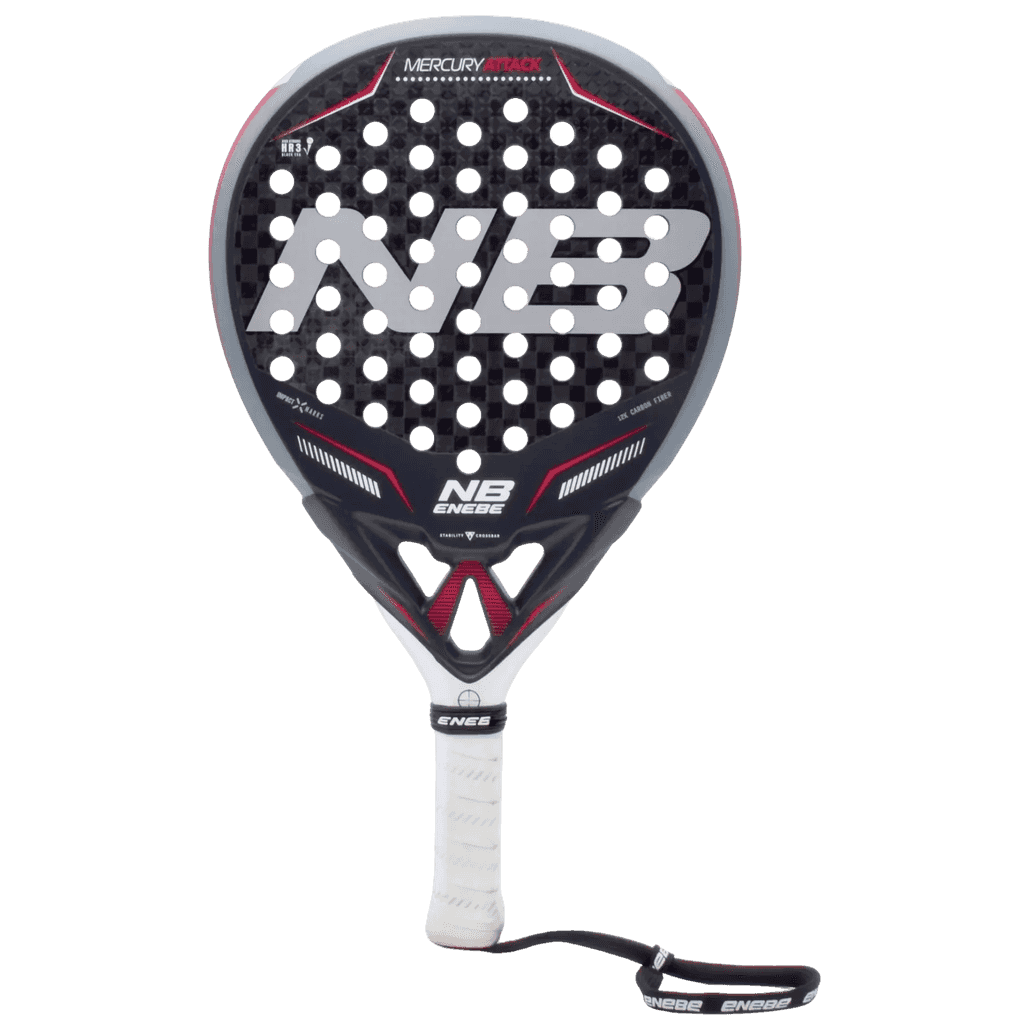
Enebe Mercury Attack 12K Grey 2027 is an attacking racket with more control built into it than its name suggests. I’d expect it to reward an assertive player who wants to press at the net, hit through the ball, and still place a defensive lob without feeling like the racket is fighting them.
The tear shape gives it a middle ground between a pure power-focused diamond and a more forgiving round racket. Its character is direct rather than soft, but it should not feel excessively demanding in normal exchanges.
Technical analysis
Shape & balance
The tear profile puts the sweet spot higher than a round racket, though not so high that every contact outside the center becomes a problem. That matters for players who build points from the baseline and then look to take over with volleys, bandejas, and overheads.
I see this as a racket for players who create their own pace. The balance should provide useful momentum through the ball, especially on attacking volleys and overhead shots, without becoming excessively head-heavy in quick exchanges. Still, it will not have the whippy, effortless handling of a low-balance control racket. Fast hand battles close to the net may require cleaner preparation.
Materials & construction
The carbon frame, 12K carbon faces, and HR3 Medium EVA core point toward a stable, firmer response without crossing into a hard, board-like feel. The stated medium feel is important here: it should give enough compression to manage depth and touch while retaining the direct feedback that stronger players often want.
That construction should favor a controlled ball exit rather than a trampoline effect. I would expect the racket to respond best when I hit with a committed swing. On slower defensive contacts, it may not give away as much free depth as a softer fiberglass-faced model. The payoff is a more predictable response when I want to flatten a volley or drive a ball through the middle.
On-court feel
Baseline play
From the baseline, I’d use the Mercury Attack as a racket to reset with intent rather than simply absorb pressure. Blocks and off-the-wall shots should feel stable, while the medium core ought to help keep low-driven lobs from flying long.
Its limitation is forgiveness. A player who regularly contacts the ball late or relies on the racket to generate easy rebound will likely find a softer, rounder option more comfortable. This one asks for the face to be set properly and the ball to be struck with purpose.
At the net
At the net, the balance and carbon faces should make sense quickly. I’d expect firm volleys with enough weight behind them to keep opponents pinned back, particularly when punching through the center or attacking the feet. The racket’s maneuverability should also be sufficient for blocks and compact countervolleys.
Touch shots are not likely to be its main party trick. A chiquita or drop shot can work, but I would not choose this racket for a highly muted, absorbent touch. The response should be clearer and more connected than plush.
Bandeja and víbora
This is where the tear shape looks well judged. There should be enough head presence to make a víbora penetrate, while the medium response ought to keep a bandeja controlled rather than overly springy. Players who like to vary pace and direction on overheads should get more from it than players who only chase a flat smash.
Conclusion
I’d look at the Mercury Attack 12K Grey 2027 as a serious option for an intermediate-to-advanced player with an attacking mindset but no interest in an unforgiving diamond racket. It should suit someone who values firm volleys, controlled overheads, and a clean response under pressure.
The trade-off is clear: it is unlikely to be the easiest racket for passive defense or ultra-soft touch. Give it active hands and a confident swing, though, and its mix of power, control, and usable maneuverability makes sense.
Switch Intelligence
Be the first to share where you switched from.
Community reviews
Real feedback from players who used this racket.
Add your review
To submit your review, log in first. You can still read all approved community reviews below.
Add review


