

Head Extreme Motion 2027
A quick, medium-hard diamond with real punch when you accelerate, fast handling at the net, and a demanding sweet spot.
Our Take
Shape
Diamond
Weight
355 - 365 gr
Touch
Medium-Hard
Core
Power Foam
Faces
unidirectional carbon fiber
What we like
- Quick handling in net exchanges
- Direct, controlled *bandeja* response
- Accessible depth at medium swings
What we don't
- Small sweet spot demands precision
- Late defensive contacts fall short
- Passive blocks lack easy absorption
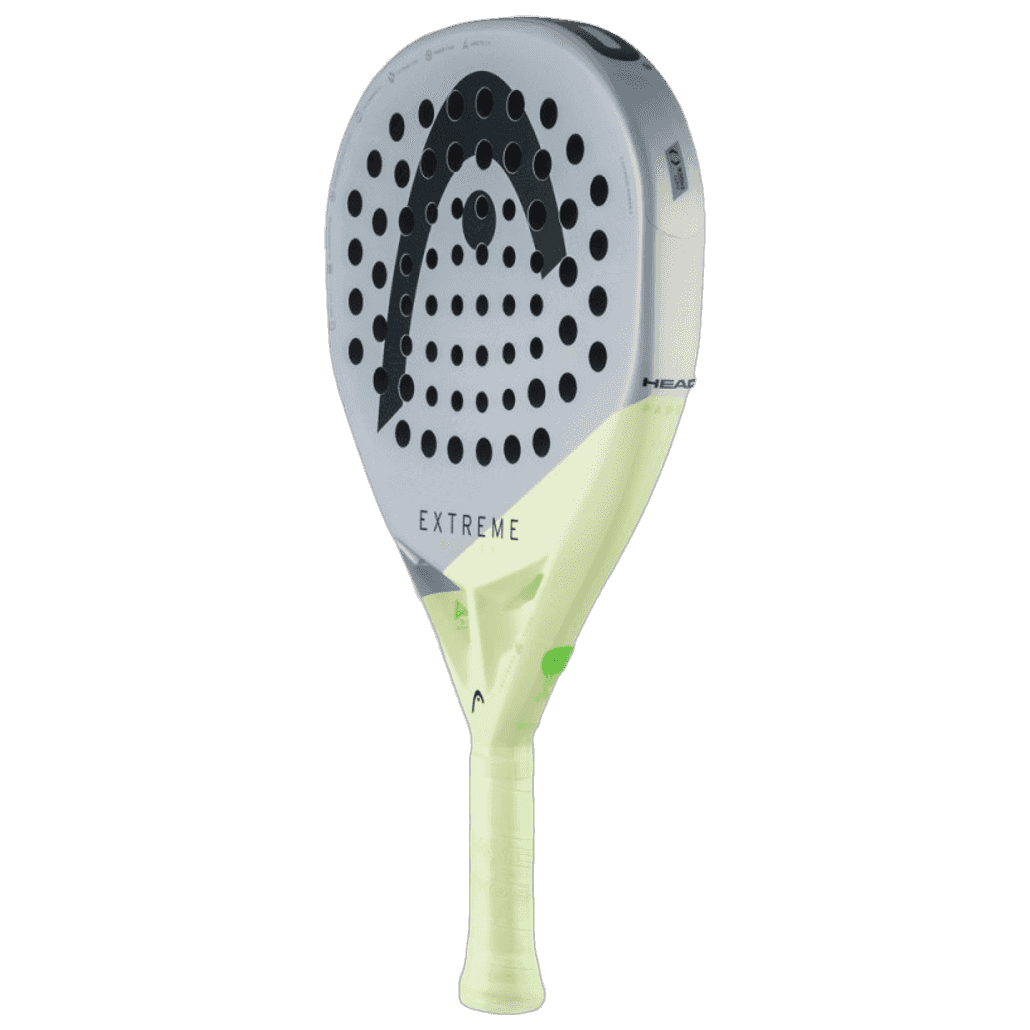
Head Extreme Motion 2027 is an attacking diamond racket that avoids the sluggish, head-heavy feel I often expect from this shape. It wants to play fast at the net, accelerate through overheads, and still give a competent player enough feedback to organize the point from the baseline.
This is not a forgiving comfort racket. Clean contact gets rewarded; rushed swings and late touches do not.
Technical analysis
Shape & balance
The diamond shape puts the sweet spot slightly higher than on a round racket, which gives the Motion its attacking intent without making it feel as demanding as a full-on power model. Compared with the Extreme Pro, the Motion is easier to get moving through quick exchanges. I notice that most on reflex volleys, defensive adjustments, and fast counterattacks where there is no time for a big preparation.
It feels attack-oriented in the hand, but not excessively cumbersome. That matters because the racket can be repositioned quickly after a volley or during a chaotic net exchange. Still, the sweet spot is not huge. Hit late, especially on a pressured block or off-the-wall ball, and the response loses weight and direction.
Materials & construction
The faces use unidirectional carbon fiber, paired with a Power Foam core. The result is a direct response with enough elasticity to help the ball travel at medium swing speeds. It does not require a full-arm swing to produce depth, which makes it more accessible than a very hard, low-output carbon racket.
The medium-hard feel is firm rather than harsh. I get a clear sense of where the ball has landed on the face, and that helps with touch shots and controlled volleys. It is not a plush setup, though. Players who rely on the racket to absorb pace in defense may find the contact a little too crisp, particularly against heavy smashes.
On-court feel
Baseline play
From the baseline, I like the racket most when I am proactive. It produces a clean, predictable ball exit on low-driven lobs and firm defensive lobs, provided I meet the ball in front. Blocks hold their line well, and there is enough response to send the ball deep without overhitting.
The trade-off is clear: incomplete strokes get exposed. A late contact after the glass, or a defensive ball played with only the wrist, can come off weak and short. It offers control through precision, not through a large, forgiving hitting area.
At the net
This is where the Motion earns its name. It comes through rapid volley exchanges quickly, and I can change direction without feeling that the frame is dragging behind my hand. Punch volleys have enough firmness to keep opponents pinned, while softer volleys and a well-disguised chiquita need a relaxed hand and fine touch, or the core sends the ball too long.
The racket does not give free pace on every contact. To make volleys really bite, I still need to accelerate through the ball and use the face properly.
Bandeja and víbora
The quicker handling helps a lot on the bandeja and víbora. I can prepare later than with the Extreme Pro and still get the racket through the ball with authority. The medium-firm response also gives these shots a controlled, direct release rather than a springy launch.
For the smash, there is real output, especially when I commit to the swing. It is powerful, but it is not a brute-force cannon that will rescue poor timing.
Conclusion
I would put the Extreme Motion 2027 in the hands of an intermediate-advanced or advanced player who attacks often but refuses to carry an unwieldy diamond racket. It suits a player who values fast hands, aggressive volleys, and controlled overheads.
You trade some forgiveness for that precision. The sweet spot asks for clean technique, and passive defense is not its strongest territory. But for players who generate their own swing speed and want a quicker attacking frame, it makes a convincing case.
What other reviewers say
- Padel Magazineen
The test finds it markedly quicker to accelerate and reposition than the Extreme Pro, helping with reflex volleys, counters and defensive adjustments while retaining real attacking output when the player accelerates. Its medium-firm response is easier to access at moderate swing speed, but the sweet spot still demands clean contact and late or incomplete strokes lose quality.
Switch Intelligence
Be the first to share where you switched from.
Community reviews
Real feedback from players who used this racket.
Add your review
To submit your review, log in first. You can still read all approved community reviews below.
Add review


