

Kombat Teide 2.5 by Manu Martin 2026
A diamond-shaped racket with heavy bite and a firm feel, built for aggressive points without losing too much stability.
Our Take
Shape
Diamond
Weight
350 - 370 gr
Touch
Medium
Core
Blue EVA
Faces
Blue Carbon 18K
Frame
Carbon fiber
What we like
- Strong smash punch
- Clean *bandeja* and *víbora*
- Predictable ball exit
What we don't
- Defense needs quicker hands
- Off-center contact loses quality
- Not very nimble at net
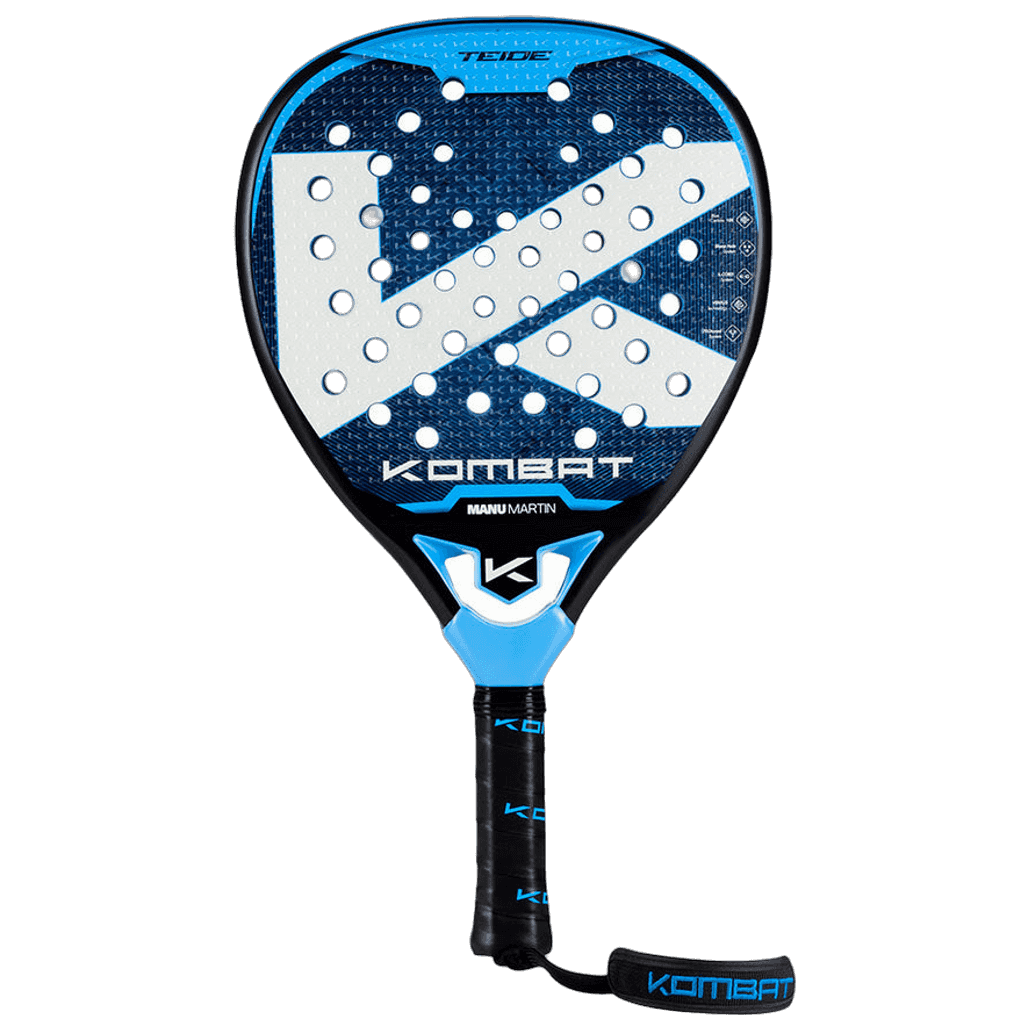
The Kombat Teide 2.5 by Manu Martin 2026 is an attacking racket with a fairly clear personality: firm, direct, and built to punish anything you catch up high. I feel it more as a weapon for players who already like to take the initiative than as a friendly all-rounder.
The diamond shape and medium feel give it that offensive bias right away. It has enough control to keep the ball in play, but its real value shows when I can step into the shot and accelerate through the ball.
Technical analysis
Shape & balance
The diamond mold pushes the sweet spot a little higher, so the racket naturally rewards overheads and aggressive contact above shoulder height. The balance sits on the assertive side, which helps when I want extra help in the smash or in a heavy bandeja.
That same setup also means it is not especially quick in emergency defending. From the baseline, when the point gets messy and I need fast hand speed, I notice the extra mass up top. If your game depends on constant reaction work and easy maneuverability, this will ask more from your wrist and timing.
Materials & construction
The fiberglass frame paired with Blue Carbon 18K faces gives the Teide 2.5 a firmer response than a softer comfort racket, but without becoming harsh. The Blue EVA core sits in that middle lane: enough rebound for depth, enough firmness for direction. I get a clean ball exit, not a trampoline effect.
That construction gives the racket a fairly stable hit for its category. It feels more controlled than wild, and more serious than plush. The downside is that it doesn’t hand you free power from nowhere. If the technique is late or lazy, the racket won’t hide it.
On-court feel
Baseline play
From the back of the court, I like it most on compact blocks, controlled lobs, and those defensive exchanges where I’m just trying to reset the point with depth. The response is predictable, and the ball comes off with enough pace to keep pressure off me.
What I don’t love is the extra effort needed when I’m stretched wide or forced into awkward off-the-wall play. It can do the job, but it doesn’t feel effortless. The sweet spot is decent, though not huge, so off-center contact loses some quality quickly.
At the net
This is where it starts to make more sense. Volleys come off with weight and a fairly crisp touch, which helps when I want to take time away from the opponent. The racket is not soft, so I can’t just block and forget about technique, but the response is useful for aggressive net exchanges.
It also behaves well on short, sharp chiquitas and on quick transitions forward. I can place the ball with enough precision to force a weaker reply, even if the racket never feels especially nimble.
Bandeja and víbora
These are probably its best shots. The shape and firmer core help me load the ball with authority without losing too much control. On the bandeja, I get a good mix of depth and bite. On the víbora, it lets me accelerate with a pretty satisfying kick.
It does not turn those shots into easy automatic winners, though. I still need to work the motion. When I do, the racket rewards me with solid penetration and a clean, purposeful trajectory.
Smash
The smash is where the Teide 2.5 feels most at home. If I hit through the ball properly, there is real punch there. It likes an attacking swing and gives me enough confidence to go after finishing shots.
What it won’t do is manufacture easy power for a player who is still building technique. The racket is more about helping committed hitters than rescuing rushed mechanics.
Conclusion
I see this as a racket for intermediate-to-advanced players who already play with intent and want a firmer, more offensive tool. It suits someone who uses the net well, likes to attack overhead, and is comfortable generating their own pace.
The trade-off is simple. You get heavier hitting, good control for an attacking mold, and a strong feel on overheads. In return, you give up some ease in defense and some comfort on off-center contact. It’s a serious racket, not a forgiving one.
Switch Intelligence
Be the first to share where you switched from.
Community reviews
Real feedback from players who used this racket.
Add your review
To submit your review, log in first. You can still read all approved community reviews below.
Add review


