

Nox X-Auro 2026
A soft, forgiving round racket that keeps the ball moving from the baseline and stays quick when the point speeds up at the net.
Our Take
Shape
Round
Weight
360 - 375 gr
Core
HR3 EVA
Faces
Fiberglass
Frame
Carbon
What we like
- Forgiving sweet spot on blocks
- Easy defensive lobs and exits
- Quick hands in net exchanges
What we don't
- Limited authority on flat smashes
- Modest bite on aggressive víboras
- Put-away volleys lack weight


Updated on 12 Oct (shipping cost not calculated)
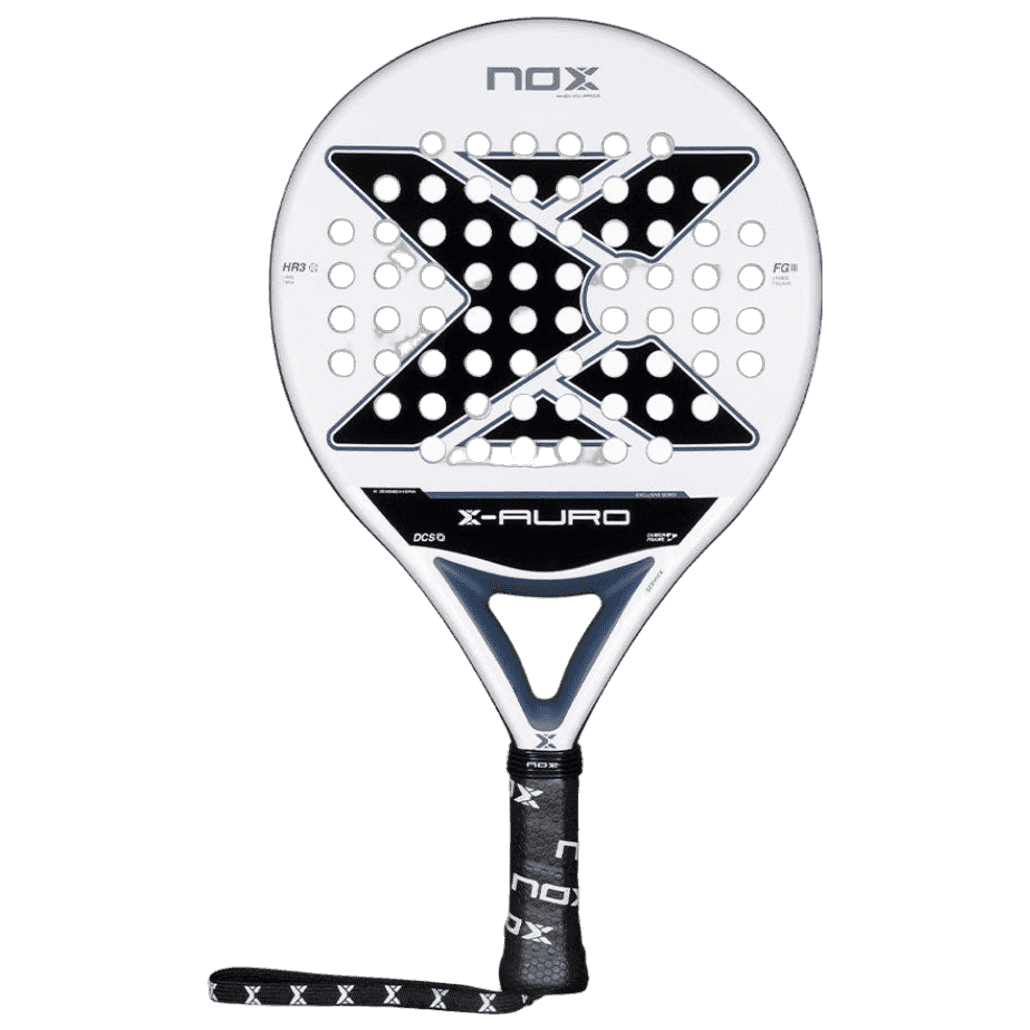
Nox X-Auro 2026 is a comfort-first control racket with a round shape, a large hitting area, and a notably forgiving response. I see it as a racket built to keep you in the point rather than end it with one swing.
Its character is easy to read: quick hands, easy depth from defense, and very little punishment when contact drifts away from center. The trade-off is equally clear. It does not bring much finishing authority when you need to flatten out a smash.
Players building consistency, especially from the baseline and in fast defensive exchanges, will get more from it than players who rely on overpowering opponents.
Technical analysis
Shape & balance
The round mold places the sweet spot low and centrally, which is a big reason the X-Auro feels so dependable on imperfect contact. I found the head-light balance helps the racket come around quickly in rushed blocks, compact volleys, and transition shots.
That maneuverability matters most when defending body shots or reacting after the ball comes off the glass. You do not need a huge preparation to get the face behind the ball. Advanced players may find that same easy handling slightly too passive: the racket does not carry much mass through the ball when you try to force pace.
Materials & construction
Nox pairs a carbon frame with fiberglass faces and an HR3 EVA core. The result is a medium-soft feel rather than a sharp, hard response. Contact is cushioned, and the ball leaves the face easily without demanding a full swing.
That construction also explains its arm-friendly behavior. On defensive pickups and off-center blocks, it absorbs impact well and keeps the response predictable. The downside is a softer, less direct strike on hard acceleration. When I really try to drive through a flat ball, the response is clean but not especially forceful.
On-court feel
Baseline play
This is where the X-Auro makes the strongest case for itself. Defensive lobs come off with little effort, while low-driven lobs and wall exits are easy to direct because the sweet spot is so generous. Reports from court testing consistently point to that forgiving exit, and it matches the kind of racket that lets you defend without overhitting.
Blocks are particularly comfortable. I can keep the swing short against heavy balls and still return enough depth to reset the point. What it will not do is turn a defensive position into offense by itself; I still need to create pace with timing and technique.
At the net
At the net, its speed is more useful than its punch. Fast volleys, reflex blocks, and short angle changes feel natural because the racket does not lag in the hand. Placement is the priority here, and I can work the ball toward the feet or play a controlled drop shot without fighting the face.
Put-away volleys require a more committed swing. The ball exits easily, but it does not have the firm rebound or weight behind the shot that makes a volley really skid through the court.
Bandeja and víbora
A controlled bandeja suits this racket well. I can keep the ball deep and maintain direction without needing to hit too hard. The smooth face and softer response are less convincing for an aggressive víbora, though. There is modest bite on sliced contact, so generating a heavy side-spin trajectory takes more work than with a textured carbon-faced racket.
Conclusion
I would put the X-Auro in the hands of a developing or intermediate player who values defense, placement, and a forgiving contact point. It is also a sensible option for anyone who wants a comfortable racket that moves quickly through compact exchanges.
The compromise is power. Flat smashes, x3 attempts, and aggressive sliced overheads are not its strong suit, and stronger attackers may outgrow its softer response. This is a racket for constructing points patiently, not for ending them on demand.
What other reviewers say
- PadelTestLaben
This review finds it highly forgiving and quick through the air, making wall exits, blocks and fast volleys easy, with a cushioned impact that is easy on the arm. The trade-off is limited authority on flat smashes and x3s, while the smooth face produces modest bite on viboras and aggressive sliced shots.
- PadelScouthr
PadelScout characterises it as a medium-soft control racket that is easy to move and undemanding at contact. It is positioned for beginners who value defence, placement and rally consistency rather than an explosive response for forcing the pace.
Switch Intelligence
Be the first to share where you switched from.
Community reviews
Real feedback from players who used this racket.
Add your review
To submit your review, log in first. You can still read all approved community reviews below.
Add review


