

Osaka Vision Pro Power 2026
A teardrop racket with a lively foam response, enough punch to finish overheads, and composure for building points from the baseline.
Our Take
Shape
Tear
Weight
355 - 370 gr
Core
10–13 White Snap EVA foam
Faces
3K Twill weave Japanese carbon
Frame
Twin-tube blown frame, 9 layers of carbon + 1 layer of Kevlar
What we like
- Stable, penetrating net volleys
- Sharp *víbora* with lively exit
- Deep, controlled *bandejas*
What we don't
- Narrow sweet spot off-center
- Demanding on rushed defense
- Delicate touch requires precision
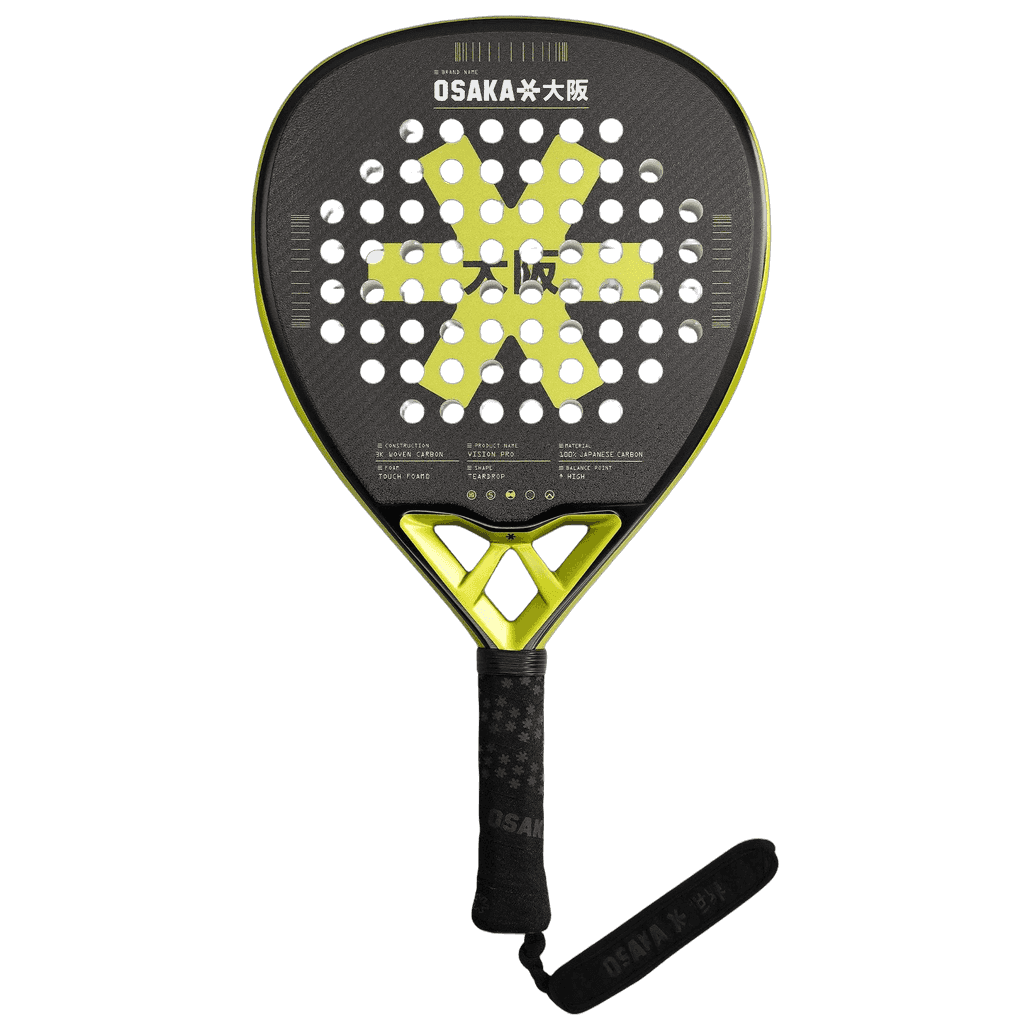
Osaka Vision Pro Power 2026 is an attacking racket with more control than its name suggests. Its tear shape keeps it quick enough for active net play, while the construction points toward a firm, lively response rather than a soft, forgiving one.
I see it fitting an intermediate-to-advanced player who builds points with pressure: deep volleys, aggressive bandejas, and overheads that force a weak reply. It is not a passive defender’s racket, though. You need to prepare early and strike cleanly.
Technical analysis
Shape & balance
The tear profile puts the sweet spot above center without pushing it as far up as a full diamond. That matters. I found this type of geometry more manageable in transition than a pure power-focused shape, particularly when reacting to fast exchanges at the net.
Still, the listed sweet spot is not especially generous. Miss high toward the frame or too far out toward the sides, and the response will likely lose consistency. Players who arrive late to the ball or rely on the racket to rescue off-center blocks may find it demanding.
The balance appears geared toward offensive acceleration rather than a notably head-light feel. It should reward a compact, committed swing on the víbora and overhead volley, but it will not feel as effortless through quick hand battles as a control-oriented round racket.
Materials & construction
Osaka uses a twin-tube blown frame built with nine layers of carbon and one layer of Kevlar, paired with 3K Twill Japanese carbon faces. That is a serious structural recipe: I would expect a stable contact sensation, limited frame flex, and a more direct response when the ball arrives with pace.
Inside sits 10-13 White Snap EVA Foam. The rebound rating suggests a core that returns energy readily, so the ball should leave the face without needing a huge swing. I would describe the expected response as a firm-medium feel: not board-like, but not the plush, long-dwell sensation some players want for slow defensive exchanges.
That construction should help the racket stay composed on hard volleys and blocks. The trade-off is touch. Delicate drop shots and soft chiquitas will require a quieter hand than they do with a softer fiberglass-faced racket.
On-court feel
Baseline play
From the baseline, I would use the Vision Pro Power to send a purposeful ball rather than to simply absorb pressure. The lively core should help on off-the-wall play and defensive lobs when I can get the racket behind the ball cleanly.
What it does not offer is automatic control on rushed defense. The moderate sweet spot and firmer face mean lazy contact gets exposed. On low balls near the glass, I would favor a compact block or a low-driven lob over trying to manufacture too much touch.
At the net
This is where the racket’s character makes sense. The stable carbon-and-Kevlar structure should let me punch volleys through the court without the face twisting much, while the tear shape keeps it more mobile than a head-heavy diamond.
Fast exchanges should be productive, but not effortless. I would not choose it for a player whose game is built around feather-light reactions and soft angle changes. Its strength is penetrating contact: firm volleys, controlled pressure, and blocks that carry depth.
Bandeja and víbora
The racket should respond well to overheads that need both pace and direction. A bandeja can stay deep without feeling mushy, and the quicker rebound should help the víbora come off with a sharper, more attacking trajectory.
For full power, it will reward technique. The smash potential is there, but the racket is less about brute force than clean energy transfer from a well-timed swing.
Conclusion
I would put the Vision Pro Power 2026 in the hands of players who want an assertive tear-shaped racket without moving all the way into a demanding diamond profile. It should suit a player who spends plenty of time at the net and wants a responsive overhead game.
The trade-off is forgiveness. Its sweet spot is not broad, and the firmer construction will not hide late preparation or inconsistent contact. For players who value soft touch and easy defensive comfort above attacking penetration, I would look elsewhere.
Switch Intelligence
Be the first to share where you switched from.
Community reviews
Real feedback from players who used this racket.
Add your review
To submit your review, log in first. You can still read all approved community reviews below.
Add review


