

Softee Speed Gold Power 4.0 Nano Mesh 2026
A lively teardrop racket with enough punch for the overhead game, yet quick and composed when points turn defensive.
Shape
Tear
Weight
355 - 375 gr
Touch
Medium
Core
Professional Black EVA
Faces
21K Carbon
What we like
- Lively ball exit from baseline
- Direct punch volleys at net
- Accelerates attacking overheads cleanly
What we don't
- Small sweet spot off-center
- Demanding on late defensive blocks
- Lively response complicates touch shots
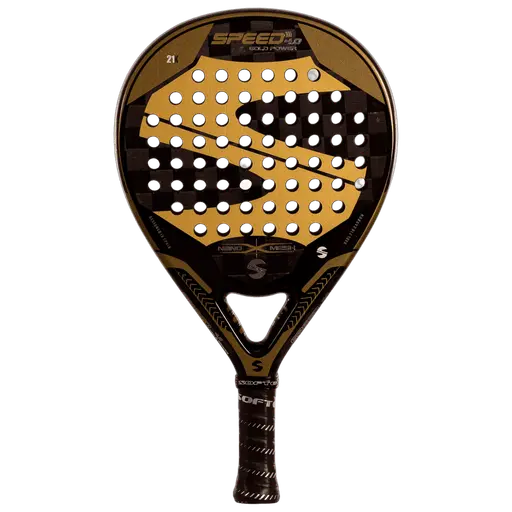
Softee Speed Gold Power 4.0 Nano Mesh 2026 is an attacking-minded racket that stops short of being a demanding, all-out power tool. Its tear shape and medium feel point toward a player who wants to press at the net, accelerate overheads, and still have enough response to work points from the baseline.
I see it fitting intermediate-to-advanced players with an active game. It has the power ceiling to finish a loose ball, but its character is more about producing a lively, direct ball than simply muscling every smash.
The compromise is clear: this is not a soft, slow racket that smooths out late contact. The sweet spot is not especially generous, so clean preparation still matters.
Technical analysis
Shape & balance
The tear shape puts the balance in a useful middle-to-upper area. I would expect it to feel quick enough in hand for fast exchanges, while carrying more punch through the ball than a round control racket.
That setup should help players who build points with volleys and overhead pressure rather than waiting for one full-power finish. It will not have the automatic forgiveness of a lower-balanced model, though. On rushed defensive blocks, especially when contact drifts toward the upper edge, I would expect the response to lose some consistency.
Materials & construction
The faces use 21K carbon, paired with a Professional Black EVA core. On paper, that is a combination aimed at a firm, responsive strike rather than a muted or overly cushioned touch. The listed rebound level also suggests that the racket should provide useful ball exit without needing a huge swing.
For me, the medium feel is an important part of the package. It should give enough feedback to place the ball accurately, while avoiding the harsh, board-like sensation that some stiff carbon faces can produce. Still, players who rely on a very soft face to absorb pace may find it a little too reactive in quick defensive exchanges.
On-court feel
Baseline play
From the baseline, I would use this racket to keep the ball deep and regain court position with purposeful lobs. The available ball exit should help when the ball comes off the glass with pace, particularly if I can meet it in front rather than letting it fall too low.
It is less convincing for passive defense. A late block or a short, improvised off-the-wall shot will not get the same help that a softer, larger-sweet-spot racket provides. I would want compact technique and a firm wrist here; otherwise, the ball can leave the face faster than intended.
At the net
This is where the Speed Gold Power’s profile makes the most sense. The tear format and responsive carbon face should give volleys enough penetration without making the racket feel cumbersome during rapid hand battles. I would expect a clean, direct response on punch volleys and attacking blocks.
Touch shots need more care. A short drop shot or chiquita requires softer hands because the rebound is lively. The racket can play those shots, but it is not built around feather-light touch.
Bandeja and víbora
The medium response should work well for players who hit their bandeja with intent rather than merely resetting the point. There should be enough firmness to keep the ball low and deep, while the tear shape gives some extra acceleration through the overhead swing.
On the víbora, the smaller effective sweet spot becomes more noticeable. When I strike cleanly, I would expect good pace and a sharp trajectory. Miss the center, and the shot may lose direction more readily than with a rounder control-focused racket.
Conclusion
I would look at this racket if I play an assertive game, like taking the net early, and want power that remains manageable in regular point construction. It should suit players who already generate decent racket speed and do not need a soft face to create depth.
The trade-off is forgiveness. It is not the racket I would choose for a player whose game is mostly defensive, whose contact is still inconsistent, or who wants maximum comfort on slow, late balls.
Its strongest appeal is the mix of lively ball exit, usable maneuverability, and attacking intent. Just do not expect it to hide poor contact.
Switch Intelligence
Be the first to share where you switched from.
Community reviews
Real feedback from players who used this racket.
Add your review
To submit your review, log in first. You can still read all approved community reviews below.
Add review


