

Pallap Velocity Star 2026
A forgiving tear-shape that moves quickly through the net, blending a cushioned touch with the precision to build points patiently.
Our Take
Shape
Tear
Weight
355 - 360 gr
Touch
Medium
Core
EVA Fusion 30
Faces
15K Alumatrix Carbon
Frame
Dual Carbon
What we like
- Quick handling in net exchanges
- Forgiving ball exit off walls
- Reliable low, directed *bandejas*
What we don't
- Limited punch on flat volleys
- Sweet spot fades near upper edge
- Smashes lack easy finishing power
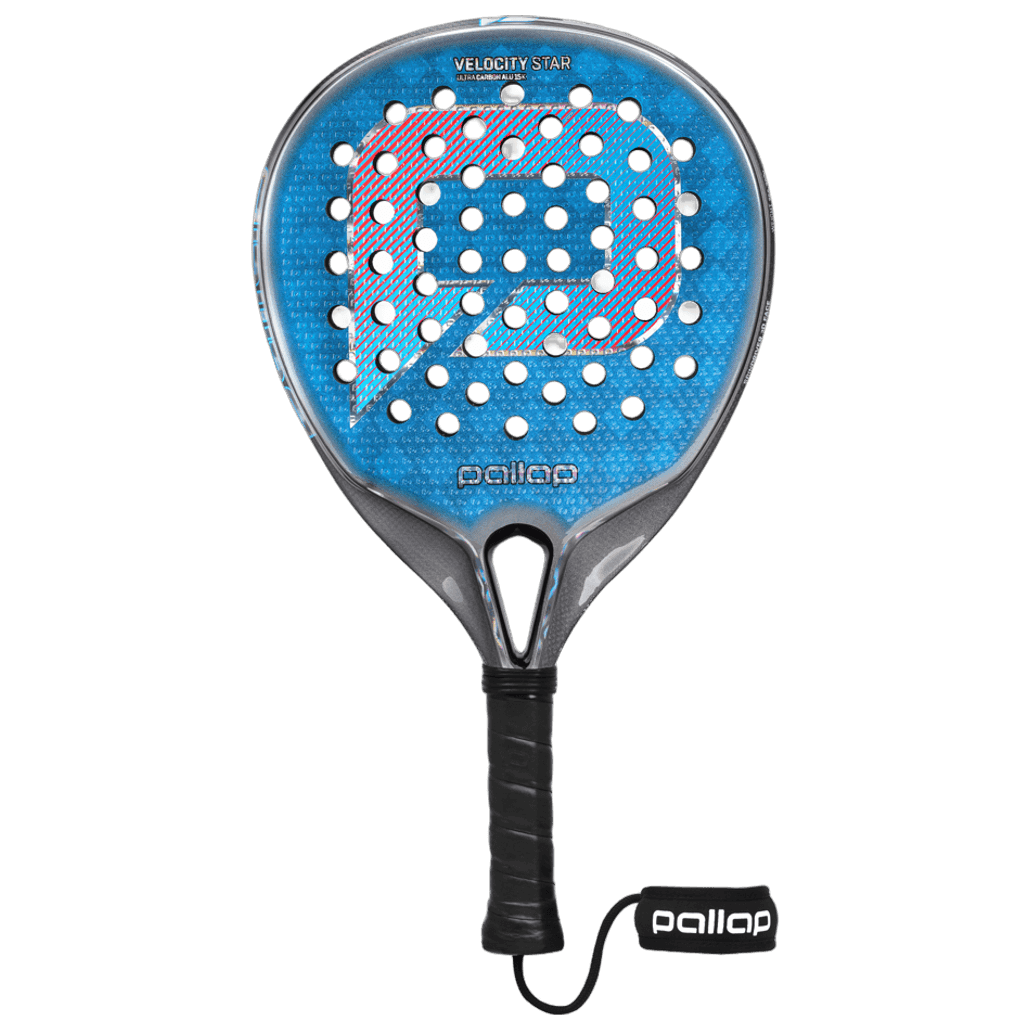
Pallap Velocity Star 2026 is a quick, composed racket built around placement and tempo rather than brute-force finishing. Its tear shape gives it a balanced attacking profile, but the personality is more controlled than aggressive.
I found it most convincing for players who like to build points, move forward behind a good lob, and keep their hands active in fast exchanges. The medium feel is noticeably more cushioned than a hard carbon racket.
Technical analysis
Shape & balance
The teardrop format does not feel head-heavy in the hand. There is enough mass toward the head to make overheads and attacking volleys feel purposeful, yet it does not become slow through the contact zone.
That balance also explains why the racket transitions well from defense to the net. I could prepare quickly for blocks, chiquitas, and countervolleys without feeling that the head was dragging behind my hand. Players used to very head-heavy diamond rackets may find it less imposing on flat attacking shots, but it is much easier to reposition when the point speeds up.
Materials & construction
The Dual Carbon frame gives the structure a stable, connected feel, while the 15K Alumatrix Carbon faces do not play as stiffly as the specification might suggest. Pallap has paired them with an EVA Fusion 30 core that absorbs impact well and rounds off minor mishits.
That softer, more forgiving response matches the feedback around this 2026 version. The ball does not fly uncontrollably, but the racket gives enough ball exit to help when you are late off the wall or defending a hard volley at your feet. The trade-off is a less explosive response on full-power swings. It does not have the sharp, immediate punch of a more attack-first hard EVA racket.
On-court feel
Baseline play
From the baseline, the Velocity Star feels calm and predictable. I liked it on defensive lobs because the face does not punish a slightly imperfect contact, and it is easy to keep the ball deep without overhitting. Off-the-wall play is similarly friendly: the racket cushions the incoming pace and gives me time to direct the return.
It still asks for clean technique if you want to accelerate a low-driven lob or drive the ball hard through the middle. The sweet spot is usable rather than huge, and contact toward the upper edge loses some authority.
At the net
This is where the racket makes the strongest case for itself. Fast volley exchanges are comfortable because the maneuverability is high and the response stays controlled even when I am blocking rather than swinging. It is easy to hold the racket steady, soften a block, or add direction late.
The touch also works well for short angles and drop shots. I would not call it a naturally heavy volley racket, though. Players who want the ball to explode through the opponent’s position from a compact punch may miss a firmer face.
Bandeja and víbora
The Velocity Star favors measured overheads. My bandeja felt particularly reliable: I could keep the ball low, work the corners, and recover net position without fighting the racket. A sliced víbora gets decent bite, although the face rewards a clean brushing action more than it creates spin by itself.
Smash
A well-timed smash has enough output, especially when I can use the full body and contact high. But this is not the racket I would choose purely to chase easy winners from every short lob. Its strength is setting up the next ball, not flattening every overhead into a finish.
Conclusion
I would put the Velocity Star in the hands of an intermediate-to-advanced player who values control in transition, quick reactions at the net, and a more forgiving carbon response than the previous generation suggests.
It gives up some raw smash power and does not feel brutally direct on flat attacking shots. In return, it offers a composed response, useful ball exit under pressure, and the hand speed to stay involved when points become messy.
What other reviewers say
- Padel Magazinees
The test finds the 2026 Velocity Star noticeably softer and more forgiving than its predecessor: it cushions impact, smooths out minor mishits, and remains composed in fast net exchanges. Its strengths are hand speed, agility, and precision through transitions rather than the raw finishing power of more attack-focused models.
Switch Intelligence
Be the first to share where you switched from.
Community reviews
Real feedback from players who used this racket.
Add your review
To submit your review, log in first. You can still read all approved community reviews below.
Add review


