

Royal Padel 34 Aniversario Hybrid 2024
A forgiving hybrid with comfortable impact and quick rebound, built to settle defense and keep the ball moving through the point.
Our Take
Shape
Tear
Weight
360 - 375 gr
Touch
Medium-Hard
Core
Polyethylene foam + EVA
Faces
Fiberglass, carbon-reinforced heart
Frame
Fiberglass (Fibertech glass fabric)
What we like
- Effortless ball exit under pressure
- Large sweet spot on blocks
- Arm-friendly off-the-wall response
What we don't
- Springy touch on slow balls
- Smash lacks effortless finishing power
- Volleys need full acceleration
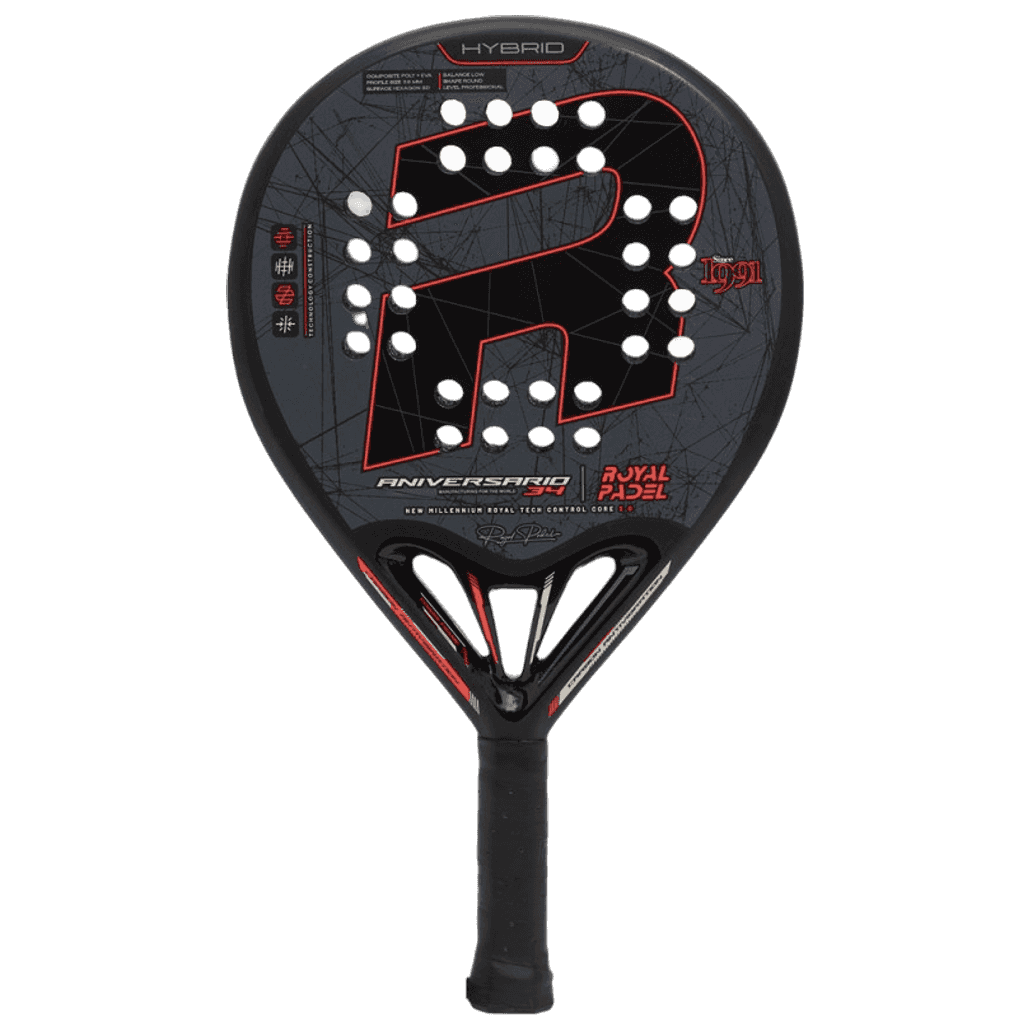
Royal Padel 34 Aniversario Hybrid 2024 is a comfort-first versatile racket, built around easy ball exit rather than a hard, explosive hit. It feels most at home in structured points: defend, reset, take the net, and keep pressure without forcing every ball.
I see it fitting a drive-side player particularly well, or anyone whose elbow and shoulder appreciate a less punishing response. It is not a pure power racket, and that is the trade-off from the first hit.
Technical analysis
Shape & balance
The tear shape gives it a useful middle ground between a round control racket and a more demanding diamond. Its medium balance keeps the head present enough for volleys and overheads, but it does not drag through the swing in the way a truly head-heavy racket can.
That balance, together with the notably generous sweet spot, makes the racket forgiving on defensive blocks and off-the-wall returns. I found it easier to get a clean response when contact was slightly low or toward the outer area of the face. It still needs a composed swing, but it does not punish small timing errors as sharply as many firmer carbon models.
Materials & construction
Royal Padel uses a fiberglass frame and faces, with a carbon-reinforced heart, over a polyethylene foam + EVA core. The result is a medium-hard feel, though it sits on the more elastic side of that label rather than feeling dry or rigid.
The foam-based construction gives this racket its standout trait: ball exit. Even from a passive position, the ball comes off the face with very little effort. That is useful when defending fast volleys or lifting a defensive lob under pressure. The downside is that players who want a very crisp, direct impact may find the response slightly too springy, especially on delicate touch shots where they prefer to supply all the pace themselves.
On-court feel
Baseline play
From the baseline, this is one of the easier Royal Padel rackets to trust. Blocks travel deep without needing a big backswing, and wall returns come out with enough rebound to turn defense into a neutral ball. That friendly response is also why it has earned a reputation among players looking for a less harsh racket on the arm.
Control is good, especially when shaping a low-driven lob or directing a return through the middle. Still, the ball exit can occasionally work against me on very slow balls. A soft drop shot or short chiquita requires a relaxed hand; if I leave the face too open, the racket gives away more depth than intended.
At the net
At the net, the maneuverability is better than its solid construction suggests. Quick volleys are uncomplicated, and the sweet spot makes it dependable for absorbing pace rather than trying to overpower it. I particularly liked it on compact forehand blocks and controlled backhand volleys into the feet.
It does not produce the heavy, terminal volley of a stiffer 12K or 18K carbon racket. To really finish through the court, I have to accelerate properly and hit cleanly. This is a racket for placing pressure and building the point, not for expecting free winners from a short swing.
Bandeja and víbora
The racket works very well on the bandeja. Its medium balance lets me keep the head stable through contact, while the lively core helps send the ball deep without overhitting. A controlled víbora also feels accessible, particularly when prioritizing direction and low bounce over outright speed.
On the smash, it is competent rather than special. There is enough response for a well-timed flat hit, but it lacks the concentrated head weight and firm face needed to make power effortless.
Conclusion
This is a strong option for intermediate to advanced players who value forgiveness, arm-friendly comfort, and reliable defensive output. Drive-side players, especially those who use blocks, lobs, wall defense, and measured overheads to construct points, will get the most from it.
The trade-off is clear: its generous rebound and large sweet spot do not come with a ruthless finishing gear. Players who build their game around aggressive smashes and heavy punch volleys will likely want a firmer, more head-heavy racket.
What other reviewers say
- PalaHackes
The review positions it as a versatile, arm-friendly racket that works particularly well for drive-side players in defense, bandejas, blocks, and wall returns. Its medium balance and large sweet spot support a control/power blend, although it is not an outright standout in either category.
Switch Intelligence
Be the first to share where you switched from.
Community reviews
Real feedback from players who used this racket.
Add your review
To submit your review, log in first. You can still read all approved community reviews below.
Add review


