

Siux Fenix Pro Black 2026 Leo Ausburger
A hard-edged diamond racket with heavy smash power, crisp control, and enough sweet spot to survive the odd off-center miss.
Shape
Diamond
Weight
355 - 375 gr
Touch
Hard
Core
EVA
Faces
12K carbon
Frame
Carbon fiber
What we like
- Huge smash power
- Stable volleys and blocks
- Manageable sweet spot
What we don't
- Defense feels demanding
- Slow *bandeja* and *víbora*
- Punishes off-center hits



Updated on 20 Oct (shipping cost not calculated)





Updated on 26 Aug (shipping cost not calculated)
Are you a store owner? Join our platform to be featured here.
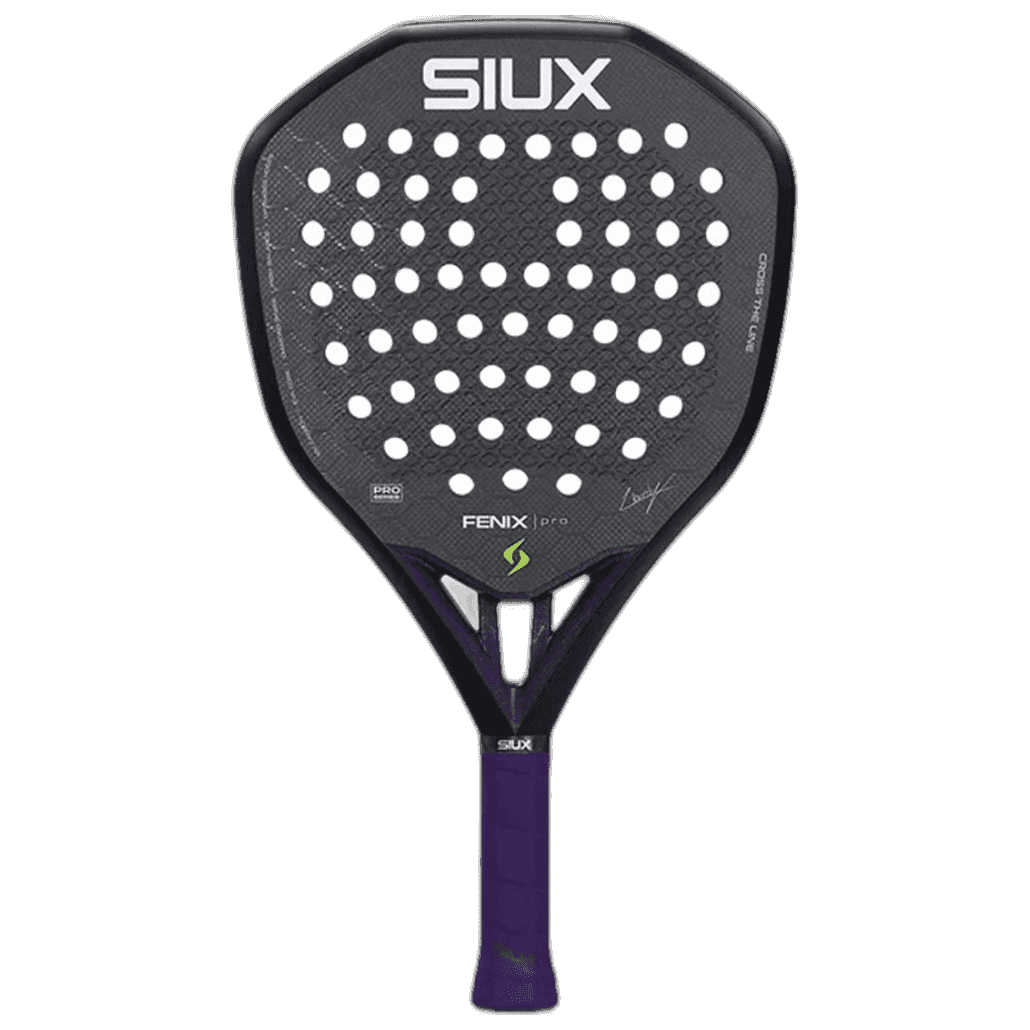
Siux Fenix Pro Black 2026 Leo Ausburger is a heady attack-first racket with a hard, direct feel. It wants you hitting above shoulder height, taking the net, and finishing points before they get messy.
The interesting part is that it is not just a blunt smasher. For a diamond shape, I find it more manageable than the profile suggests, with enough control to keep the ball where I want it when I’m not forcing the issue.
Technical analysis
Shape & balance
The diamond shape and pronounced head-heavy balance set the tone immediately. This is a racket that loads the upper part of the court and rewards players who are comfortable living on offense. If you like to press with volleys, punish short balls, and go after the smash, the geometry makes sense.
What it does not do is hide your mistakes. In defensive phases, the balance can feel demanding if you’re late or lazy with preparation. I still think it is more maneuverable than some diamond rackets with this much power, but it never fully loses that forward-leaning character.
Materials & construction
Siux pairs a fiberglass frame with 12K carbon on the faces and an EVA core, and the result is a crisp, dry feel. The contact is firm. The ball does not sink in much, so you get a fast, immediate response rather than a plush one.
That construction helps explain the racket’s aggressive behavior. The face texture and carbon layup give it plenty of bite, so I can get heavy spin on attacking shots. The trade-off is forgiveness. Off-center hits are punished more than with easier, softer frames, and that becomes obvious when the point speeds up.
On-court feel
Baseline play
From the baseline, I like it more on blocks and quick counters than on relaxed defense. It gives a clean rebound when I meet the ball early, and the sweet spot is bigger than I expected for a diamond, so it does help on awkward exchanges.
Still, this is not a racket that makes you lazy. Defensive lobs need proper timing, and when I get stretched out, the hard response can feel demanding. If your back-court game relies on easy ball output, this will ask more of you.
At the net
This is where the Fenix Pro Black starts making sense. Volleys come off with authority, and the racket feels stable when I’m accelerating through contact. It rewards compact, committed hands. Fast blocks are very solid too, which matters a lot in fast hands exchanges.
The downside is that it is not especially friendly on slow preparation. If the ball sits up and I’m a fraction late, I feel it. The racket wants sharp timing and an active wrist, not passive guiding.
Bandeja and víbora
These two shots are the most revealing. The racket can hit them well, but it does not hand them to you. I need a quicker arm and cleaner technique to get the best out of the bandeja and víbora, because the frame feels a little slow if I try to cruise through the motion.
When I’m on time, the spin and depth are there. When I’m not, the response feels heavy and the shot loses its usual threat.
Smash
This is the racket’s natural language. The smash is where the power shows up most clearly, and it has the kind of extra punch that can change a point fast. I also get a very direct contact that helps me commit without wondering whether the ball is going to die on the face.
Conclusion
I see this as a serious attacking racket for players who already control their mechanics and want something with real finishing power. It suits an aggressive net player who likes to dictate with volleys, fast blocks, and overheads.
What you trade off is comfort and forgiveness. It can be demanding in defense, and bandejas or víboras need cleaner timing than on easier frames. If you want a hard, powerful racket that rewards precise hands more than lazy swings, this one makes sense.
What other reviewers say
- Padelvergleich.dede
The Fenix Pro 2026 is portrayed as a clearly attack-first racket: it stands out for raw power on smashes and volleys, plus strong spin from the rough face. In return, it asks for technique and suits players who dictate from above rather than those wanting an easy, forgiving frame.
- Reddit r/Padelracketen
The user describes it as very powerful and surprisingly maneuverable for a diamond-shaped racket, with a large sweet spot that helps in defense. The less friendly side shows up on viboras and bandejas, which feel slow and demand a fast arm to get the most out of them.
- Reddit r/Padelracketen
The Fenix Pro 2026 is described as having a crisp, dry feel that is more controlled but also more demanding than easier options like the Coello Motion. The comment suggests it can be excellent for high-level technique, but it punishes mishits more.
Switch Intelligence
Be the first to share where you switched from.
Community reviews
Real feedback from players who used this racket.
4 reviews

Loved it, 10/10


I think for a left sided aggressive player that wants control aswell as power , this is something I would recommend. It has a big pop when hitting due to the hard surface but once you get used to it, it is amazing . Very good racket
Add your review
To submit your review, log in first. You can still read all approved community reviews below.
Add review


