

Siux Obsidian Pro Black 2027
A responsive tear-shape racket with a broad sweet spot, built to absorb pace at the baseline and place the next ball with calm.
Our Take
Shape
Tear
Weight
360 - 375 gr
Touch
Medium
Core
Soft EVA
Faces
16K Carbon
Frame
Carbon
What we like
- Generous sweet spot on defense
- Quick handling in volley exchanges
- Predictable lobs and controlled blocks
What we don't
- Smash lacks effortless penetration
- Lively exit on fast shots
- Limited extreme-spin surface bite
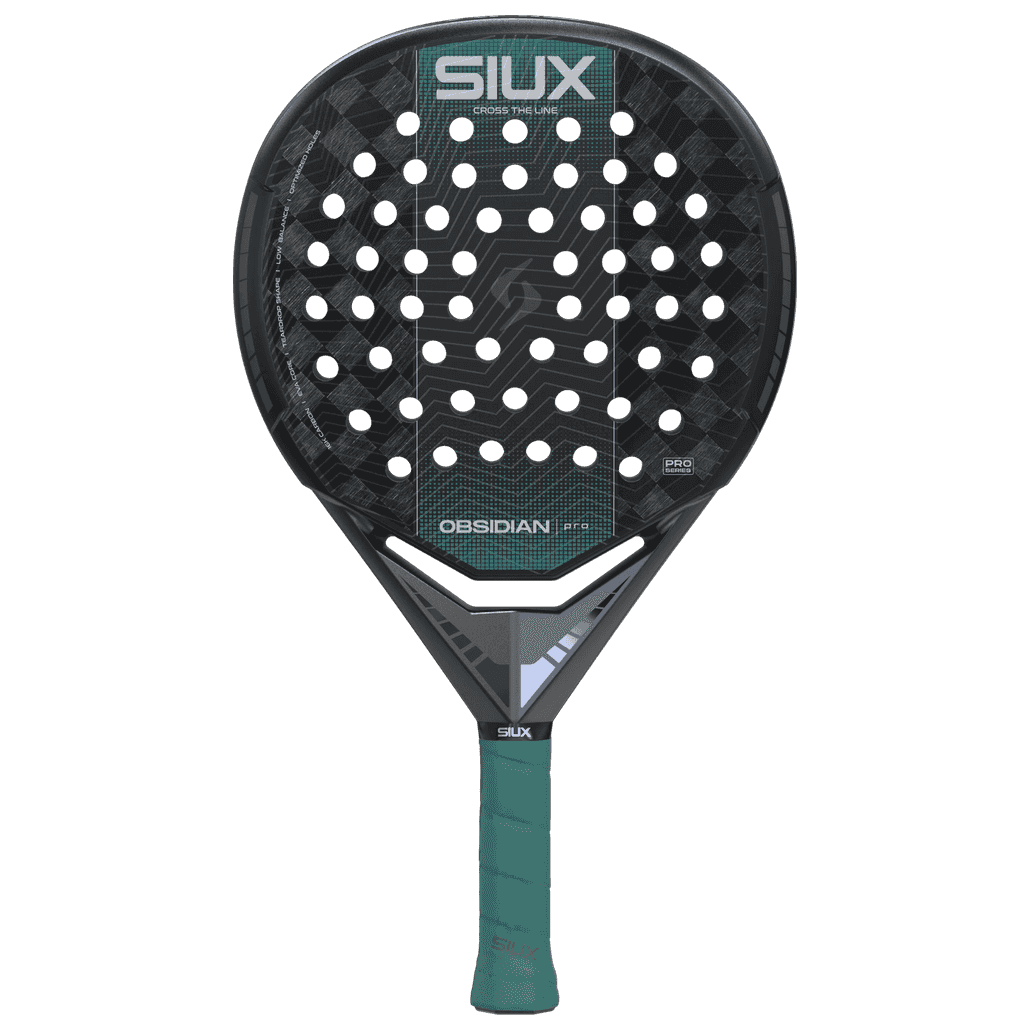
The Siux Obsidian Pro Black 2027 is a control-first racket that still has enough punch to finish a short ball. Its teardrop shape keeps it quick through the air, while the medium feel avoids the hollow or overly muted response that some soft-core rackets can have.
I see it fitting an intermediate-to-advanced player who builds points with placement, changes of pace, and pressure at the net rather than trying to win every rally with a flat smash.
It is not a brute-force attacker’s racket. The power is there, but it asks for clean timing and a committed swing.
Technical analysis
Shape & balance
The teardrop mold gives this racket a broad, forgiving sweet spot without moving too far toward a head-heavy setup. That matters in real exchanges: I found it easier to get the racket into position on quick volley exchanges and late defensive blocks than with a more demanding diamond-shaped model.
Its balance feels geared toward maneuverability rather than sheer momentum. The racket moves cleanly through a víbora and lets me make small directional adjustments at the last second. Players who rely on a heavy, pendulum-like sensation above the head may find it a little too quick and controlled.
Materials & construction
A carbon frame gives the structure a stable feel on contact, while the 16K carbon faces bring a crisp enough response to keep the ball from sitting on the racket too long. There is good feedback on flatter volleys and low-driven lobs, especially when I am trying to send the ball deep without overhitting.
The EVA Soft core adds accessible ball exit and helps when defending from an awkward position. It is forgiving, but not mushy. Still, softer EVA does not create free power at the top end. On full-power overheads, I need to accelerate properly; a harder, more head-heavy racket will produce more raw penetration with the same swing.
On-court feel
Baseline play
From the baseline, this is where the Obsidian Pro Black feels most complete. The sweet spot is generous, and off-the-wall play is comfortable because the core gives the ball enough rebound to get out of trouble without needing a huge swing.
I particularly liked it for defensive lobs and controlled blocks. The response is predictable, so I can focus on height and depth rather than fighting an erratic launch. The trade-off is that players who prefer a very firm, deadened defensive racket may find the ball exit a touch lively on fast incoming shots.
At the net
At the net, the racket feels fast and composed. Volleys come off the face with good direction, and the maneuverability helps on body shots where there is no time for a full preparation. There is enough bite to play short angles and chiquitas, although the surface does not feel especially aggressive for generating extreme spin.
In quick exchanges, I found its control more valuable than its finishing power. It rewards a compact punch volley and precise placement. It does not naturally bulldoze the ball through the court.
Bandeja and víbora
The quick, low-balance handling works well for a controlled bandeja and a faster víbora. I can keep the racket head stable through contact and vary direction without feeling that the head is dragging behind my arm.
A flat smash is solid rather than explosive. Clean technique gets results, but this is not the racket I would choose solely for chasing effortless winners from every overhead.
Conclusion
The Siux Obsidian Pro Black 2027 suits players who want a responsive, maneuverable racket with a large usable sweet spot and dependable control in defense.
Its strongest areas are baseline consistency, blocks, volleys, and overhead placement. The softer core also makes it less punishing on imperfect contact.
What you trade off is outright intimidation on the smash. Players who want a hard face, high balance, and maximum power on demand will likely want something more aggressive.
Switch Intelligence
Be the first to share where you switched from.
Community reviews
Real feedback from players who used this racket.
Add your review
To submit your review, log in first. You can still read all approved community reviews below.
Add review


