

Siux Pegasus Pro Lava Orange 2026
A hard-feeling attacking hybrid with quick ball exit, sharp spin, and the kind of stability that rewards clean, committed swings.
Shape
Tear
Weight
355 - 375 gr
Touch
Hard
Core
EVA PRO
Faces
12K carbon
Frame
Carbon fiber
What we like
- Fast ball exit on attacks
- Stable volleys with bite
- Crisp *bandeja* and *víbora*
What we don't
- Demands clean technique
- Harsh on late contact
- Defense needs active hands



Updated on 20 Oct (shipping cost not calculated)
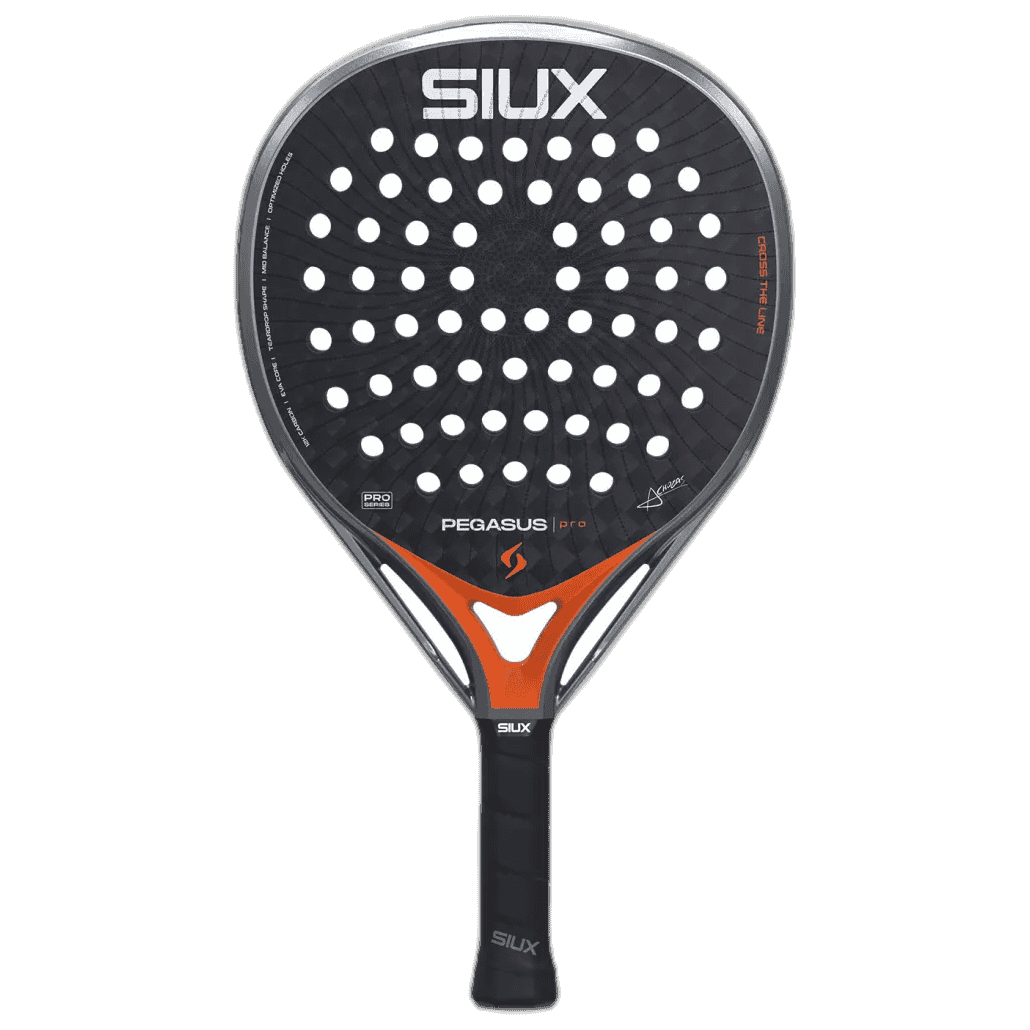
Siux Pegasus Pro Lava Orange 2026 is a hard-hitting attacking hybrid with enough control to keep it from feeling like a blunt weapon. I see it as a racket for players who like to speed the ball up, hit with intention, and live comfortably above the tape.
The identity is clear from the first few exchanges: firm response, fast ball exit, and a lot of authority on aggressive shots. It asks for clean mechanics. If your technique is lazy or you arrive late, it will show you quickly.
Technical analysis
Shape & balance
The tear shape gives this Siux a more balanced personality than a pure power racket, but make no mistake: the balance still leans toward the attacking side. In hand, it feels stable and ready to load up on overheads without getting clumsy.
That balance also helps it stay usable from the back of the court. I would not call it easygoing, though. It rewards early preparation and good timing more than it rescues rushed swings.
Materials & construction
The Fibra de carbono frame and Carbono 12K faces create a very firm structure. Add the EVA PRO core and the first thing you notice is how direct the response is. There is very little trampoline effect here. The ball leaves quickly, with a dry, connected feel.
That stiffness is part of the appeal, but it is also the main filter. This is not a comfortable, forgiving build. If you like a softer racket that cushions imperfect contact, this one will probably feel too demanding. The upside is stability and a very clear transfer of energy when you hit cleanly.
On-court feel
Baseline play
From the baseline, the racket gives me depth without making me work for excess launch. Defensive lobs come out with good trajectory if I set the face properly, and low balls can be handled, but they need active hands. This is not the kind of racket that will float a defensive block for you.
Where it struggles most is when the point gets messy. Late contact, awkward half-volleys, and low shots on the move expose the hard feel. It wants the point to be organized. When I am out of sync, I feel that rigidity right away.
At the net
Up at the net, it feels much more in its element. Volleys come off fast and heavy, with enough stability to keep the racket from twisting on firm exchanges. I can press the point without feeling like I am fighting the frame.
The textured surface also helps when I want to brush the ball. The extra bite is useful on angled volleys and sudden changes of pace. It does not do the work for me, but it gives me enough grip to shape the shot properly.
Bandeja and víbora
This is one of the racket’s best zones. The firm core and direct response make the bandeja feel crisp, and the surface helps the ball grip well on the way out. I get a nice blend of control and penetration.
The víbora is even more satisfying. When I accelerate the swing, the racket rewards that tempo with a sharp, loaded shot that stays low and annoying for the opponent. It is not as plush as softer hybrids, but the spin potential is real.
Smash
The smash is where the Pegasus Pro Lava Orange shows its teeth. It gives me a strong, direct strike with plenty behind the ball, and that matters when I want to finish a point instead of just creating pressure.
I do think it asks for timing and a full swing. If I am even slightly late, the benefits drop fast. But when I connect well, the racket sends the ball with a very serious punch.
Conclusion
I would point this racket toward advanced players who like a firm, attacking hybrid and are happy to work for their results. It offers real power, solid control for its category, and a very useful surface for spin.
What you give up is comfort and forgiveness. Long sessions can feel demanding, and defensive improvisation is not its strong point. If you want a softer, easier response, this is not the right court partner. If you like a dry feel and want your overhead game to carry real weight, it makes a strong case.
What other reviewers say
- PadelScouten
The racket is portrayed as firm and reactive, with fast ball خروج and plenty of weight behind attacking shots. It stands out on volleys, smashes, and spin, but it asks for clean technique and is not the most comfortable option for long sessions.
- Padelgidsen
It is presented as a high-performance, hard-feeling racket for advanced players who want to combine power and control. The textured surface helps generate spin, and the ball comes off the face quickly and directly.
- Ketcherspecialisten.dkda
The description positions it as a medium-balance hybrid with an all-round character and a rigid build that favors stability and power. It is aimed at players who want finishing ability without giving up too much maneuverability.
- Tumejorpalaes
The review sees it as an attacking hybrid that responds best when you accelerate your swing. From the baseline it provides depth and power, while at the net volleys and bandejas feel solid and gain extra spin thanks to the 3D surface.
Switch Intelligence
Be the first to share where you switched from.
Community reviews
Real feedback from players who used this racket.
1 review

Add your review
To submit your review, log in first. You can still read all approved community reviews below.
Add review


