

Siux Pegasus Pro Storm Grey 2026
A hard-edged tear that fires through volleys and smashes, with heavy spin and a demanding, precise response under pressure.
Shape
Tear
Weight
355 - 375 gr
Touch
Hard
Core
EVA PRO
Faces
12K carbon
Frame
Carbon fiber
What we like
- Heavy, sharp volleys
- Excellent *bandeja* spin
- Stable, precise response
What we don't
- Passive defense feels demanding
- Small sweet spot punishes mishits
- Hard feel can tire arm


Updated on 12 Oct (shipping cost not calculated)


Updated on 12 Oct (shipping cost not calculated)
Are you a store owner? Join our platform to be featured here.
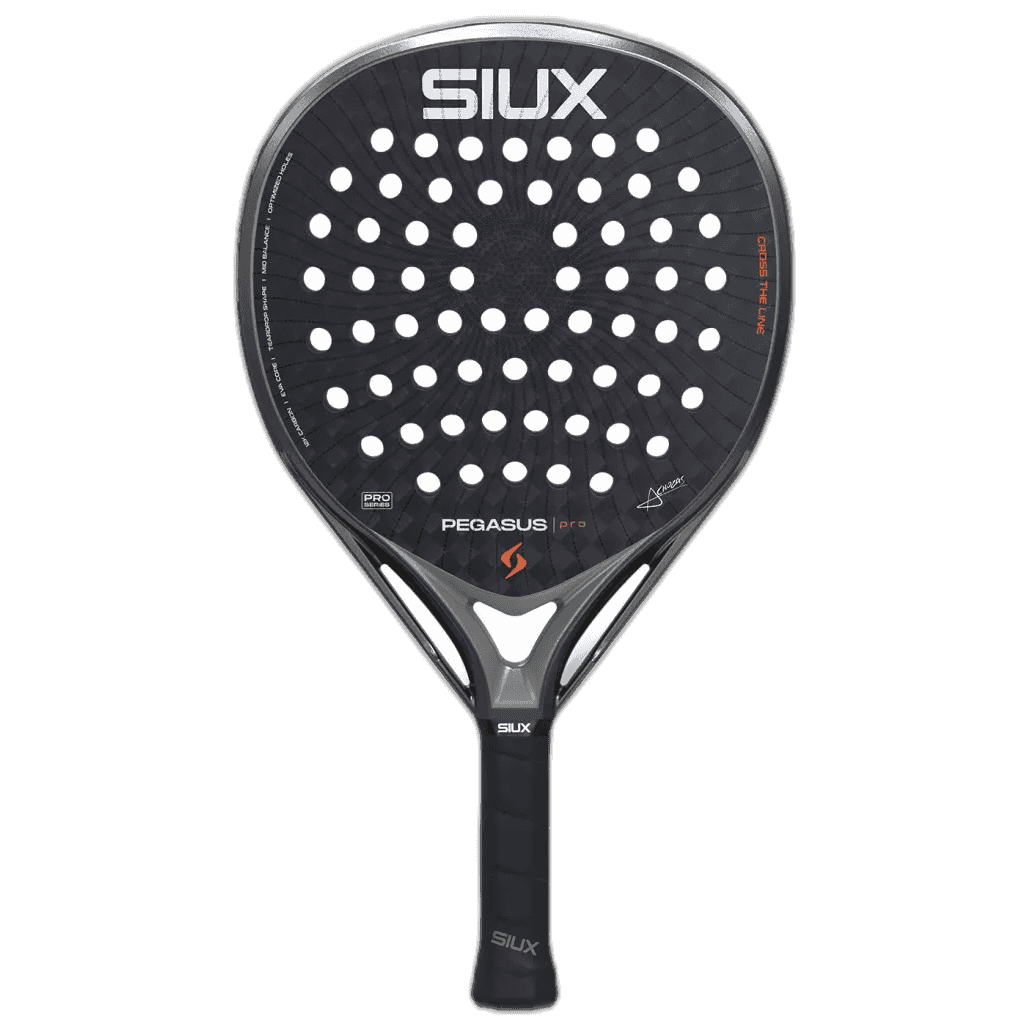
Siux Pegasus Pro Storm Grey 2026 is a racket with a very clear attacking bias, but not a wild one. It feels firm, precise, and demanding. I’d read it as a weapon for players who want to pressure points from the first volley and are happy to earn their rewards with clean timing.
The combination of tear shape, 12K carbon faces, and a hard feel gives it a serious, direct response. It does not hide mistakes. Off-center contact is felt immediately, and passive defense is not its comfort zone. When you swing with intent, though, it produces a lot.
Technical analysis
Shape & balance
The tear shape gives this Siux a useful middle ground between strike power and usable control, but I wouldn’t call it forgiving. The balance sits in a place that helps you load the ball on offensive shots without making the racket feel sluggish in hand. In other words, it wants to attack, yet it still lets me place the ball with decent order.
What I like is that the frame does not feel loose or unstable when I speed up the swing. What I don’t like is that the sweet spot is not generous enough to let lazy mechanics slide. If contact drifts away from the center, the response drops off quickly.
Materials & construction
The carbon fiber frame and 12K carbon faces create a rigid, fairly crisp structure. That is exactly why the racket feels so direct on impact. The EVA PRO core keeps the response firm and compressed rather than lively, which suits aggressive players who prefer to take charge of the point with their own swing.
This construction also explains the hard feel. There is good precision, but not much cushioning. I can feel why reviewers keep pointing to arm fatigue over long matches: the racket does not filter much vibration, and if your technique gets sloppy, the frame reminds you.
On-court feel
Baseline play
From the baseline, it asks for proper preparation. Defensive lobs and blocks are possible, but they are not automatic. I need to put the racket in early and keep the stroke compact, otherwise the ball comes back with less depth than I want. Low-driven lobs come off well when I commit, but passive defense is not where this racket earns its keep.
That said, the response is very stable when I strike cleanly. It gives me a firm, controlled sensation on loaded groundstrokes and helps me direct the ball with intent. It just does not forgive late contact or lazy hands.
At the net
This is where it feels at home. Volleys come out heavy and sharp, and the racket makes it easy to keep pressure on the opponent’s toes. I also like the precision on fast exchanges because the face does not wobble. It feels connected to the ball, not soft or vague.
Bandeja and víbora
The rough surface earns its place here. On bandeja and víbora, I can create a lot of spin without having to force the wrist. The texture helps the ball bite the face, and the hard construction gives the shot a more aggressive finish.
The downside is that these shots reward committed mechanics. If I get tentative, the racket does not rescue me with free output. It wants an active swing and clean timing.
Conclusion
I see this as a racket for advanced players, or at least very committed intermediates, who live comfortably with a hard response and want their racket to reward offensive intent. It makes more sense if your game is built around volleys, spin, and controlled aggression.
What you trade off is comfort and forgiveness. It is not friendly on passive defense, and it can feel demanding on the arm in longer sessions. But if you like a firm, accurate racket that bites on attacking shots and does not blur the feedback, this one makes a strong case.
What other reviewers say
- PadelRacketReviewsen
The review frames it as a clearly attack-first racket: it shines on volleys, viboras, and bandejas when the swing is committed, and the rough surface helps generate plenty of spin. In return, it demands clean technique and punishes passive defense or off-center hits, while feeling harsh on the arm over long matches.
- Padelgidsnl
The editorial page presents it as a pro-level racket that balances power, control, and precision, meant to dominate with aggressive smashes without losing handling on touch shots and defense. It also emphasizes that the hard core gives strong output and that the 3D texture noticeably improves spin.
Switch Intelligence
Be the first to share where you switched from.
Community reviews
Real feedback from players who used this racket.
6 reviews


Add your review
To submit your review, log in first. You can still read all approved community reviews below.
Add review


