

Tactical El Jefe Master Edition 2026 Lucas Bergamini
A round, quick-handling control racket that gives the baseline more depth and keeps enough pace in reserve for a clean finish.
Our Take
Shape
Round
Weight
355 - 365 gr
Touch
Medium-Soft
Core
5-Layer Hybrid Foam
Faces
3K Lightweight Carbon Fiber
What we like
- Broad sweet spot on blocks
- Quick wrist adjustments at net
- Deep defensive lobs with ease
What we don't
- Limited leverage on smashes
- Passive swings lack free pace
- Off-center contact feels communicative
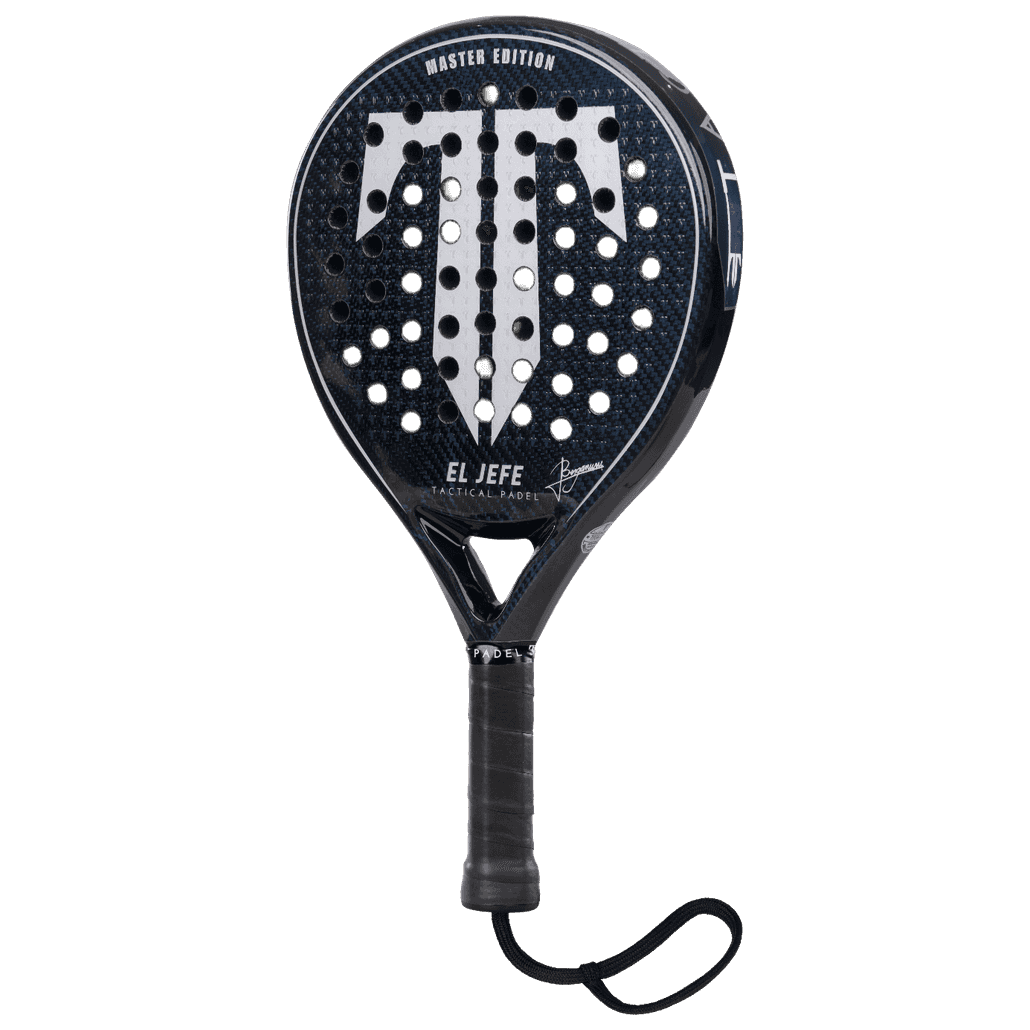
Tactical El Jefe Master Edition 2026 Lucas Bergamini is a control racket that wants to keep the point organized. It is quick through the air, forgiving around the center, and far more interested in depth and placement than blasting winners from anywhere on court.
I felt its character most clearly in defense and during fast exchanges at the net. The power is there when I accelerate, but this is not a head-heavy weapon built around easy smashes.
It suits players who construct points, use the lob well, and want a racket that responds cleanly without feeling overly stiff.
Technical analysis
Shape & balance
The round shape gives this racket its broad, accessible sweet spot. Contact slightly away from center remains predictable, which matters on rushed blocks, defensive lobs, and off-the-wall balls where clean timing is not always available.
Its reported low balance is equally important. The head comes around quickly, and I found it easy to make late adjustments with the wrist. That agility helps in compact volley exchanges and when changing from a defensive position into a counterattack. The trade-off is clear: it does not generate the same natural leverage overhead as a higher-balance racket. You have to create the acceleration yourself.
Materials & construction
The faces use 3K Lightweight Carbon Fiber, paired with a 5-layer hybrid foam core. On court, that combination produces a medium-soft feel with a fairly direct response. The ball does not sink excessively into the face, but there is enough give to make defensive shots and controlled volleys feel accessible.
Ball exit is strong on active strokes. If I push through a forehand from the baseline or drive a low ball after the glass, the racket returns useful depth without needing a huge swing. Comfort, however, is not its strongest argument. The response is not harsh, but players looking for a heavily damped, ultra-plush racket may find it a little too communicative on off-center contact.
On-court feel
Baseline play
From the baseline, El Jefe feels very composed. The large sweet spot and manageable head make it easier to block hard balls and send a defensive lob deep enough to reset the point. I particularly liked its response on low-driven lobs: there is enough ball exit to get the ball moving without losing the line.
It rewards a player who chooses targets. I could work corners, play a measured chiquita, or use a controlled drive through the middle with confidence. What it does not do is add free pace to passive swings. If I arrive late and simply put the racket behind the ball, the return is safe but not especially heavy.
At the net
Quick preparation is one of its better traits. In volley exchanges, the racket stays maneuverable and lets me keep the face stable without feeling like the head is pulling downward. Directional control is strong, especially when blocking toward the feet or opening the face for an angled drop shot.
The softer side of the response also helps take pace off the ball. Still, players who like to finish volleys with sheer weight may want more firmness and more head mass. This racket places the ball well; it does not automatically crush it.
Bandeja and víbora
The low balance makes repeat overheads comfortable. I could play a controlled bandeja with good margin and recover quickly for the next ball. A víbora can be accelerated cleanly too, though the racket favors direction and depth over a violently heavy ball.
Smash
The smash ceiling is moderate. With sound technique and full acceleration, it produces enough pace to close a short ball. But it is not the racket I would choose for easy power or for relying on the racket to help bring the ball back over the fence.
Conclusion
I would put El Jefe Master Edition in the hands of an intermediate to advanced player who values control, defensive depth, and quick handling. It makes sense for someone who wins points through placement, consistency, and intelligent transitions to the net.
The trade-off is power. It will support an aggressive player, but it will not replace the leverage of a more head-heavy, harder racket on smashes and heavy overheads.
For my game, its appeal is simple: it keeps the racket fast, the sweet spot generous, and the ball under control when the point gets messy.
What other reviewers say
- padel.howen
This review positions the El Jefe Master Edition as a point-building racket: it delivers above-average control and defensive depth, with a direct response that rewards clean contact and placement. Its smash ceiling is more limited, and comfort does not stand out against more damped alternatives.
- PadelRallyen
The review describes it as a complete control-oriented racket: its round shape, low balance, and expanded sweet spot support wrist maneuverability and precision. It still provides usable pace to finish points when the player accelerates, without being a pure power frame.
Switch Intelligence
Be the first to share where you switched from.
Community reviews
Real feedback from players who used this racket.
Add your review
To submit your review, log in first. You can still read all approved community reviews below.
Add review


