

Tactical El Jefe Midnight 3K 2026 Lucas Bergamini
A round, forgiving control racket with a soft, quick response that keeps the ball obedient from defense to the net.
Our Take
Shape
Round
Weight
355 - 365 gr
Touch
Medium-Soft
Core
5-layer hybrid foam
Faces
3K lightweight carbon fiber
Frame
Carbon construction
What we like
- Broad sweet spot on defense
- Quick handling for net blocks
- Controlled defensive lob ball exit
What we don't
- Overheads lack natural penetration
- Off-center contact loses precision
- Put-away volleys need acceleration
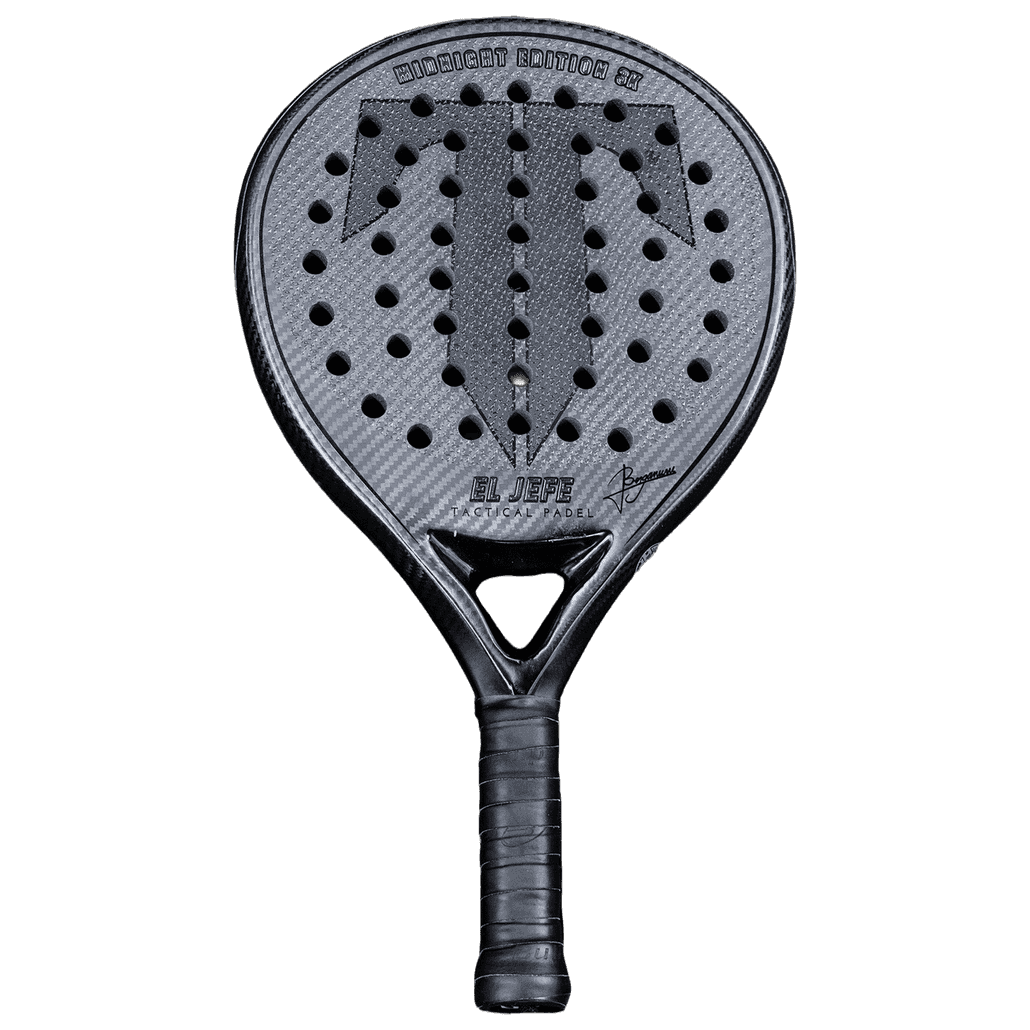
Tactical El Jefe Midnight 3K 2026 Lucas Bergamini is a control-first racket with enough liveliness to keep defensive play from feeling passive. Its Round shape, broad sweet spot, and Medium-Soft response make it a racket I’d reach for when placement and consistency matter more than brute-force finishing.
This is not a cannon for easy winners from anywhere on court. It rewards clean timing, patient construction, and using the whole court rather than trying to end every ball with the first smash.
The character is calm and forgiving, but not vague. I found it particularly suited to players who want a reliable contact point without the disconnected feel that some softer round rackets can have.
Technical analysis
Shape & balance
The round mold puts the sweet spot centrally and keeps the racket quick through preparation. That shows up most on hurried blocks, defensive lobs, and exchanges at the net where I need to adjust late. The balance feels manageable rather than head-heavy, so the frame does not drag behind the hand during compact swings.
That maneuverability comes with a trade-off. Players accustomed to a diamond or aggressively head-heavy racket may find the ball less naturally penetrating on overheads. I can generate pace, but I have to bring it myself through acceleration and technique.
Materials & construction
The Carbon construction frame gives the racket a stable base, while the 3K Lightweight Carbon Fiber faces keep the impact fairly accessible. It is not a hard, sharp carbon response. There is a little dwell time on the ball, which helps me direct volleys and take pace off difficult defensive returns.
The 5-layer hybrid foam core is doing much of the work here. It provides generous ball exit without turning the response overly bouncy. On slower balls, I do not need to force the shot to get depth. On faster exchanges, though, the softer response can feel less precise than a firmer racket if I hit outside the center.
On-court feel
Baseline play
From the baseline, this is where El Jefe makes the strongest case for itself. The large sweet spot is genuinely useful when I am stretched wide or playing off the wall with limited preparation. Blocks come off cleanly, and the racket gives enough rebound to send the ball deep without overhitting.
I also liked it for defensive lobs. The medium-soft contact helps lift the ball with a controlled swing, especially when I am under pressure. What it does not do as well is produce a very low, skidding ball on demand; players who like a firmer, more surgical low-driven lob may want a crisper face.
At the net
At the net, the racket is fast and predictable. Quick volleys, blocks into the middle, and short-angle drop shots are easy to shape because the head moves without much resistance. I can hold the racket steady against pace and still make small directional adjustments late.
Put-away volleys need more input. The ball exits well, but there is not the heavy, automatic punch I get from a stiffer, higher-balance racket. This favors placement and repeated pressure over one-shot violence.
Bandeja and víbora
The manageable balance makes the bandeja comfortable to repeat for long stretches. I can keep the ball deep and work the corners without feeling that the racket is pulling my arm through the swing. The víbora is controlled too, though it delivers more placement than raw penetration.
For a full smash, it is competent rather than fearsome. Flat contact produces respectable speed, but it is not built to make mediocre technique look powerful.
Conclusion
I would put this racket in the hands of intermediate and advanced players who build points with defense, direction, and steady net play. It has a forgiving contact zone, quick handling, and enough ball exit to remain useful when the point gets messy.
The trade-off is clear: it will not provide the heavy overhead finish or hard, explosive response of a more attack-focused racket. If my game depends on dominating with smash power, I would look elsewhere. If I want a composed round racket that helps me play cleaner padel under pressure, this is a convincing option.
Switch Intelligence
Be the first to share where you switched from.
Community reviews
Real feedback from players who used this racket.
Add your review
To submit your review, log in first. You can still read all approved community reviews below.
Add review


