

Varlion Bourne Summum Prisma Airflow W 2024
A sharp diamond built for decisive overheads, yet composed enough to keep the point together from the baseline.
Our Take
Shape
Diamond
Weight
340 - 375 gr
Touch
Medium-Hard
Core
Hypersoft Foam (hard core for below 25°C)
Faces
12K carbon fiber + 3K plain carbon weave + thin fiberglass
Frame
Bidirectional carbon tubular
What we like
- Penetrating *víbora* trajectory
- Stable, weighty net volleys
- Controlled off-the-wall response
What we don't
- Demanding late defensive blocks
- Limited ball exit on slow swings
- High sweet spot punishes low contact
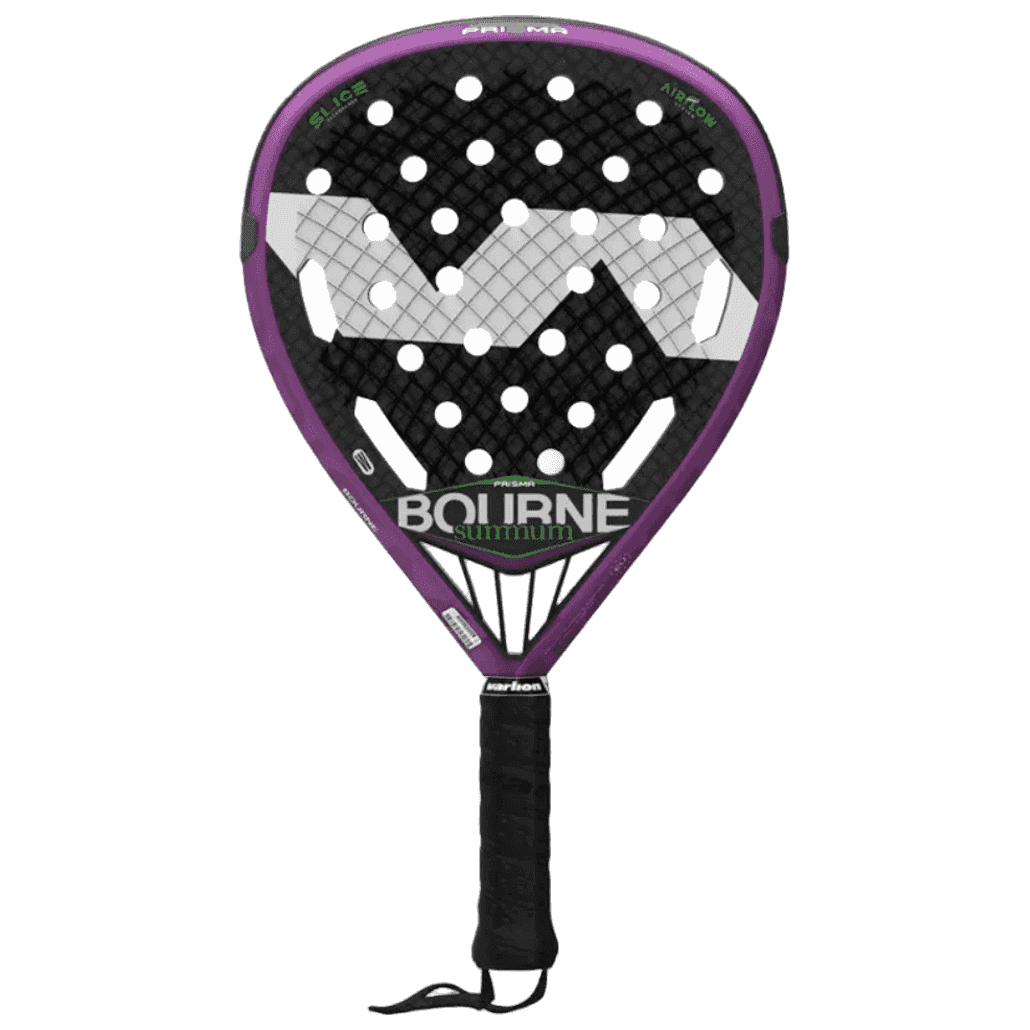
Varlion Bourne Summum Prisma Airflow W 2024 is an attacking racket with a very clear bias toward finishing points. Its diamond shape, high balance, and medium-hard feel put the emphasis on acceleration above the net, not passive comfort from the baseline.
I see it as a racket for players who already generate a reasonably clean swing and want more penetration on volleys, overheads, and the smash. It is not a forgiving “just get the ball back” option.
The Bourne’s character is demanding but not completely brutal. There is enough touch in the construction to keep it usable outside attack, though I would not choose it for a defense-first game.
Technical analysis
Shape & balance
The diamond mold places the sweet spot higher than on a round or hybrid racket. That changes the timing: when I contact the ball out in front, especially on overheads, the racket feels fast and forceful through the ball. Miss that contact point, however, and the response becomes less predictable.
Its high balance creates real leverage on aggressive volleys and low-driven lobs. The trade-off is clear in quick exchanges: it does not move as effortlessly as a head-light racket, and late defensive blocks can feel cumbersome. Players with compact preparation will manage it better than those who rely on last-second wrist corrections.
Materials & construction
Varlion uses a bidirectional carbon tubular frame, 12K carbon with plain 3K carbon and fine fiberglass in the faces, plus a FOAM Hypersoft core designed to retain firmness in cold conditions. On court, that recipe points to a firm, relatively direct response rather than a soft, trampoline-like ball exit.
I expect the thin fiberglass layer to take a little edge off the carbon face, but this is still a racket that rewards an active stroke. The core does not give away much free depth at low swing speed. That can be a strength for placement, yet it makes defensive recovery shots more demanding than with a softer EVA setup.
On-court feel
Baseline play
From the baseline, I found the Bourne more capable than its aggressive profile suggests, provided I prepared early. It gives a stable platform for blocks and lets me send a defensive lob with good direction when I strike cleanly. Off-the-wall play feels firm and controlled rather than bouncy.
What it will not do is rescue poor positioning. A relaxed, short swing does not produce much easy ball exit, and the higher balance becomes noticeable when I am stretched wide or defending fast balls at my body. This is a racket that asks me to use my legs and meet the ball properly.
At the net
At the net, the racket makes much more sense. Firm volleys come off with weight, and I can press the middle without feeling that the face twists easily. The larger-than-expected usable hitting area helps on fast exchanges, although the actual sweet spot still sits high enough that low contacts need attention.
For chiquitas and touch drop shots, I need softer hands than with a softer racket. The response is clean, but not naturally plush. It favors purposeful, forward volleys over delicate manipulation.
Bandeja and víbora
This is one of its strongest areas. The head-heavy setup helps me carry speed through the ball on a bandeja, while the firmer face gives the víbora a penetrating trajectory. I can hit with intent without the racket feeling vague at impact.
It is less friendly for players who use overheads mainly to reset the point. The racket wants a committed swing and clean timing; otherwise, the ball can leave flatter than intended.
Conclusion
I would choose this racket for an advanced attacking player who spends plenty of time at the net and wants a serious overhead weapon. Its power-oriented behavior is backed up by a stable frame, firm faces, and a response that stays composed under pressure.
The trade-off is comfort. Defensive play, low contacts, and slow swings require more work than they do with a softer, lower-balanced racket. If I want easy depth and maximum maneuverability, I would look elsewhere.
Switch Intelligence
Be the first to share where you switched from.
Community reviews
Real feedback from players who used this racket.
Add your review
To submit your review, log in first. You can still read all approved community reviews below.
Add review


