

Varlion Maxima Summum Prisma Airflow S 2024
A quick, firm teardrop that brings real punch overhead while keeping the hands fast enough for sharp defensive work.
Our Take
Shape
Tear
Core
S rubber: hard core for temperatures above 25°C
Faces
12K carbon fiber + plain 3K carbon weave + thin fiberglass
Frame
Bidirectional carbon tubular
What we like
- Quick handling in net exchanges
- Stable directional blocks and volleys
- Precise *bandeja* and *víbora* placement
What we don't
- Demanding on slow defensive balls
- Short response when contact is late
- Hard touch on drop shots
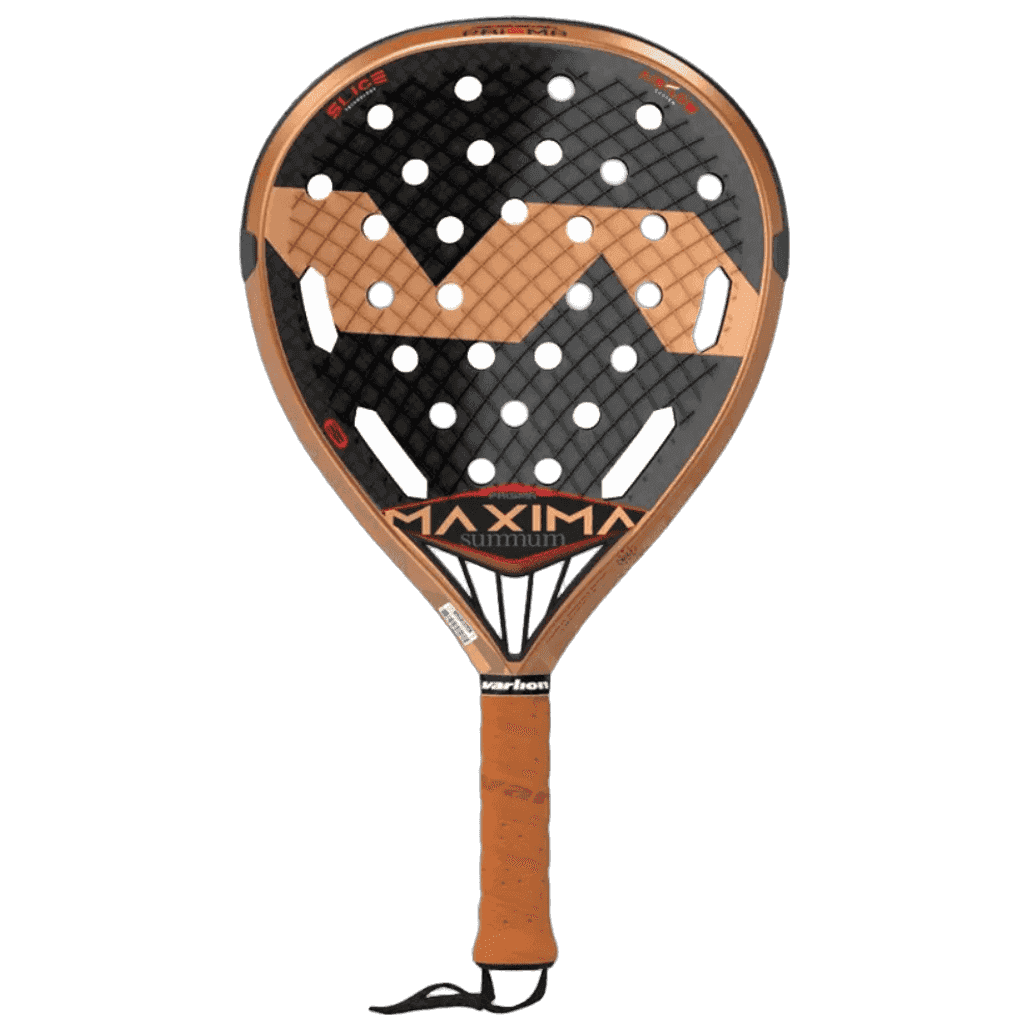
Varlion Maxima Summum Prisma Airflow S 2024 is a firm, attack-minded racket that still gives me enough steering from the baseline to avoid feeling one-dimensional. It is built for players who hit through the ball rather than relying on easy rebound.
The S core gives it a distinctly hard feel, especially in warm conditions. I get a crisp, connected response, but the racket does not do much of the work for me on slow defensive balls.
Its quick handling is the surprise. Despite its power-oriented build, it does not feel cumbersome during fast exchanges at the net.
Technical analysis
Shape & balance
The tear shape gives this Maxima a broader operating range than a pure diamond racket. The sweet spot is reasonably generous for a firm, offensive model, sitting high enough to reward aggressive overheads without making every low contact feel like a mis-hit.
I would describe the balance as medium-high rather than brutally head-heavy. The Prisma Airflow construction helps the racket come through the air cleanly, which I notice most when changing direction quickly on volleys or preparing late for a víbora. It still asks for clean timing, though. Players with a compact, passive swing may find it demanding from deep in the court.
Materials & construction
Varlion uses a bidirectional carbon tubular frame, with faces combining 12K carbon, plain 3K carbon, and a thin fiberglass layer. That mix produces a firm face without the completely dry, board-like impact some full-carbon rackets can have.
The S rubber core is specified as hard above 25°C, and that temperature sensitivity matters. In warmer conditions, I feel a very direct response: excellent when I accelerate through a volley, smash, or low-driven lob, less forgiving when I am just trying to lift the ball back into play. Ball exit is controlled rather than explosive. I need to supply the pace.
On-court feel
Baseline play
From the baseline, this racket rewards proper preparation. Blocks stay stable and directional, and I can send a defensive lob deep without the face wobbling at impact. The firm core also helps me keep the ball low on flatter counterattacks.
The trade-off is comfort. Off-the-wall play requires a more active swing than with a softer EVA racket, particularly on balls that arrive slow and low. If I am late, the response can feel short. This is not the racket I would choose for effortless defense or for players who want a large, soft safety net around the sweet spot.
At the net
At the net, the Maxima feels more natural. It moves quickly enough for hand battles, while the firmer face lets me punch volleys through the court without overhitting. There is good stability on hard blocks, and the racket keeps its line well when I redirect pace.
Touch shots require discipline. A chiquita or drop shot can be precise, but I need soft hands; the hard response does not automatically cushion the ball. The same applies to short angled volleys. It can do them, but it favors a committed strike over delicate improvisation.
Bandeja and víbora
This is one of its strongest areas. The balance and crisp face make it easy for me to accelerate a bandeja with depth or flatten a víbora into the corner. I get a direct sense of where the face is pointing, which matters when I am trying to keep opponents pinned behind the service line.
On the smash, it has plenty of punch, but it is not a free-power racket. Clean technique and racket-head speed are still required. In return, I get more placement than I usually expect from a racket with this much offensive intent.
Conclusion
I would put the Maxima Summum Prisma Airflow S 2024 in the hands of an experienced player who likes a firm response, attacks from the net, and can generate their own pace. It suits an aggressive player who still values a usable tear-shaped sweet spot.
Its strengths are stability, maneuverability, precise overheads, and a controlled kind of power. The cost is clear: it is less comfortable on slow defensive balls, less forgiving on off-center contact, and not especially helpful for players who depend on soft ball exit.
Switch Intelligence
Be the first to share where you switched from.
Community reviews
Real feedback from players who used this racket.
Add your review
To submit your review, log in first. You can still read all approved community reviews below.
Add review


