

Varlion LW Summum Prisma Airflow S 2024
A quick, round control racket with a firm foam response, wide sweet spot, and enough punch to finish without forcing the issue.
Our Take
Shape
Round
Weight
350 - 375 gr
Touch
Medium-Hard
Core
Hypersoft Foam (hard core for temperatures above 25°C)
Faces
12K carbon fiber + 3K plain carbon weave + thin fiberglass
Frame
Bidirectional carbon tubular frame
What we like
- Large sweet spot on blocks
- Fast handling in volley exchanges
- Precise *bandeja* placement
What we don't
- Passive blocks lack depth
- Smashes require clean acceleration
- Limited bite on spin shots
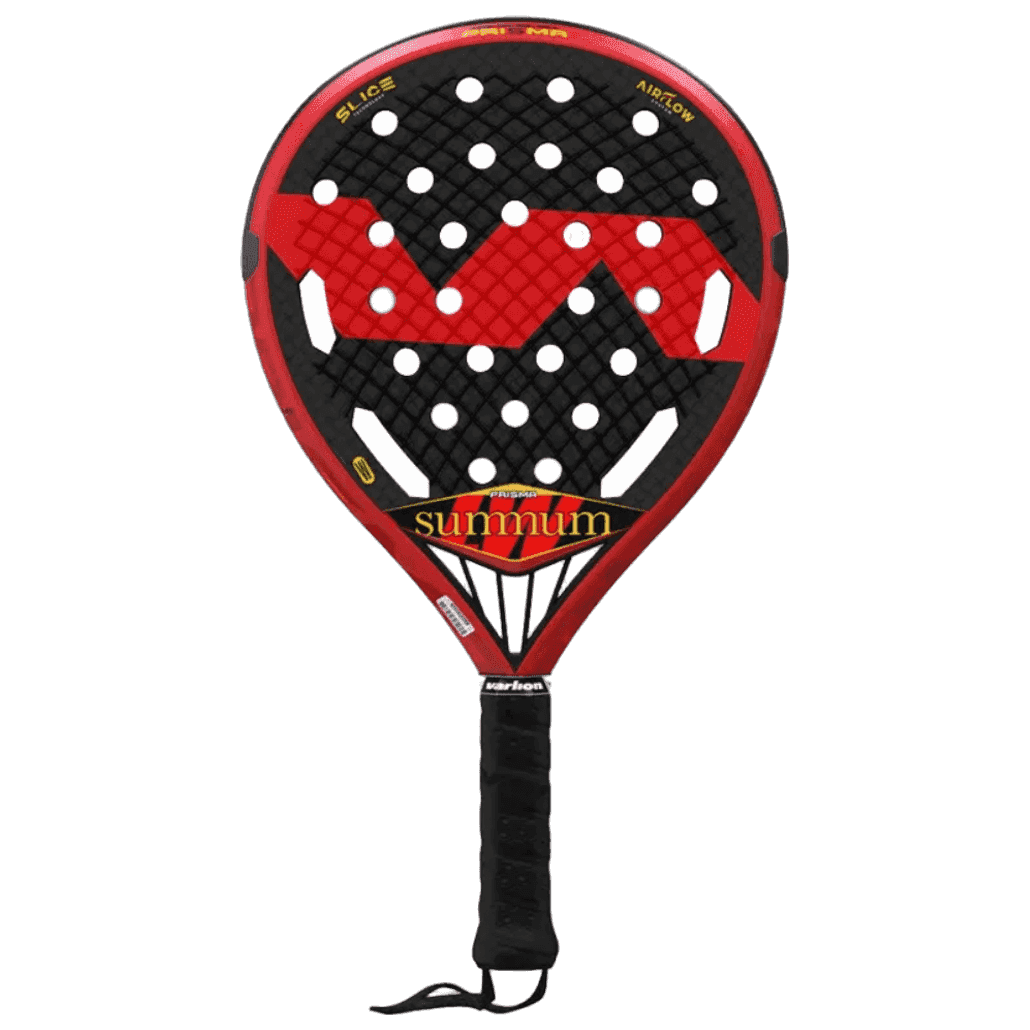
The Varlion LW Summum Prisma Airflow S 2024 is a control-first racket with a firmer, more technical response than its round shape suggests. It is quick through the air, very forgiving around the center, and built for players who win points by placing the ball well rather than forcing every finish.
I see it as a serious option for an intermediate-to-advanced player who spends plenty of time constructing from the baseline and wants a fast racket at the net. It will not hand out easy power, though. You need to accelerate cleanly if you want the ball to really travel.
Its character is precise, stable, and fairly dry in warm conditions. That last point matters with this core: the feel can become more demanding as temperatures rise.
Technical analysis
Shape & balance
The round shape gives this racket its broad, usable hitting area. With a very large sweet spot, I found it easier to keep defensive blocks and volleys on line even when contact was not completely clean. That is a real benefit in fast exchanges, especially when the ball arrives into the body.
Varlion’s Prisma frame profile and Airflow-oriented construction also support its standout trait: maneuverability. The racket gets into position quickly for late defensive contacts, compact volleys, and rushed overheads. It does not feel head-heavy, so I could change direction without fighting the frame.
That said, the low balance limits its finishing ceiling. A well-hit smash has enough penetration, but this is not the racket I would choose purely to generate easy overhead power from average technique.
Materials & construction
The frame uses bidirectional carbon tubular construction, while the faces combine 12K carbon, plain 3K carbon fabric, and a thin fiberglass layer. The result is not a harsh carbon-board sensation; there is some dwell time on the ball, but the face still responds with a defined, fairly direct impact.
Inside sits Foam Hypersoft, described as a hard core for temperatures above 25°C. That helps explain the racket’s medium-hard feel. In warmer conditions, it should suit players who like a crisp response and prefer to create their own ball exit. In colder weather, I would expect a little more comfort and rebound, although it still will not feel especially soft.
The mixed face construction adds some forgiveness, but this remains a racket that rewards clean mechanics. Players who rely on the racket to lift short balls from deep defense may find the response too restrained.
On-court feel
Baseline play
From the baseline, this is where the LW Summum Prisma Airflow S makes most sense. The large sweet spot gives confidence on off-the-wall play, and the fast handling helps when I need to prepare late after a difficult rebound. Defensive lobs are easy to direct, particularly when I can get under the ball and use a full swing.
Low-driven lobs and controlled counterattacks are also a strength. The racket does not launch the ball unpredictably, so I can hit with margin without feeling that the face is doing too much for me.
The trade-off is ball exit. Against heavy pace, a passive block can land short unless I add something to the shot. It is more accurate than explosive.
At the net
At the net, the maneuverability is immediately noticeable. I liked it for quick forehand-backhand volley exchanges, where a compact movement and a stable face matter more than raw punch. It is also a useful racket for placing a chiquita or a short drop shot without overhitting.
On harder volleys, the response is clean but not automatically heavy. I had to drive through the ball to produce depth and penetration. Players who want their racket to do more of the work may prefer a softer core or a higher balance.
Bandeja and víbora
The quick head speed works well for controlled overheads. My bandeja felt easy to shape and place toward the side wall, while the stable sweet spot helped keep the face controlled when contact drifted slightly away from center.
The víbora is more about direction and consistency than violent speed. I could accelerate it, but the racket does not produce the same heavy, attacking ball as a more head-heavy diamond model.
Conclusion
I would recommend this racket to players who prioritize control, speed in hand, and a forgiving contact area without wanting a soft, vague response. It suits a player who builds points patiently, uses placement at the net, and values reliable defense.
The compromise is clear: power is available, but it has to come from your technique. If your game depends on effortless smashes, booming volleys, or passive ball exit from the back of the court, this Varlion may feel too restrained.
For a technically sound player who wants a quick round racket with a firmer edge, it has a very coherent identity.
Switch Intelligence
Be the first to share where you switched from.
Community reviews
Real feedback from players who used this racket.
Add your review
To submit your review, log in first. You can still read all approved community reviews below.
Add review


