

Babolat Air Crest 2026
A soft, quick tear shape that makes defense forgiving and keeps the ball moving fast without asking much of your arm.
Our Take
Shape
Tear
Weight
345 gr
Touch
Soft
Core
EVA Soft
Faces
Fiberglass
Frame
Hybrid Frame (carbon and fiberglass)
What we like
- Easy defensive ball exit
- Large, forgiving sweet spot
- Fast hands on volleys
What we don't
- Lacks heavy smash penetration
- Springy response on short balls
- Limited bite on víboras
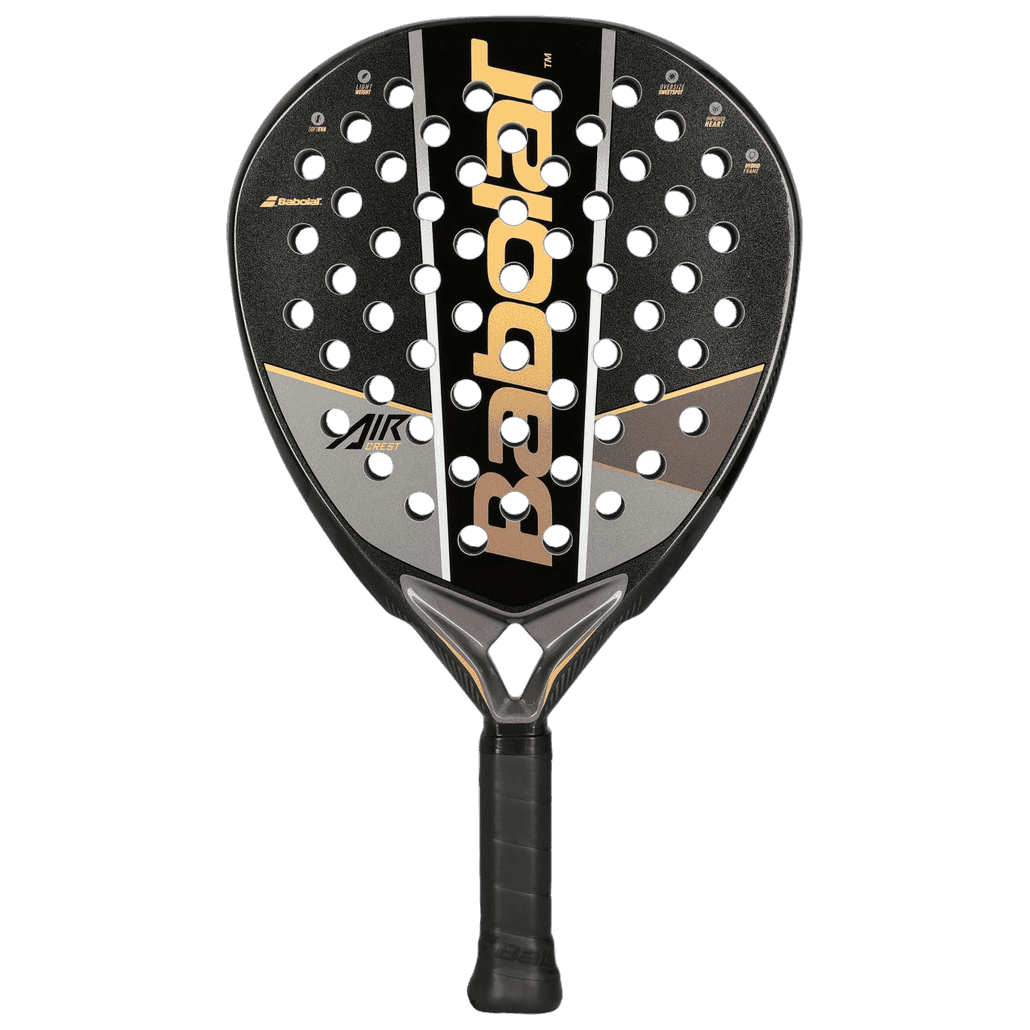
Babolat Air Crest 2026 is a quick, forgiving racket built around easy ball exit rather than brute force. It feels made for the player who wants to defend comfortably, arrive early at the net, and keep the ball moving without having to swing at full speed.
The tear shape gives it a more attacking profile than a round racket, but its soft feel keeps the response friendly. This is not a power racket in disguise. It is a fast, elastic all-court option with a very large margin for error.
Technical analysis
Shape & balance
The tear shape places the sweet spot higher than on a control-focused round racket, though not so high that the racket becomes demanding from the baseline. Its balance feels manageable in the hand, and the maneuverability is one of the clearest parts of its character. I can get the head through quickly on volleys, reaction blocks, and late defensive shots.
That speed comes with a trade-off. The racket does not carry the same punch through the ball as a firmer, head-heavy model. If I want to finish a point with a flat smash, I need clean technique and good acceleration. It helps me create speed; it does not create heavy ball by itself.
Materials & construction
Babolat uses a Hybrid Frame, combining carbon and fiberglass, with fiberglass faces and an EVA Soft core. On court, that package points toward comfort and rebound. The faces flex readily, so the ball leaves the racket with very little effort, especially on slower defensive contacts.
The sweet spot is notably generous. Misses toward the upper and outer areas remain playable rather than dying off the face, which makes it reassuring during rushed exchanges. The downside is a less crisp impact than I get from carbon-faced rackets. Players who want a hard, direct response for punch volleys and aggressive overheads may find it slightly too springy.
On-court feel
Baseline play
From the baseline, the Air Crest is easy to use. It gives me free depth on defensive lobs, blocked returns, and off-the-wall balls where I cannot fully prepare. The soft core absorbs pace well enough that I can steady the racket face and send the ball back deep without fighting it.
Ball exit is very high, however, and that needs a little adjustment. On short balls or low-driven lobs, I have to soften my hands and shorten the swing; otherwise, the racket can launch the ball more than I intended. It rewards touch, but not lazy touch.
At the net
At the net, the fast handling is a real asset. Quick volleys, body shots, and blocks feel natural because the racket changes direction easily. I particularly liked its forgiveness when reacting late to a hard counterattack: the large sweet spot keeps the response stable enough to stay in the point.
For controlled placement, it works well. A chiquita or softer angled volley comes off cleanly, with enough dwell time to feel the ball. What it lacks is that firm, penetrating response that makes a volley feel heavy through the court. Against strong opponents, I need to supply the pace myself.
Bandeja and víbora
The Air Crest is comfortable for a bandeja because it moves quickly through the overhead preparation and does not punish slightly off-center contact. I can keep the ball deep with a relaxed swing, which matters when defending the net position rather than trying to force a winner.
The víbora is less natural. There is enough maneuverability to create racket-head speed, but the soft face does not give the same sharp, biting finish as a firmer carbon setup. It is more about placement and continuity than making the ball skid aggressively after the glass.
Conclusion
I would choose the Air Crest 2026 as an intermediate player who values easy defense, fast hands, and a forgiving response in regular club matches. It suits a player who builds points, uses the lob well, and prefers to win net exchanges through consistency and positioning.
The trade-off is clear: comfort and rebound come before authority. It will help on rushed blocks and off-the-wall recovery, but it will not give a naturally heavy smash or the dry precision that aggressive carbon rackets provide.
Switch Intelligence
Be the first to share where you switched from.
Community reviews
Real feedback from players who used this racket.
Add your review
To submit your review, log in first. You can still read all approved community reviews below.
Add review


