

Enebe Mustang Gold 15K 2026
A firm, composed tear-shape that brings real pace overhead while keeping enough touch to work the point from the baseline.
Our Take
Shape
Tear
Weight
355 - 370 gr
Touch
Medium-Hard
Core
Professional EVA (Soft-Medium Density)
Faces
15K Carbon
Frame
Carbon
What we like
- Stable, punchy net volleys
- Directed *bandeja* and *víbora*
- Controlled low-driven lob placement
What we don't
- Limited free depth on defense
- Less forgiving on late contact
- Delicate drop shots need touch
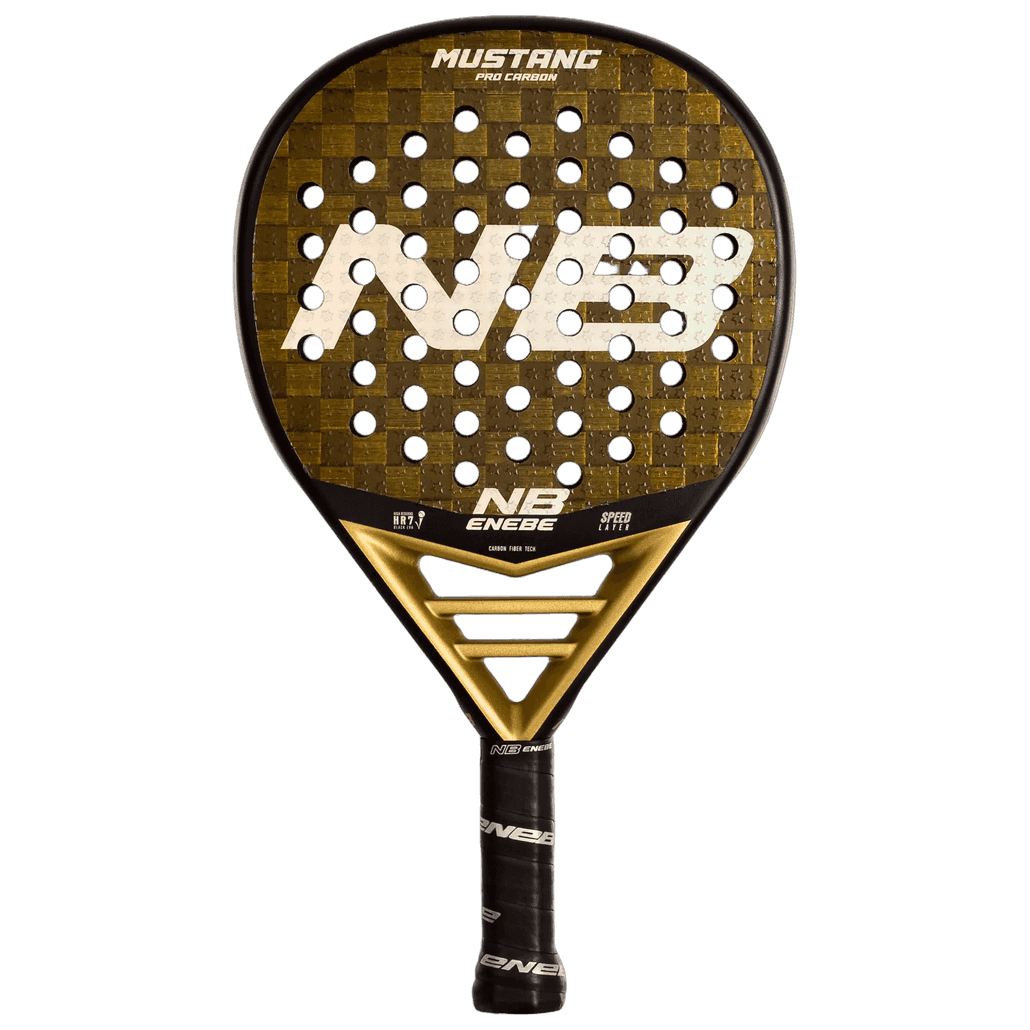
Enebe Mustang Gold 15K 2026 is an attacking all-court racket with a firmer, more deliberate response than its soft-medium core might suggest. It is built for players who want to press from the net and finish overheads without giving up too much order from the baseline.
Its tear shape keeps the balance around the middle without pushing it into a demanding, head-heavy feel. I see it fitting intermediate-advanced players who generate their own racket speed and prefer a crisp contact over a springy one.
The medium-hard feel is the key to its character. This is not a forgiving, plush racket that sends the ball deep from a lazy defensive block.
Technical analysis
Shape & balance
The tear mold gives the Mustang Gold a more centered sweet spot than a diamond racket, while still leaving enough mass toward the head for attacking shots. That matters in fast exchanges: I can accelerate through volleys and overheads without feeling that the racket is trying to pull my hand forward.
Maneuverability should be good for its attacking profile, but it will not feel as quick through the air as a genuinely head-light round racket. Players who rely on late wrist adjustments at the net may find it a little less forgiving than a control-first model.
Materials & construction
A carbon frame gives the structure a stable base, while the 15K carbon faces should produce the firmer, cleaner impact associated with a more direct response. There is less of that trampoline-style ball exit you get from softer fiberglass faces; I would expect the racket to reward a committed swing more than a passive one.
The Professional EVA soft-medium-density core softens the impact enough to stop the racket from becoming overly dry. Still, the face material and listed feel point toward controlled output rather than easy rebound. On slower defensive contacts, I would not expect it to provide much free depth.
On-court feel
Baseline play
From the back of the court, the Mustang Gold should feel most reliable when I prepare early and hit through the ball. Its centered tear shape helps on groundstrokes, controlled wall exits, and low-driven lobs where I want direction without opening the face too much.
The trade-off is clear on rushed defense. A soft racket can help rescue a short preparation with more automatic ball exit; this one is likely to ask for cleaner contact. Defensive lobs should be accurate when struck well, but I would not choose it for a player whose game depends on effortless lift and comfort under pressure.
At the net
This is where the racket’s firmer response makes more sense. Volleys should come off with a compact, stable feel, particularly when punching through the middle or blocking hard balls at the body. The face ought to give enough feedback to place a chiquita or take pace off a volley rather than simply launching it.
Touch shots will need a relaxed hand. The medium-hard response can make drop shots and very soft angles feel slightly less natural than they do with a softer-core racket.
Bandeja and víbora
The Mustang Gold looks well suited to an aggressive bandeja and a driven víbora. The tear shape should help carry the racket through the ball, while the carbon face gives a more direct release for players who like to hit with purpose and keep opponents pinned behind the service line.
For the smash, I would expect solid penetration rather than effortless power. It should respond well when I create speed and contact high, but it is not a shortcut for players who do not yet generate clean overhead acceleration.
Conclusion
I would look at the Mustang Gold 15K if my game is moving toward assertive net play, controlled overheads, and firmer volleys. It offers a useful middle ground between a pure power racket and a soft control model.
What I trade for that attacking stability is easy defensive assistance. It will not flatter late contact, loose technique, or players who want a soft, highly elastic ball exit.
Switch Intelligence
Be the first to share where you switched from.
Community reviews
Real feedback from players who used this racket.
Add your review
To submit your review, log in first. You can still read all approved community reviews below.
Add review


