

Nox AT10 Genius 18K Alum Buenos Aires 2026 Agustin Tapia
A firm, responsive tear shape that rewards committed swings, holds steady in defense, and brings bite to every attacking ball.
Our Take
Recommended retail price €390 €284 at PadelProShop
Updated on 18 Nov


Updated on 18 Nov (shipping cost not calculated)
Shape
Tear
Weight
360 - 375 gr
Touch
Medium
Core
MLD Black EVA
Faces
18K Aluminum Carbon Fiber
Frame
Carbon
What we like
- Stable blocks and deep resets
- Easy spin on bandejas, víboras
- Forceful smashes with acceleration
What we don't
- Short swings produce shallow balls
- Head-loaded feel fatigues arm
- Late preparation exposes mishits
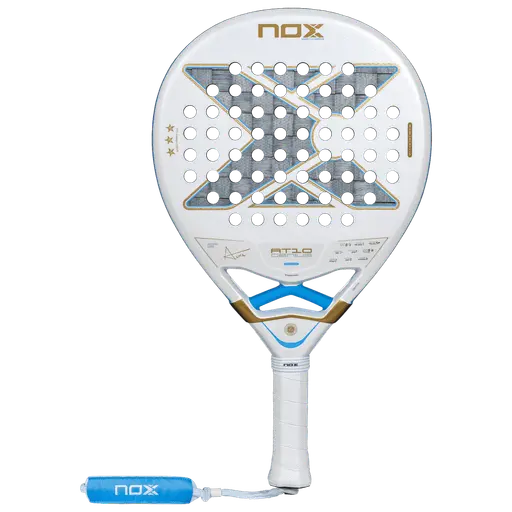
Nox AT10 Genius 18K Alum Buenos Aires 2026 Agustin Tapia is a demanding all-court racket with a clear attacking edge. It does not hand you easy power, but when I accelerate properly, it gives me a heavy, controlled ball and a very dependable response in faster exchanges.
I see it in the hands of an advanced player who builds points from the baseline but wants to take over at the net. It has enough forgiveness for defense, though it is not a relaxed, automatic racket for late preparation.
Technical analysis
Shape & balance
The tear shape gives this racket a useful middle ground between a round control racket and a full diamond attacker. Its balance feels closer to head-heavy than head-light, which helps it carry momentum through volleys, overheads, and aggressive blocks.
That balance also explains the trade-off. The racket feels stable through contact, but it asks for a clean setup. If I am late on a defensive ball or try to flick a short swing from an awkward position, the ball can come off flatter and land shorter than I want.
Materials & construction
Nox combines a Carbon frame, 18K Aluminium Carbon Fibre faces, and an MLD Black Eva core. The result is a Medium feel on paper, although the hitting sensation is firmer and more direct than a softer medium racket.
The faces give the ball a crisp release once I commit to the stroke. There is enough dwell time to shape the ball, but this is not a trampoline-style response that helps every passive shot. Off-center contact is more manageable than I expected from an 18K face, particularly on blocks, yet the sweet spot still rewards proper technique rather than casual contact.
On-court feel
Baseline play
From the baseline, I liked the stability most. Defensive blocks stay composed, and the racket does a good job absorbing pace before sending a controlled return back deep. It is also reliable in off-the-wall play, where the frame does not twist much when the ball arrives heavy or low.
Ball exit is progressive rather than explosive. With a full preparation, I can find depth without forcing the ball. With a compact swing, though, it does not generate much free length. Players who rely on the racket to rescue late defensive lobs may find it a little unforgiving over a long match.
At the net
At the net, the AT10 feels quick enough for its balance and notably solid through the volley. I can block hard drives with confidence, then accelerate the next ball without the face feeling unstable. The response favors firm, directed volleys over soft touch work.
A chiquita or drop shot is possible, but it needs a quiet hand. The firmer construction communicates contact clearly, which I like, though it will expose a heavy grip pressure or rushed wrist action.
Bandeja and víbora
This is one of its better areas. The face gives me easy access to spin on the bandeja and víbora, while the balance helps the racket travel through the ball rather than stall at contact. I can keep the ball low and make it skid after the glass without needing a huge swing.
The racket responds especially well when I accelerate late through the overhead. A slow, guiding action produces a safer but less penetrating ball; it wants intent.
Smash
The smash has plenty of authority, but it is technique-dependent. With timing and arm speed, the racket transfers energy efficiently and produces a direct, forceful finish. It does not feel like a pure power diamond that will manufacture winners from poor positioning.
Conclusion
I would choose this racket for an advanced player who likes to defend with structure, then press forward through volleys, spin-heavy overheads, and well-timed smashes. It suits a player who can generate racket-head speed rather than one looking for effortless output.
Its main compromise is fatigue and forgiveness. The stable, firmer response is excellent when I am prepared, but the head-loaded character can tax the arm during long sessions and does not flatter short or late swings.
What other reviewers say
- PadelTestLaben
It stands out for stable blocks, easy defensive resets and readily available spin on bandejas and víboras. Power arrives with fast, well-timed acceleration; short swings produce a flatter, shallower ball.
- PadelBooen
This review positions it as a versatile, relatively comfortable racket with good ball output and useful performance in both defence and attack. Compared with the 12K version, it finds the 18K more forgiving on defence and off-centre contact, although it still requires sound technique.
- Padelhosten
It describes an attacking racket for the left-side player: fast volleys, bandejas, víboras and smashes feel direct and forceful. In return, the stiff, head-loaded setup punishes mishits and can fatigue the arm during long matches.
Switch Intelligence
Be the first to share where you switched from.
Community reviews
Real feedback from players who used this racket.
Add your review
To submit your review, log in first. You can still read all approved community reviews below.
Add review


