

Siux Electra Pro IT 2026
A firm teardrop that rewards an active swing, bringing crisp bite to the *víbora* while staying composed through busy net exchanges.
Shape
Tear
Weight
365 gr
Touch
Medium-Hard
Core
EVA
Faces
12K Carbon
Frame
3K Carbon
What we like
- Stable blocks and firm volleys
- Heavy sliced *bandeja* and *víbora*
- Direct acceleration on flat smashes
What we don't
- Passive defense lacks easy depth
- Off-center blocks transmit vibration
- Drop shots need deliberate touch
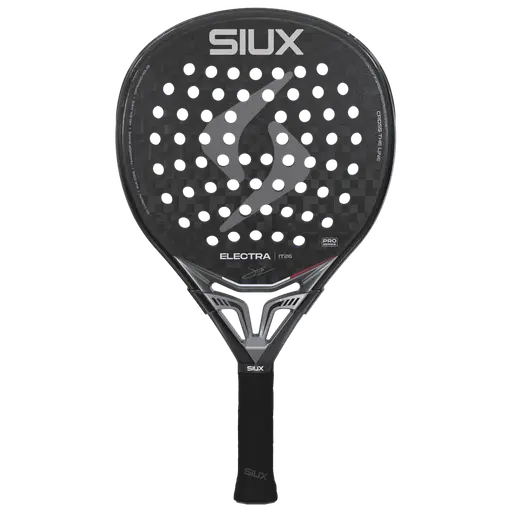
Siux Electra Pro IT 2026 is a firm, attack-minded racket that still keeps enough order to play a complete match. I felt its character most clearly in fast exchanges: it wants a committed swing, clean contact, and an intention to move the point forward.
Its tear shape and medium-hard feel put it between a pure power racket and a softer control-oriented option. It suits intermediate-advanced players who build points from the baseline but want to take charge once they reach the net.
Technical analysis
Shape & balance
The tear format gives the Electra Pro IT a fairly centered balance with a slight attacking bias. It comes through quickly enough for defensive blocks and volley exchanges, yet there is enough mass toward the upper area to make overheads feel substantial.
I found it more maneuverable than many attack-focused rackets, particularly when reacting to a fast volley at the net. The sweet spot is not tiny, but it is not especially forgiving either. Contact outside the central hitting area can feel firmer and send some vibration into the hand, especially on rushed backhand blocks.
Materials & construction
The 3K carbon frame, 12K carbon faces, and EVA core produce a direct, compact response. There is no spongy delay at impact. The ball leaves with purpose when I accelerate through it, while slower swings receive less free help.
The rough face also matters. It gives noticeable bite on sliced shots, particularly when I want to keep a bandeja low or put more curve on a víbora. ShockOut dampeners help take the edge off the firmer construction, but they do not turn this into a plush racket. Players who prefer a very soft, cushioned response may find it too dry.
On-court feel
Baseline play
From the baseline, I liked the precision on active defense. A properly prepared defensive lob can be placed with good height and direction, and off-the-wall play feels stable once I meet the ball in front of my body.
Passive defense is the trade-off. The Electra Pro IT does not produce effortless depth from a short swing. On low balls after the glass, or when I am late and simply need the racket to carry the ball, I have to work harder than I would with a softer face. Low-driven lobs are effective, but only if I accelerate cleanly through them.
At the net
This is where the racket makes most sense. It stays composed through firm volleys and does not wobble when I block a hard counterattack. I can play a compact forehand volley with pace, then soften the next ball into a chiquita without feeling that the racket is fighting me.
Its stability encourages aggressive positioning, although touch shots require deliberate hands. A drop shot is possible, but the firm face gives less automatic delicacy than a softer EVA setup.
Bandeja and víbora
The combination of firm response and textured faces works very well overhead. My bandeja came off with a heavy, controlled slice, while the víbora had enough bite to push opponents toward the side glass rather than merely keeping them back.
On a flat smash, it offers strong acceleration and a solid hit, but it is not a specialized power weapon. Players looking for effortless finishing from any position will find more head-heavy options. This racket rewards timing and technique more than brute force.
Conclusion
I would choose the Electra Pro IT 2026 for an intermediate-advanced player who likes a firmer racket, plays proactively, and values stable volleys, sliced overheads, and controlled attacking pace.
It gives up some easy defensive ball exit and forgiveness on off-center contact. That is the price of its sharper, more demanding response. For players willing to supply the swing, it is a convincing all-court racket with a clear preference for taking over at the net.
What other reviewers say
- PadelTestLabes
This test presents it as a firm, attack-leaning racket: it delivers strong output on smashes, viboras and attacking volleys, while the rough face helps produce heavier slice. It needs an active swing in defence; wall exits, lobs and passive blocks lack easy depth, and off-centre contact can vibrate.
- PadelRacketReviews.comes
The review rates it as a versatile option with strong control, manoeuvrability, sweet spot and comfort, rather than forcing a purely attacking or defensive style. It highlights stable feel and reduced vibration from the ShockOut dampeners, but says it is less outstanding in outright power or pure control than Siux's more specialised models.
Switch Intelligence
Be the first to share where you switched from.
Community reviews
Real feedback from players who used this racket.
Add your review
To submit your review, log in first. You can still read all approved community reviews below.
Add review


