

Hirostar Alien Core 2026 Tolito Aguirre
A firm, control-first diamond that rewards committed swings and keeps enough composure to build points from the baseline.
Shape
Diamond
Weight
365 - 380 gr
Core
EVA Black
Faces
12K Carbon
Frame
100% Carbon
What we like
- Stable punch volleys at net
- Direct *víbora* response
- Controlled offensive overheads
What we don't
- Demanding late defensive contacts
- Less forgiving off-the-wall returns
- Delicate touch shots need adjustment
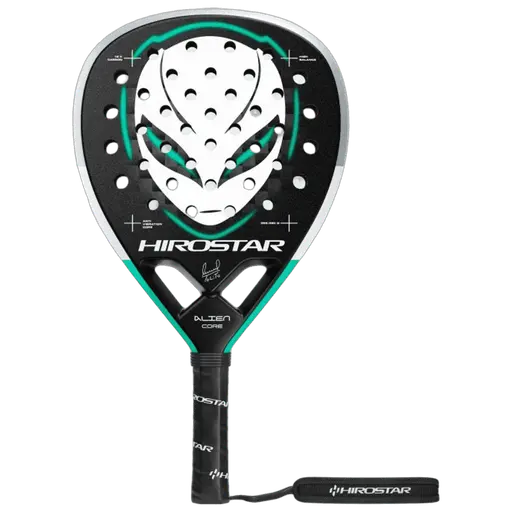
Hirostar Alien Core 2026 Tolito Aguirre is a control-first diamond racket with enough attacking intent to avoid being a one-note tool. Its diamond shape puts the emphasis on taking charge above the net, but the listed control and rebound figures suggest a more measured response than a brutally demanding diamond.
I see it suiting players who build points from pressure: firm volleys, aggressive bandejas, and overheads hit with purpose. It is not a racket that looks designed to make passive defense effortless.
Hirostar lists a medium-high balance. With this shape and construction, I would expect the racket to feel more head-oriented than head-light, even if it should not be an extreme club in the hand.
Technical analysis
Shape & balance
The diamond mold places the sweet spot higher than on a round racket, which generally helps when I am contacting the ball above shoulder height. That matters on attacking volleys and the smash, where the racket should reward a full, committed swing.
The trade-off is predictability lower on the face. Defensive blocks near the baseline, hurried off-the-wall returns, and low balls played late will require clean preparation. Its 7.4 sweet-spot rating supports that expectation: usable, but not especially generous for players who often defend under pressure.
Materials & construction
A 100% carbon frame gives the structure a stable base, while the 12K carbon faces should produce a direct, relatively crisp contact. I would expect less of the soft, trampoline-like behavior found in fiberglass-faced rackets and more feedback on whether I have struck the center cleanly.
The EVA Black core should reinforce that firmer, more controlled character. The core absorbs pace rather than adding a trampoline effect, so this is unlikely to be the sort of racket that supplies easy depth from a compact defensive swing; it should respond better when I accelerate through the ball.
On-court feel
Baseline play
From the back of the court, I would use this racket to play actively rather than simply absorb pace. The published control score points toward reliable direction on a defensive lob and low-driven lob, provided I get behind the ball and avoid opening the face too much.
What I would not expect is effortless recovery on awkward contacts. A higher sweet spot and firmer carbon layup can punish late hands, especially when the ball dies off the glass. Players who rely on soft touch and easy ball exit in defense may find it more demanding than the numbers initially suggest.
At the net
This is where the Alien Core’s layout makes the most sense. The face should feel stable through firm blocks and punch volleys, while the diamond profile gives enough leverage to put weight behind a finishing volley without overhitting.
Touch shots will need some adjustment. I would not choose this type of construction for a very soft chiquita or a delicate drop shot played mainly from the wrist. It should handle those shots, but its natural language is firmer and more decisive.
Bandeja and víbora
The racket should work well for players who hit overheads with a fast, committed action. The higher contact zone can help carry the ball deep on a bandeja, while the carbon face should give a clean, direct release on a víbora.
I would keep expectations realistic on spin. Carbon can provide bite, but surface texture and finish matter as much as the face material, and those details are not specified. Do not assume excessive grip simply because it uses 12K carbon.
Conclusion
I would look at the Alien Core 2026 if my game is built around claiming the net and finishing points with assertive volleys, overhead pressure, and a confident smash. It appears to balance offensive geometry with enough control to remain usable from the baseline.
The compromise is comfort. It is unlikely to be the most forgiving option for late defensive contacts, slow swings, or players who want a soft, broad sweet spot. Clean technique should get the best from it; casual contact probably will not.
Switch Intelligence
Be the first to share where you switched from.
Community reviews
Real feedback from players who used this racket.
Add your review
To submit your review, log in first. You can still read all approved community reviews below.
Add review


