

Kombat Onyx Pro 2026
A versatile teardrop racket with a surprisingly willing sweet spot, bringing spin and quick handling to aggressive play without feeling soft.
Our Take
Shape
Tear
Weight
370 - 380 gr
Core
Red EVA
Faces
18K Rough Carbon
What we like
- Quick handling at the net
- Penetrating *bandeja* and *víbora* response
- Rough face adds spin bite
What we don't
- Demanding defensive ball exit
- Firm feedback on high mishits
- Smaller sweet spot than rounds
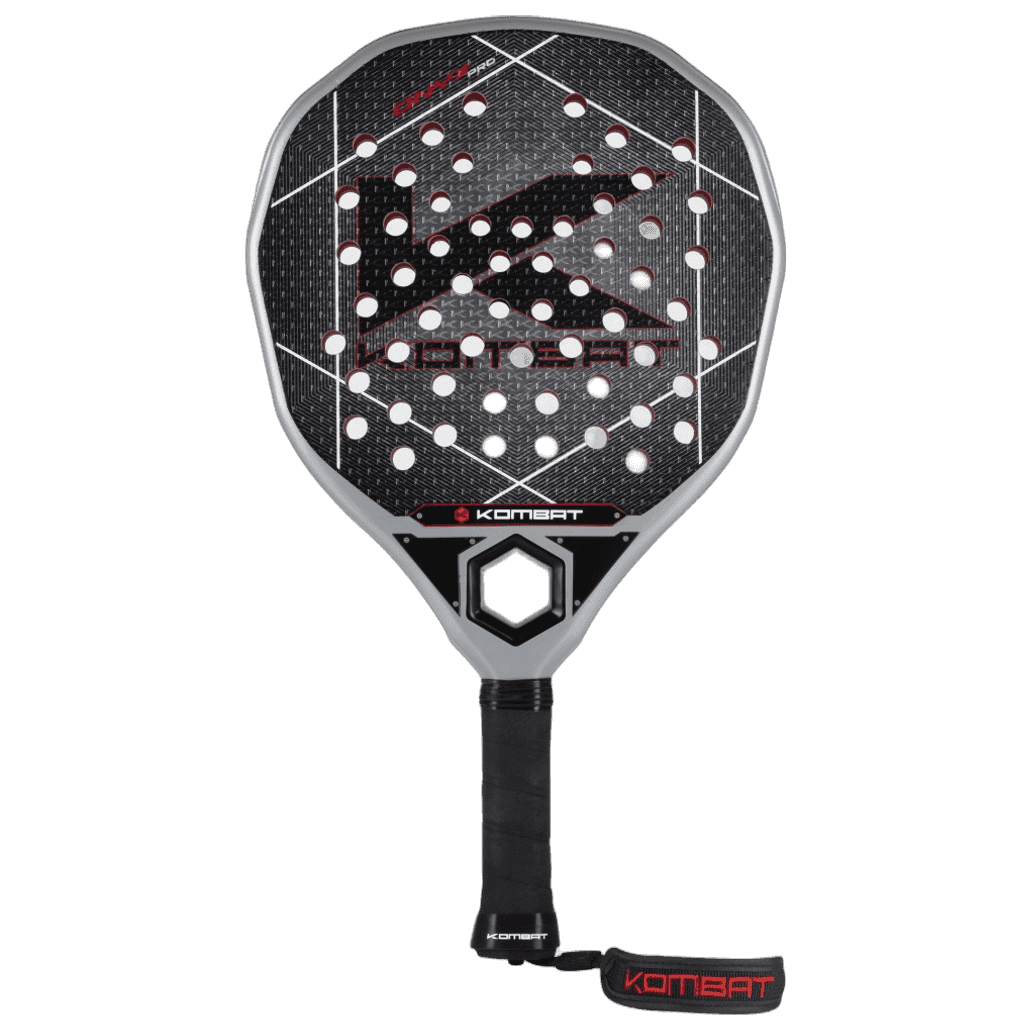
Kombat Onyx Pro 2026 is a versatile racket with real punch that doesn’t demand a head-heavy setup to hit hard. Its teardrop shape and low-to-medium balance give it a quicker, more manageable character than its punch suggests.
I see it fitting an intermediate-to-advanced player who likes to press at the net, attack short balls, and put real speed through overheads. It is not a soft, easy-exit racket for passive defense.
The feel sits in the medium-firm range: more forgiving than the Kombat Mirage Pro according to player reports, but still denser and firmer than softer options such as a Head Extreme Motion.
Technical analysis
Shape & balance
The teardrop profile puts the sweet spot above center without pushing it too far toward the tip. That matters here because the Onyx Pro has plenty of punch, yet it does not feel cumbersome during quick exchanges.
Its low-to-medium balance is one of the more convincing parts of the setup. Player and reviewer reports put the balance at around 25.5 to 26.5 cm, and that matches the racket’s reputation for maneuverability. I would expect it to come through quickly on volleys, blocks, and rushed reactions at the net.
That said, the sweet spot is not enormous. It is reportedly more generous than you might expect from an offensive teardrop racket, but off-center contact will still feel less stable than on a round control model.
Materials & construction
The faces use 18K Rough Carbon, paired with a Red EVA core. This combination explains the Onyx Pro’s direct response: the carbon face gives the ball a crisp release when I accelerate through the shot, while the core keeps enough compression to avoid feeling completely board-like.
The rough 3D texture has received consistent praise for grip on the ball. I would use it for loaded víbora shots, cut volleys, and aggressive lobs that need to drop sharply. It adds bite, although texture cannot replace clean technique or a properly timed contact point.
Ball exit is moderate rather than springy. The racket gives more help than the firmer Mirage Pro, but I would not call it soft or particularly bouncy. Players who rely on the racket to launch defensive balls with a compact swing may find it demanding.
On-court feel
Baseline play
From the baseline, the Onyx Pro rewards an active swing. Defensive lobs can be placed with good depth when I open the face and commit through contact, and the manageable balance helps when the ball arrives late after the wall.
Still, this is not the most relaxed racket for absorbing pace. The firmer, denser response means blocks need a stable hand; simply putting the racket behind the ball will not always produce easy length. On slow balls, that directness is useful. Against heavy hitters, it can feel less forgiving.
At the net
At the net, it makes more sense. The head moves quickly enough for fast volley exchanges, while the carbon face gives a solid, penetrating response on punch volleys. I would be comfortable using it to squeeze opponents with low volleys rather than only trying to finish points.
The texture also helps on short angled balls and a controlled chiquita. Its maneuverability should suit players who like to keep the racket active in front of the body rather than waiting for a big swing.
Bandeja and víbora
This is a strong area for the Onyx Pro. The lower balance makes it easier to repeat overhead preparation, and the face gives enough firmness to drive a bandeja deep without the racket twisting excessively.
A víbora can carry real speed and spin, particularly when I strike through the ball rather than trying to brush it too lightly. The trade-off is comfort: mishits high on the face will feel firmer than they do with a softer EVA racket.
Conclusion
I would choose the Onyx Pro for a versatile player who wants spin, quick handling, and enough punch to attack without committing to a demanding head-heavy diamond shape. It should suit players who build points at the net and use overheads to control territory.
The trade-off is clear. It does not provide the soft touch or automatic defensive ball exit that some players want from the back of the court. If your game depends on effortless blocks and gentle off-the-wall play, this may feel too firm.
What other reviewers say
- r/Padelracket (Reddit)en
A player who handled two units calls the Onyx Pro medium-firm rather than genuinely soft, with more ball output and less stiffness than the Mirage. They also praise its sweet spot, maneuverability, roughly 25.5 balance, and highly effective 3D texture.
Switch Intelligence
Be the first to share where you switched from.
Community reviews
Real feedback from players who used this racket.
Add your review
To submit your review, log in first. You can still read all approved community reviews below.
Add review


