

Royal Padel EFE Xtreme 2026
A soft, composed teardrop that makes defense and volleys feel simple, rewarding patient construction over all-out finishing force.
Our Take
Shape
Tear
Weight
365 - 380 gr
Touch
Medium-Soft
Core
Soft EVA
Faces
12K Carbon
What we like
- Forgiving on off-center contact
- Deep defensive lobs with ease
- Quick, controlled net blocks
What we don't
- Flat smashes need acceleration
- Limited punch on attacking volleys
- Muted response lacks crispness
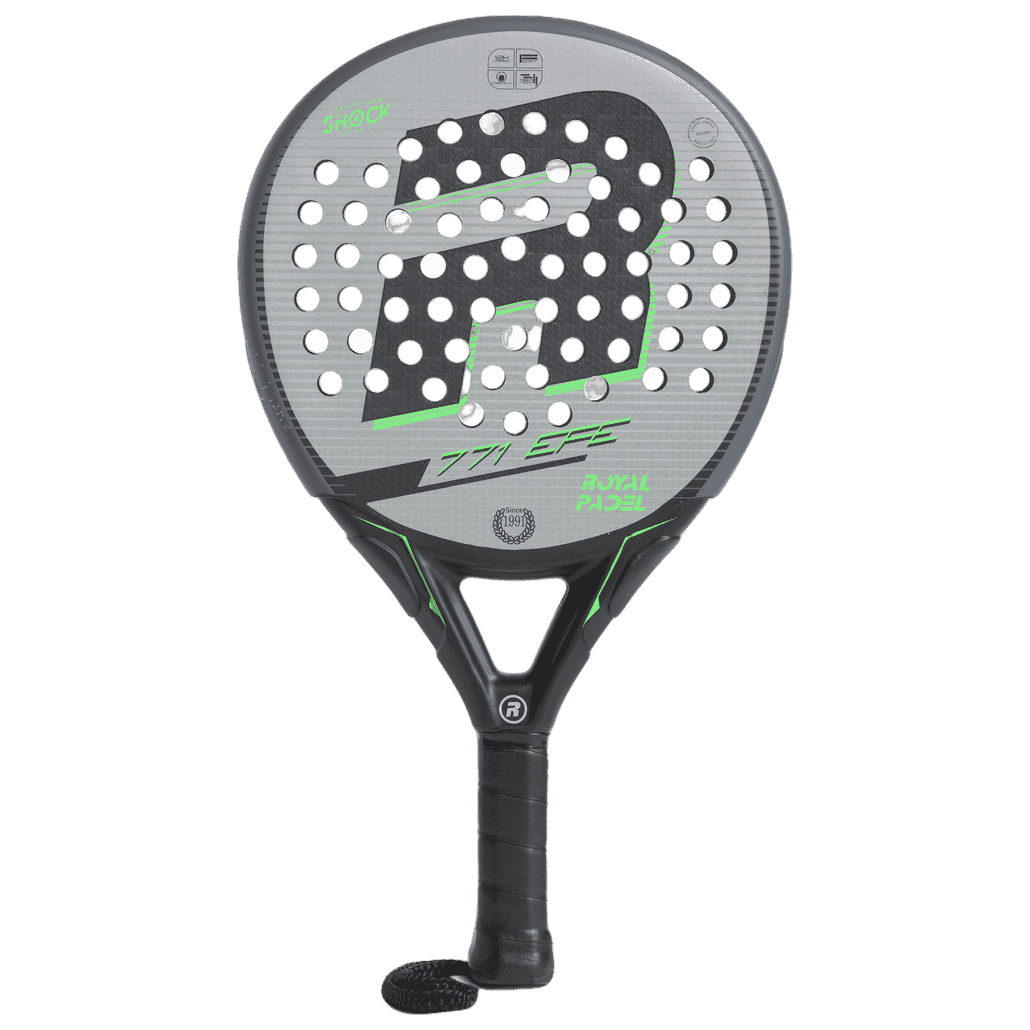
Royal Padel EFE Xtreme 2026 is a comfortable, control-led racket that keeps the game simple from the baseline through to the net. It has an easy response rather than a hard, explosive one, and that defines nearly every shot.
I see it suiting regular intermediate players who build points with placement, lobs, and measured pressure rather than trying to finish every short ball. It is forgiving without feeling disconnected.
Technical analysis
Shape & balance
The teardrop shape and medium balance give this racket its sensible all-court behavior. It moves quickly through compact volleys and lets me make late wrist corrections when the ball arrives awkwardly. That agility matters in fast exchanges at the net, but also when I am scrambling to recover a ball after the glass.
The sweet spot feels stable and reasonably broad for this shape. Miss the center slightly and the racket does not punish the contact with a harsh vibration or a wild launch. Still, this is not a head-heavy weapon that adds free pace overhead. Players who depend on the racket to drive the ball through the court will find it restrained.
Materials & construction
The 12K carbon faces add enough structure to keep the response controlled, while the EVA Soft core gives the racket its dampened, accessible output. The overall medium-soft feel is noticeable immediately: contact is muted, comfortable, and less abrupt than with a hard-carbon setup.
That softer construction helps on defensive blocks and off-the-wall recoveries, where I can guide the ball deep without needing a huge swing. The trade-off is a less crisp release when I want to attack. It does not give the sharp, hard feedback that some players want for aggressive volleying or finishing overheads.
On-court feel
Baseline play
From the baseline, the EFE Xtreme is easy to trust. The ball comes off the face without demanding perfect timing, which is useful when I am defending under pressure or arriving late to a wall ball. Blocks stay controlled, and defensive lobs are easier to lift with enough height and depth.
I particularly like the way it handles low-driven lobs and neutral balls through the middle. There is enough ball exit to get out of trouble, but not so much that touch shots become unpredictable. What it will not do is turn a lazy swing into a penetrating counterattack; I still need to accelerate through the ball to create real depth.
At the net
Quick volley exchanges are one of its stronger areas. The manageable balance keeps the racket mobile, while the soft core absorbs pace well on blocks. I can take speed off the ball or redirect it without feeling that the face is fighting me.
For attacking volleys, placement comes more naturally than brute force. I can work angles, play into the feet, or use a short drop shot with good confidence. A harder racket would give more bite and a cleaner punch when ending the point, though.
Bandeja and víbora
The racket works well for controlled overheads. A bandeja is easy to place deep, and the muted response helps me keep the ball low rather than overhitting. With the víbora, I need to provide the acceleration myself; it responds accurately, but it does not create much extra violence through the ball.
Smashes are the clear limitation. A well-prepared smash has enough output, but flatter hits and x3 attempts demand clean technique, timing, and real racket-head speed. This is not the choice for players who prioritize effortless winners overhead.
Conclusion
I would pick this racket for a controlled, comfortable game built around consistency, defense, and smart net positioning. It is especially convincing for players who value forgiveness on imperfect contact and want help getting the ball back deep from difficult positions.
The trade-off is obvious: comfort and control come ahead of explosive power. If my game relies on hard smashes, aggressive víboras, and a crisp attacking response, I would look toward a firmer, more head-heavy racket.
What other reviewers say
- PadelTestLabfr
This review characterizes it as a soft-feeling all-rounder with easy ball output, dependable blocking volleys, and useful assistance on late wall-ball recoveries. Its medium balance and Soft EVA favor maneuverability and comfort, but flatter smashes and x3 winners require more player-generated pace.
- PadelScouthr
The review highlights a controlled, slightly muted response, a stable sweet spot, and enough agility for volleys, transitions, and quick wrist adjustments. It has adequate finishing power when well prepared, but is geared more toward constructing points and placement than explosive output.
Switch Intelligence
Be the first to share where you switched from.
Community reviews
Real feedback from players who used this racket.
Add your review
To submit your review, log in first. You can still read all approved community reviews below.
Add review


