

Royal Padel Torino Bronze 2026
A soft-touch diamond built to finish points with authority, yet forgiving enough to keep its head when defense gets hurried.
Our Take
Shape
Diamond
Weight
365 - 375 gr
Touch
Soft
Core
Medium-density polyethylene
Faces
Carbon and fiberglass
What we like
- Heavy smash without full swing
- Lively depth on defensive blocks
- Generous diamond sweet spot
What we don't
- Slower in quick hand exchanges
- Touch shots can spring long
- Less precise low-pace lobs
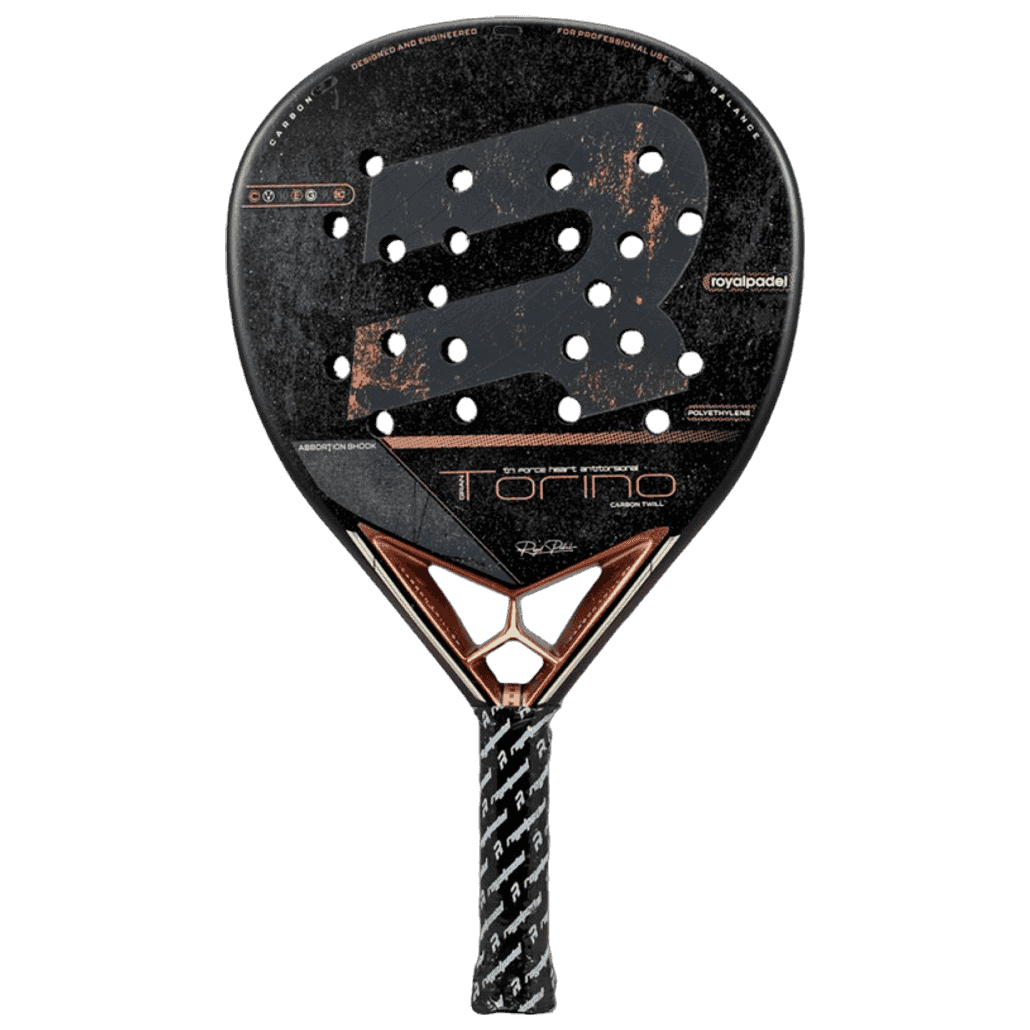
Royal Padel Torino Bronze 2026 is a power-first racket with a surprisingly elastic response. Its diamond shape puts the attacking intent up front, while the soft feel and very high ball exit keep it from playing like a dry, punishing hitter’s racket.
I see it fitting an experienced player who wants help finishing points, especially from the net and on overheads, but does not want every defensive ball to demand a full swing.
There is a trade-off, though. This is not a quick, surgical racket for players who build their game around effortless hand speed and pinpoint placement.
Technical analysis
Shape & balance
The diamond mold naturally shifts the working area higher in the racket, and the Torino Bronze feels built to reward an aggressive contact point. The sweet spot is relatively generous for this shape, which matters on rushed volleys and overheads where contact is not always clean.
That higher, attack-oriented balance also makes the racket less nimble in fast exchanges. I would not choose it for a player who likes a notably head-light setup or who frequently defends late with compact wrist movements. It wants preparation.
Materials & construction
The faces combine carbon and fiberglass, a pairing that explains much of this racket’s character. Carbon gives the face enough firmness to drive the ball through the court, while fiberglass softens the impact and adds a more springy release than a full-carbon attacking racket.
Inside, the medium-density polyethylene core should appeal to players who prefer a cushioned contact over a hard EVA-style response. The ball does not feel trapped on the face for long; it comes off quickly. That lively rebound is useful for depth from defensive positions, but it can make touch shots harder to regulate when the pace is already high.
On-court feel
Baseline play
From the baseline, I found the easy ball exit to be the main story. A compact block or a controlled off-the-wall return can still carry good depth, which takes some pressure off when defending a strong pair at the net.
The limitation is precision under low pace. On a soft defensive lob or a chiquita, the face can give more than expected unless I stay relaxed and use a short, deliberate stroke. Players who rely on a deadened response to take speed off the ball may find it too lively.
At the net
Volleys come through with authority. The racket has enough stability and face response to make a simple punch volley travel deep, and it is particularly effective when I want to accelerate through the middle rather than overwork the ball.
Quick hand battles are less comfortable. The diamond balance is noticeable when changing direction repeatedly, so I would not call it a natural choice for a player whose net game depends on flicks, late blocks, and constant racket-head adjustments.
Smash
This is where the Torino Bronze makes the most sense. The higher contact area, strong rebound, and power-oriented construction help turn a clean smash into a genuinely heavy ball without needing an exaggerated swing.
It also works well for an attacking bandeja or víbora when I drive through the shot. Fine spin placement is not its strongest point; it favors penetration and pace more than delicate carving.
Conclusion
I would put the Torino Bronze in the hands of an intermediate-to-advanced attacking player who wants lively power and a softer impact than many diamond rackets provide. It rewards proactive net play, overhead pressure, and firm volleys.
The trade-off is maneuverability and touch control. Players who prioritize a head-light feel, subtle drop shots, or calm handling in frantic defensive exchanges will likely want something more restrained.
Switch Intelligence
Be the first to share where you switched from.
Community reviews
Real feedback from players who used this racket.
Add your review
To submit your review, log in first. You can still read all approved community reviews below.
Add review


