

Royal Padel Japan R Carbon 2025
A soft-feeling diamond built to finish points with authority, yet forgiving enough to keep defensive blocks and lobs from feeling punishing.
Shape
Diamond
Weight
360 - 380 gr
Touch
Soft
Core
Polyethylene foam
Faces
Fiberglass
Frame
Carbon reinforcements
What we like
- Easy depth from baseline
- Heavy smash with little effort
- Forgiving sweet spot on blocks
What we don't
- Head-heavy through quick exchanges
- Lively rebound hurts touch control
- Less precise low-driven lobs
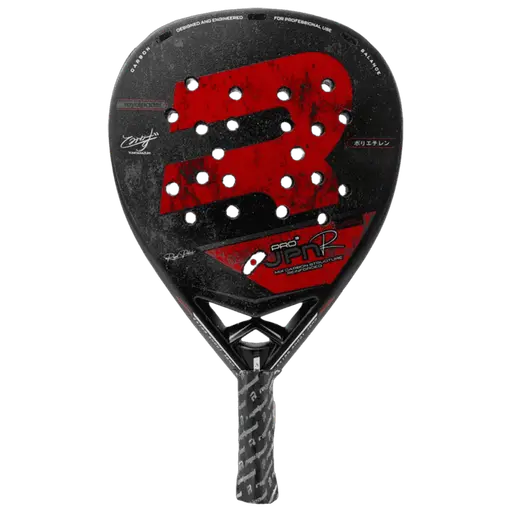
The Royal Padel Japan R Carbon 2025 is a power racket with a surprisingly forgiving contact. Its diamond shape points it toward aggressive play, but the soft feel and very lively rebound keep it from feeling like a demanding, hard-faced hammer.
I see it fitting an attacking intermediate-to-advanced player who wants easy depth and help finishing overheads. It is not a precision instrument for slow, surgical padel.
Technical analysis
Shape & balance
The diamond format gives this racket a clear attacking bias. There is enough mass toward the upper part of the frame to make volleys and overheads land with authority, but it does ask more of my wrist and shoulder during fast exchanges. Maneuverability is not its strong suit; late defensive reactions and rapid hand battles can feel a fraction behind lighter, lower-balanced rackets.
The sweet spot is generous for this shape, though. I do not need to strike the exact center every time to get a useful ball. That matters on rushed blocks and off-the-wall balls, where the racket still returns more depth than I expect from an attack-oriented profile.
Materials & construction
Royal Padel uses carbon reinforcements in the frame, fiberglass faces, and a polyethylene FOAM core. That combination explains much of the racket’s character: the frame keeps the response stable enough under impact, while the fiberglass and soft foam create a noticeably elastic ball exit.
The contact is not crisp or dry. The ball stays on the face briefly, then leaves with plenty of assistance. Players who generate their own pace may find that rebound excessive on touch shots, especially when trying to play a short chiquita or absorb a hard volley. I had to soften my hands rather than simply present the racket.
On-court feel
Baseline play
From the baseline, this is a comfortable racket for finding length. Defensive lobs come off easily, and even compact swings can send the ball deep. The soft response is particularly useful when I am under pressure and cannot fully load the shot.
Control is more relative than absolute, though. On low-driven lobs or flatter returns, the ball can jump off the face if my contact is too open. I would not choose it for a player whose game depends on constant placement variation and very measured tempo.
At the net
At the net, the Japan R Carbon feels stable and forceful. Firm volleys travel through the court well without needing a huge swing, and the larger effective hitting area gives some margin on blocked reaction volleys.
Its limitation shows up in quick exchanges. The head-biased diamond profile is less nimble for repeated backhand volleys or sudden body shots. It rewards early preparation; it does not rescue lazy hands.
Smash
This is where the racket makes the most sense. The high ball exit and diamond profile help produce a heavy smash, even when I am not striking at full pace. It also gives a useful boost on aggressive bandeja and víbora shots, where the ball carries deep with relatively little effort.
That same liveliness means finesse overheads need restraint. A soft wrist and a relaxed swing work better than trying to guide the ball delicately with the face.
Conclusion
I would pick the Japan R Carbon 2025 for an attacking player who wants easy power, a soft impact, and a forgiving sweet spot in a diamond racket. It suits players who like to press at the net and finish points with overhead pace rather than win through ultra-fine placement.
The trade-off is clear: it is not especially quick through the air, and its rebound can be too eager for players who prefer a firmer, more controlled response. If your game relies on touch and rapid hand speed, there are cleaner options.
Switch Intelligence
Be the first to share where you switched from.
Community reviews
Real feedback from players who used this racket.
Add your review
To submit your review, log in first. You can still read all approved community reviews below.
Add review


