

Royal Padel Whip Hybrid 2025
A cushioned round racket that makes late defensive balls easier, then rewards patient hands with spin, touch, and calm volleys.
Shape
Round
Weight
360 - 380 gr
Touch
Medium
Core
High-density EVA foam and polyethylene blend
Faces
Fiber Tech (two layers of aluminized fiberglass)
Frame
Bidirectional fiberglass tubular frame with carbon reinforcements
What we like
- Easy depth on defensive blocks
- Broad sweet spot on pickups
- Spin-friendly bandeja and víbora bite
What we don't
- Limited punch on flat smashes
- Slower reactions in fast volleys
- Springy response lacks crispness
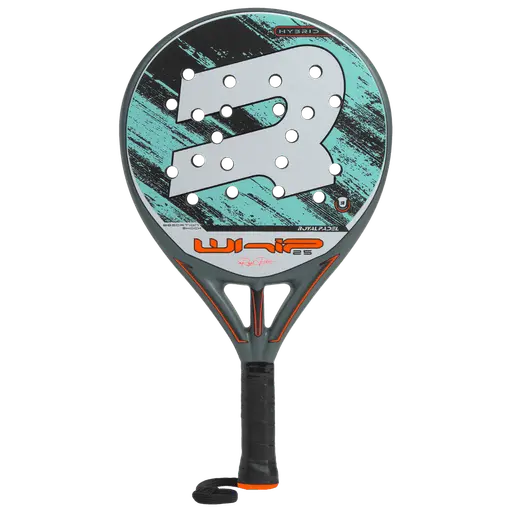
The Royal Padel Whip Hybrid 2025 is a comfort-first control racket with unusually easy ball exit. It is built for players who defend under pressure, value a forgiving response, and prefer placement over brute-force finishing.
Its character is calm rather than explosive. I felt it helps keep the ball deep from awkward contact points, but it will not turn a compact flat swing into a devastating smash.
The round shape and medium feel make sense for an intermediate to advanced player who spends plenty of time constructing points rather than forcing them.
Technical analysis
Shape & balance
The round mold gives the Whip Hybrid a broad, usable sweet spot. Off-center contact is notably less punishing than with a more attack-focused racket, and that matters on late blocks, low pickups, and defensive lobs struck after the ball has already dropped.
Royal Padel does not present this as a head-heavy weapon, and it does not behave like one. The racket stays stable through the ball, though it is not especially quick in frantic hand battles at the net. In very fast volley exchanges, I would rather have something more head-light and sharper through the air.
Materials & construction
The bidirectional fiberglass tubular frame with carbon reinforcements is paired with Fiber Tech faces: two layers of aluminized fiberglass. That construction explains much of the damped, cushioned impact. The racket absorbs vibration well, particularly on defensive contacts outside the center.
Inside, the high-density EVA–polyethylene core gives the response its elastic, forgiving character. Ball exit arrives with little effort, which is useful when defending from the baseline, but the trade-off is a less direct hit than I get from a hard EVA and carbon-faced racket. Players who want a crisp, immediate response may find it slightly too springy.
On-court feel
Baseline play
This is where the Whip Hybrid earns its place. From the baseline, it makes depth accessible without asking me to overhit. Late blocks and off-the-wall play come off the face with enough lift and length to reset the point, while the broad sweet spot gives me more margin on defensive balls struck low or slightly behind my body.
That forgiving response does not mean it is vague. I can still guide a low-driven lob or play a measured chiquita, but the racket favors smooth acceleration and placement rather than forcing a hard, flat ball.
At the net
Volleys feel stable and comfortable, especially when I am absorbing pace. The racket is good for directing placement volleys into space rather than trying to punch every ball through the opponent.
Its limitation shows up when the exchange becomes frantic. It is not sluggish, but it does not have the instant, knife-like handling of a lighter-feeling net racket. Quick reaction volleys need earlier preparation.
Bandeja and víbora
The rough face finish gives the racket useful bite. I found it easy to work spin into a controlled bandeja and a shaped víbora, with enough comfort to keep those shots deep without overloading the arm.
Smash
A flat smash is not its headline shot. It will finish when technique and timing are there, but it lacks the explosive, direct punch of a power-oriented diamond racket. I would use it to place and build pressure overhead rather than chase outright winners.
Conclusion
I would choose the Whip Hybrid for a control-minded player who wants comfort, easy depth, and a generous response in defense. It suits players who use placement, spin, and consistency to earn the net rather than relying on raw acceleration.
The trade-off is clear: less flat-smash authority and slightly slower reactions in the quickest volley exchanges. If your game depends on explosive overheads, look elsewhere. If you want a racket that makes difficult defensive contacts feel less dramatic, this one has a very convincing case.
What other reviewers say
- PadelCriticen
This review finds it exceptionally cushioned, stable and forgiving, helping players retrieve low balls and defend late contacts with easy depth. It performs best on placement volleys and controlled bandejas or víboras, but lacks the explosive finish of a direct flat smash.
- PadelTestLabde
The test praises its generous ball output, broad sweet spot and noticeable damping on off-centre impacts; the rough finish is particularly effective for spin on bandejas and víboras. In return, the more elastic response gives up some flat-smash punch, while its weight slows reactions in very fast volley exchanges.
Switch Intelligence
Be the first to share where you switched from.
Community reviews
Real feedback from players who used this racket.
Add your review
To submit your review, log in first. You can still read all approved community reviews below.
Add review


